PS; 30 years ago club gigs paid $50 a man... there were clubs everywhere and they all had live music. Everyone went out to see live music and unless you were falling down drunk you didn't get a DUI.

Enjoy the benefits of a premium membership!
Upgrade Account
-
TalkBass has been independent since 1998. Add your voice.
Create a free account to reply to discussions, view embedded media, and browse with fewer display ads.
Join free Log in
Want zero display ads or expanded classifieds tools? Compare plans.
You are using an out of date browser. It may not display this or other websites correctly.
You should upgrade or use an alternative browser.
You should upgrade or use an alternative browser.
What basses will be worh $$$$ 30+ years from now?
- Thread starter seang15
- Start date
More options
Who Replied?
And remember what Stephen Spielberg thought 2015 was going to look like in Back To The Future? He was waaaay off. Things just don't advance as much as we think. Sure, computers got smaller and more powerful, but... that's about it. Everything else advances in pretty small increments. We still live in the same kind houses, we still drive the same kind of cars (wheels and crappy roads), etc, etc. Imo, 30 years won't be much different.
Not to derail the thread, but I think that our predictions of the future pretty consistently pick the wrong dimensions in which progress will arrive. If you go back to 30 years ago, you'd have a hard time imagining that in 2013 the average person walking around would have a small, battery powered device in their pockets capable of accessing 99.8% of the music, video, and general knowledge mankind had collected to date - in seconds.
I think cars have survived in their current form, in large part, because we like cars. We like driving them. If it was just about getting from point A to point B we would have made the move to total urban public transportation decades ago.
For the same reasons, I think we will continue to like bass guitars - strings, pickups, wood, etc. Is this the simplest, most efficient way to insert bass notes into popular music? Heck no, but they're as much a part of the music to us (and listeners) as the notes themselves. They aren't going anywhere.
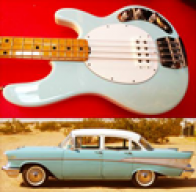
Not to derail the thread, but I think that our predictions of the future pretty consistently pick the wrong dimensions in which progress will arrive. If you go back to 30 years ago, you'd have a hard time imagining that in 2013 the average person walking around would have a small, battery powered device in their pockets capable of accessing 99.8% of the music, video, and general knowledge mankind had collected to date - in seconds.
I think cars have survived in their current form, in large part, because we like cars. We like driving them. If it was just about getting from point A to point B we would have made the move to total urban public transportation decades ago.
For the same reasons, I think we will continue to like bass guitars - strings, pickups, wood, etc. Is this the simplest, most efficient way to insert bass notes into popular music? Heck no, but they're as much a part of the music to us (and listeners) as the notes themselves. They aren't going anywhere.
Sorry man, but I don't like driving. I don't know where you live, but I live where there's too much traffic, crappy roads, and a road structure that encourages road rage. Not a great experience. A better invention is way over due.
I do agree with you about continuing to like analog instruments. Here's the thing, a lot of music is timeless. Given that, kids today do listen to very old music and a lot of them think it's their favorite. Sure, there are many more genres today, but young people are still identifying old music and getting inspired by it. You've got people like Jake Bugg creating big hits like "Lightening Bolt" using all old classic sounding instruments 40s 50s style. And where there's timeless music, there's timeless instruments that will always be in demand. And the more scarce they get, the more valuable they will become.
As for cars, sure you have collectors out there, but driving isn't timeless like music. In fact, it's getting way too old and frustrating as more people are on the road.

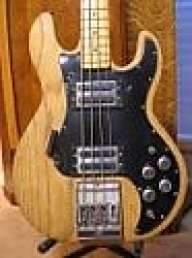
Moving a little back on track (and I haven't read the whole thread to see if anyone else has suggested it), may I propose an early, first-year production, first-ever bass for Peavey: 1978 T-40!:
[Invalid or Expired Link Removed]
Made of dense Ash, Heavy as a boat anchor, virtually indestructible...THESE will still be around, still be playable, and I may be biased, but I truly believe they will be "collectible" 30 years from now.
[Invalid or Expired Link Removed]
Made of dense Ash, Heavy as a boat anchor, virtually indestructible...THESE will still be around, still be playable, and I may be biased, but I truly believe they will be "collectible" 30 years from now.
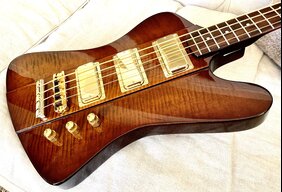
If you want my guess on what is relatively current in production and might be worth more 30 years from now I'd suggest the following:
Under $1000 - Musicman SUB 5 string active bass (not the new one) used in mint condition. You can still pick one up for around $600 but its getting harder to find them.
Around $1000 - an early run low production number Reverend Rumblefish. You can fid them used in mint condition for around $1000 and they are unique with a strong following. Same goes for a 1990's Warwick thumb BO. Both have been holding their value well for the last few years and might start to climb a little in value as fewer become available.
Between $1500 and $2500 - a mint used Sadowsky, Alembic Essence, Pedulla Buzz bass or Lull Thunderbird. Obviously the closer you can get to finding one of these around the $1500 mark the better.
Over $2500 - a mint used Alleva Coppela, a limited run top end Alembic, a limited run top end Warwick and maybe some of the Ritter models as will.
Note that everything I've mentioned is used. The only way you're going to see your investment grow on most new basses is to let someone else pick up the cost of the initial depreciation which in many cases is as much as 50%. Also there are a lot of other potential good buys out there like Ric and Spector etc that I didn't mention but the ones above look really good to me right now.
Under $1000 - Musicman SUB 5 string active bass (not the new one) used in mint condition. You can still pick one up for around $600 but its getting harder to find them.
Around $1000 - an early run low production number Reverend Rumblefish. You can fid them used in mint condition for around $1000 and they are unique with a strong following. Same goes for a 1990's Warwick thumb BO. Both have been holding their value well for the last few years and might start to climb a little in value as fewer become available.
Between $1500 and $2500 - a mint used Sadowsky, Alembic Essence, Pedulla Buzz bass or Lull Thunderbird. Obviously the closer you can get to finding one of these around the $1500 mark the better.
Over $2500 - a mint used Alleva Coppela, a limited run top end Alembic, a limited run top end Warwick and maybe some of the Ritter models as will.
Note that everything I've mentioned is used. The only way you're going to see your investment grow on most new basses is to let someone else pick up the cost of the initial depreciation which in many cases is as much as 50%. Also there are a lot of other potential good buys out there like Ric and Spector etc that I didn't mention but the ones above look really good to me right now.
I think quality is less relevant than nostalgia when it comes to what will be collectible. I agree with the early post that said 80's pointy guitars will be worth more. The functionality is not a major factor in what will appreciate. Nostalgia and scarcity matter.
Ex: I recently sold my 2001 Triumph Bonneville. It was demonstrably better than a classic Bonnie. I could ride it for a thousand miles over a weekend and not worry. I customized it to look like a 1970. Bottom line - 9K invested, sold for 3k. A 1970 in excellent condition likely would have cost about 2k and is worth over 7k. 1970 was over a decade after the model was introduced but it was the bikes of the 60's that the old timers rode in the day and the old timers have money.
My recommendation is to buy up US BC Rich, Gibson Explorers, Us Kramers with aluminum necks and anything that is clearly something an 80's hair band used. Look for big fads in music that appealed to male teens and that is where the money will be in another 10 to 20 years. In 30 years it will be the 90's turn which will have some metal type axes and then 70's style bases (the axe of choice for "alternative types". 50 years on may bring the dire predictions of no bass market but then again maybe the next big thing that appeals to young males may come around and everyone will buy that new Danelectro Wild thing that Mr. Rock-n-roll plays and then thirty years later those will be the boobies.
Ex: I recently sold my 2001 Triumph Bonneville. It was demonstrably better than a classic Bonnie. I could ride it for a thousand miles over a weekend and not worry. I customized it to look like a 1970. Bottom line - 9K invested, sold for 3k. A 1970 in excellent condition likely would have cost about 2k and is worth over 7k. 1970 was over a decade after the model was introduced but it was the bikes of the 60's that the old timers rode in the day and the old timers have money.
My recommendation is to buy up US BC Rich, Gibson Explorers, Us Kramers with aluminum necks and anything that is clearly something an 80's hair band used. Look for big fads in music that appealed to male teens and that is where the money will be in another 10 to 20 years. In 30 years it will be the 90's turn which will have some metal type axes and then 70's style bases (the axe of choice for "alternative types". 50 years on may bring the dire predictions of no bass market but then again maybe the next big thing that appeals to young males may come around and everyone will buy that new Danelectro Wild thing that Mr. Rock-n-roll plays and then thirty years later those will be the boobies.


I think quality is less relevant than nostalgia when it comes to what will be collectible. I agree with the early post that said 80's pointy guitars will be worth more. The functionality is not a major factor in what will appreciate. Nostalgia and scarcity matter.
Ex: I recently sold my 2001 Triumph Bonneville. It was demonstrably better than a classic Bonnie. I could ride it for a thousand miles over a weekend and not worry. I customized it to look like a 1970. Bottom line - 9K invested, sold for 3k. A 1970 in excellent condition likely would have cost about 2k and is worth over 7k. 1970 was over a decade after the model was introduced but it was the bikes of the 60's that the old timers rode in the day and the old timers have money.
Ok, I couldn't let this one go... I have a pretty nice 1970 Triumph Bonneville. I have a lot of respect for the new ones, but they aren't the classic Triumphs, no matter how much they try to mimic them. Yes, from any objective perspective, they are TONS better, but they're not the same.
So... back to the topic at hand, I think anything that is original, made at an acknowledged, storied company on US soil will eventually hold up. Not so sure about boutique basses that aren't original and just mimic other designs.
My last purchase was a Gibson EB. An original design, well known historic company/manufacturer. Not sure how well these are doing in the market and how long it'll be available - but it's an excellent instrument and I think down the road it'll hold up for value.
Of course, I could be completely full of crap.
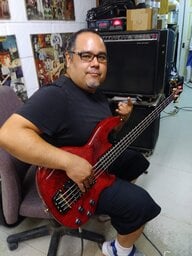
Psychbunny said:I think quality is less relevant than nostalgia when it comes to what will be collectible.
Yes, in complete agreement here too!
While there are/were some fantastic boutique basses made, most still won't be a blip on the screen unless some big name laid out a killer commercial (or at least major underground) album using "X" bass. And by that...that would be an album making non-musicians turn into musicians, or the already musicians searching for 'more'.
We've seen all the old threads; What did Geddy use, What did John Taylor use, what did Sting use, etc.
The only time I ever saw an original era Tobias on an arena stage, was Robert Trujillo in 1994 in Suicial Tendencies opening for Metallica. But I feel a Kubicki or even a Steinberger will be the nostalgic mover to bring a very strong dollar.

"Ok, I couldn't let this one go... I have a pretty nice 1970 Triumph Bonneville. I have a lot of respect for the new ones, but they aren't the classic Triumphs, no matter how much they try to mimic them. Yes, from any objective perspective, they are TONS better, but they're not the same".
This is my point exactly. There are basses that objectively are better but what makes something collectible is subjective. I have a late model Mustang but I would love a 68 fastback the difference is I cant afford a 68 and need a daily driver. A late model muscle car is unlikely to appreciate like a period correct muscle car. A Fender Am Sp will not appreciate the way a 1961 Fender P has even though it is objectively better. If the EB ends up a big seller the 2012 will likely appreciate over thirty years. It is scarce and IMHO a hell of a good instrument. If it does not take off it could still become a collectors dream if some cool bass player uses one or could be a collectible if it develops a cult following from Gibson bass lovers. I think the EB is a pretty modern bass and like the coil splitting but it is likely to be as technologically primitive as a 60's EBO is today. Today if some one offered me a 1965 EB in mint condition OR a 2013 EB fiver I would pick the 65 even though it objectively is nowhere the instrument that the 2013 is. When you talk about an epiphone copy of an SG Then it will never be worth much, same goes for MIM Fenders, or even Lakland Skylines. Objectivity doesn't mean crap when it comes to what brings the big bucks thirty years from now.
Swamp - Are you a fat middle aged bald guy? If so you could be my long lost twin I am and am a classic brit bike fan as well as a Gibson bass owner.
This is my point exactly. There are basses that objectively are better but what makes something collectible is subjective. I have a late model Mustang but I would love a 68 fastback the difference is I cant afford a 68 and need a daily driver. A late model muscle car is unlikely to appreciate like a period correct muscle car. A Fender Am Sp will not appreciate the way a 1961 Fender P has even though it is objectively better. If the EB ends up a big seller the 2012 will likely appreciate over thirty years. It is scarce and IMHO a hell of a good instrument. If it does not take off it could still become a collectors dream if some cool bass player uses one or could be a collectible if it develops a cult following from Gibson bass lovers. I think the EB is a pretty modern bass and like the coil splitting but it is likely to be as technologically primitive as a 60's EBO is today. Today if some one offered me a 1965 EB in mint condition OR a 2013 EB fiver I would pick the 65 even though it objectively is nowhere the instrument that the 2013 is. When you talk about an epiphone copy of an SG Then it will never be worth much, same goes for MIM Fenders, or even Lakland Skylines. Objectivity doesn't mean crap when it comes to what brings the big bucks thirty years from now.
Swamp - Are you a fat middle aged bald guy? If so you could be my long lost twin I am and am a classic brit bike fan as well as a Gibson bass owner.
Psychbunny said:This is my point exactly. There are basses that objectively are better but what makes something collectible is subjective. I have a late model Mustang but I would love a 68 fastback the difference is I cant afford a 68 and need a daily driver. A late model muscle car is unlikely to appreciate like a period correct muscle car.
Mustang lover here too.!!!
On topic....two years ago I sold my basket case '67 Fastback 390 4spd car to buy a Wal bass. I didn't loose out on the car "investment", nor the Wal "investment". Made a profit on both. Today I have an '07 convertible GT. Yup had the choice in a '68 convertible, but needed one that could be a daily driver.
Swamp - Are you a fat middle aged bald guy? If so you could be my long lost twin I am and am a classic brit bike fan as well as a Gibson bass owner.
Hahaha. No, I'm actually a skinny middle aged white haired guy, but sounds like we're kindred spirits anyway! Still have 3 old Triumphs - the bonnie, a neat 61 bitsa T110 and 75 Trident (as well as some newer stuff)... And 2 Gibson basses (SG Supreme and the EB).
Anyway... Personally i think there's sort of an inverse relationship between technology and long term collectability. Generally, the more technologically advanced something is, the shorter it's useful life and relevance and consequently it's opportunity to make a significant impact. Exceptions exist of course. But in general? I don't know, will a first generation iPhone ever be collectible? As relates to basses and guitars - I'm not sure technical "advancements" (e.g. Gibson's Robot tuners, Firebird X, etc) are likely to make them long term collectible - adhering to the basics seems to be the best bet. I guess my point is the lack of any real technology in the EB doesn't seem like a detriment to me so far as potential collectibility.
As noted before, I could be completely full of crap...
Britbike lover here, as well. I rode Nortons, Triumphs & BSAs for 25 years, until multiple back surgeries made me give up riding altogether. Which is actually one of the reasons I picked up bass guitar! It's something I can do in a chair at home.
There are similarities between classic Britbikes and bass guitars. They come in all sorts of shapes, sizes and colors. And they're fun to use. And there's a big aftermarket supplying parts for them. And they're fun to restore. And they're fun to use in "relic'd" condition. And older ones are definitely worth some money today. And there's always someone telling you "I used to have one of those!". I'm sure there are many others.
I'm just glad to have found something to fill up the hole in my soul that accompanied my having to give up riding.
There are similarities between classic Britbikes and bass guitars. They come in all sorts of shapes, sizes and colors. And they're fun to use. And there's a big aftermarket supplying parts for them. And they're fun to restore. And they're fun to use in "relic'd" condition. And older ones are definitely worth some money today. And there's always someone telling you "I used to have one of those!". I'm sure there are many others.
I'm just glad to have found something to fill up the hole in my soul that accompanied my having to give up riding.

How about modulus? especially the 1997-2000 models, well they are rare to get nowdays imagine in the future? With an original lane poor alone would be worth quite a bit probably in the future also. Well with that said, that's if Modulus dont start up again as they were.


I suspect my 84 cherry JayDee may well pick up some value, Mark King association, and rare, mine is also a pre Mark King endorsement model. But it might not. I buy basses to play and never intend to sell that one. It might actually be a pain if it gets very valuable due to increased insurance premiums.
As former owner of Rick 4001 I sold for $200 because the truss rod nut was stripped, and a Tokai Talbo that I bought on clearance for $150 and dumped for not much more because I thought it was a one-trick pony with second-rate workmanship, I have to get my 2c worth in. (Here in Canada, the penny no longer exists, so 2c gets rounded down at retail to...nothing.)
I see two factors in picking lower-priced basses that could be worth mentioning; one is fairly obvious, the other sort of clubbed me over the head a couple of weeks ago.
The first: unusual designs. Weird-but-appealing shapes always seem to find a niche. Those cheapo battle-axe and machine-gun basses could be the Teisco's and National's of tomorrow in a world that doesn't glorify gore nearly as much as we do today...but it pays to remember that for every Teisco, there's an Eko, a Stewart, and a couple of Kent's that have all the shape appeal but fetch a fraction of the value. Truly one-of-a-kind designs, however, are a bit different. And one that comes to mind actually covers both trends: the Traveler TB4P. Not only is it a headless, it's also an ultra-short, and uses a body design that is, to the best of my knowledge, utterly unique in its price range and very limited in numbers. Its niche appeal insures that it'll always turn heads, and any instrument that players will buy you a beer just to try out or talk about is probably worth an extra hundred or two on the used market.
It's also got the added cachet of being an ultra-short, and this could be a major trend in basses at some point. I say this because the ultra-short-scale bass has the elements of past successes, and one in particular: the Les Paul. That was built as a reaction to the hollowbodies and Hawaiians of the day, and it stuck, I think, because it was a purer, simpler tone than the predominantly single-coil solidbodies of the day which had a distinct tonal personality of their own, and are still prized for that reason. When Les Paul went for the less-harmonically-cluttered tone, he struck gold. And that could be a big part of the future of bass tone.
A few weeks back, I finally built the ultra-short-scale bass I'd wanted for so long...it wasn't the "fretted Ashbory" that I THOUGHT it would be...it was a chance remark on another forum that led me to make it a steel-stringed magnetic-pickup bass, and I built it at 22-1/2" on a Squier MINI strat platform. And it worked brilliantly...in no small part thanks to a simple trick of stringing it as a normal 4-string using a thicker 5-string set. (A long-scale B string, capo'd at the fifth fret, is essentially an E string scaled very close to 24"...it's an insanely simple trick, and it really is the business...admit it, you've thought about converting that dust-magnet Squier of yours into an ultra-short-scale at some point, haven't you? Now you know how to string it to be truly giggable. Trust me...use finger bridges or a narrow-spread import bridge and a blade-pole or lipstick-tube pickup or two, and it *will* sound good with those thicker strings.)
I gigged this bass briefly just after Hallowe'en, and was shocked when my bandleader suggested at the next rehearsal that I park my Steinberger, Pre and Cirrus, and just use the ultra-short from now on. It wasn't just his preference, either...he was making this request on behalf of the 3/4 of the rest of the band that had an opinion on the matter. They ALL prefered it. And I think this had a lot to do with the simplicity of the tone, and the way that the stronger fundamental presented itself in the mix. Who was I to argue? Sure, I'd rather hear my Cirrus' VFL's, but all that lovely top end and upper mid ends up buried under crunch-guitar tone anyway. One thing I had to say about the ultra-short: every note was clear and audible around the pitch, not just a layer of bass noise under the guitar distortion. And I suspect that this return to simple tone could be particularly appealing with the current acoustic wave...aren't there a lot of shortscales turning up in the bands on late-night TV lately? Could the Samick MCR-1 Corsair or Kala Ubass become historically-important collectibles? Three weeks ago, I'd have said "not bloody likely".
Oh...and just as I posted this, another factor came to mind. I've noticed that the Indonesian Peavey Cirrus' have been rising in price since Peavey stopped production. I think there'll always be value to be gained in a situation where a cheap version of an expensive and famous item exists only in small numbers. In most cases, what happens is that the manufacturer OVERproduces a cheap version of an expensive popular product, diluting the brand value. (Ask any owner of a *good* Yamaha Pacifica.) This is the opposite effect, and the distinctive tone will insure a market for the Cirrus for a long time to come.
Sure it's fun to speculate, but I've been involved in discussion of this elsewhere, and speculating with anything more substantial than your imagination is, as has already been said, a sucker bet. But I still want one of those Travelers!
I see two factors in picking lower-priced basses that could be worth mentioning; one is fairly obvious, the other sort of clubbed me over the head a couple of weeks ago.
The first: unusual designs. Weird-but-appealing shapes always seem to find a niche. Those cheapo battle-axe and machine-gun basses could be the Teisco's and National's of tomorrow in a world that doesn't glorify gore nearly as much as we do today...but it pays to remember that for every Teisco, there's an Eko, a Stewart, and a couple of Kent's that have all the shape appeal but fetch a fraction of the value. Truly one-of-a-kind designs, however, are a bit different. And one that comes to mind actually covers both trends: the Traveler TB4P. Not only is it a headless, it's also an ultra-short, and uses a body design that is, to the best of my knowledge, utterly unique in its price range and very limited in numbers. Its niche appeal insures that it'll always turn heads, and any instrument that players will buy you a beer just to try out or talk about is probably worth an extra hundred or two on the used market.
It's also got the added cachet of being an ultra-short, and this could be a major trend in basses at some point. I say this because the ultra-short-scale bass has the elements of past successes, and one in particular: the Les Paul. That was built as a reaction to the hollowbodies and Hawaiians of the day, and it stuck, I think, because it was a purer, simpler tone than the predominantly single-coil solidbodies of the day which had a distinct tonal personality of their own, and are still prized for that reason. When Les Paul went for the less-harmonically-cluttered tone, he struck gold. And that could be a big part of the future of bass tone.
A few weeks back, I finally built the ultra-short-scale bass I'd wanted for so long...it wasn't the "fretted Ashbory" that I THOUGHT it would be...it was a chance remark on another forum that led me to make it a steel-stringed magnetic-pickup bass, and I built it at 22-1/2" on a Squier MINI strat platform. And it worked brilliantly...in no small part thanks to a simple trick of stringing it as a normal 4-string using a thicker 5-string set. (A long-scale B string, capo'd at the fifth fret, is essentially an E string scaled very close to 24"...it's an insanely simple trick, and it really is the business...admit it, you've thought about converting that dust-magnet Squier of yours into an ultra-short-scale at some point, haven't you? Now you know how to string it to be truly giggable. Trust me...use finger bridges or a narrow-spread import bridge and a blade-pole or lipstick-tube pickup or two, and it *will* sound good with those thicker strings.)
I gigged this bass briefly just after Hallowe'en, and was shocked when my bandleader suggested at the next rehearsal that I park my Steinberger, Pre and Cirrus, and just use the ultra-short from now on. It wasn't just his preference, either...he was making this request on behalf of the 3/4 of the rest of the band that had an opinion on the matter. They ALL prefered it. And I think this had a lot to do with the simplicity of the tone, and the way that the stronger fundamental presented itself in the mix. Who was I to argue? Sure, I'd rather hear my Cirrus' VFL's, but all that lovely top end and upper mid ends up buried under crunch-guitar tone anyway. One thing I had to say about the ultra-short: every note was clear and audible around the pitch, not just a layer of bass noise under the guitar distortion. And I suspect that this return to simple tone could be particularly appealing with the current acoustic wave...aren't there a lot of shortscales turning up in the bands on late-night TV lately? Could the Samick MCR-1 Corsair or Kala Ubass become historically-important collectibles? Three weeks ago, I'd have said "not bloody likely".
Oh...and just as I posted this, another factor came to mind. I've noticed that the Indonesian Peavey Cirrus' have been rising in price since Peavey stopped production. I think there'll always be value to be gained in a situation where a cheap version of an expensive and famous item exists only in small numbers. In most cases, what happens is that the manufacturer OVERproduces a cheap version of an expensive popular product, diluting the brand value. (Ask any owner of a *good* Yamaha Pacifica.) This is the opposite effect, and the distinctive tone will insure a market for the Cirrus for a long time to come.
Sure it's fun to speculate, but I've been involved in discussion of this elsewhere, and speculating with anything more substantial than your imagination is, as has already been said, a sucker bet. But I still want one of those Travelers!

80,s FENDER RI JV & Fullerton Basses.My guess would be you will at least double if not triple your money.....Hey i can give an example of the past 30 years i just purchased a brand new in the case 1983 Fender Precision "Standard" Fullerton in Cream Rosewood i was happy to pay $1200 to my dealer who originally stored it 30 years ago.I believe these basses retailed for apprx. $699 back then.
In 30 years, people will be praising how the Mexican Fenders got it right.
No, I'm not trolling. Look at the attention the Japanese instruments are getting, and yes it's well-deserved. Some of the low end Korean Epiphones are now becoming more sought after as production shifts elsewhere. Mexican standards will eventually reach that status.
No, I'm not trolling. Look at the attention the Japanese instruments are getting, and yes it's well-deserved. Some of the low end Korean Epiphones are now becoming more sought after as production shifts elsewhere. Mexican standards will eventually reach that status.

Gaolee
Official leathers tester and crash dummy
Think about what a 15 year old kid thinks is great. I don't know what that might be, since my kid is 23 and a trumpet player, but kids his age are the ones who will drive price up in 30 years. They will be at a point they have money, have got the kids out of the house, and can buy what they want. Whatever it is that they start buying because it's what they couldn't have back when (now) is what's going to be expensive. Some goofy pointy looking Dean perhaps?
For what its worth, I ride a Triumph and own a 1968 Camaro convertible that I have had since 1980. Sometimes never getting around to getting rid of things works out OK. Now all I need to do is finish bolting down the motor, replace the top, sort out a problem with the dashboard, fix the console...
For what its worth, I ride a Triumph and own a 1968 Camaro convertible that I have had since 1980. Sometimes never getting around to getting rid of things works out OK. Now all I need to do is finish bolting down the motor, replace the top, sort out a problem with the dashboard, fix the console...


