• TalkBass has been independent since 1998. Add your voice.
    Create a free account to reply to discussions, view embedded media, and browse with fewer display ads.
    Join freeLog in
    Want zero display ads or expanded classifieds tools? Compare plans.

What makes a bass a "keeper"

There was one bass that I had in the early 80s that I have posted about many times. T was a 78 Jazz in Sienna Sunburst, block inlays. Even though 70s era Fenders get a lot of criticism, it was one of the best playing and best sounding basses I have ever owned. Unfortunately, my drummer stole it from me and I have never found another one in the same finish. It is a bass that I don't think I ever would have sold.

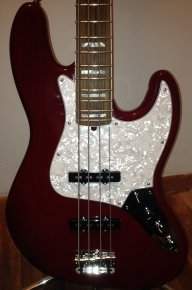
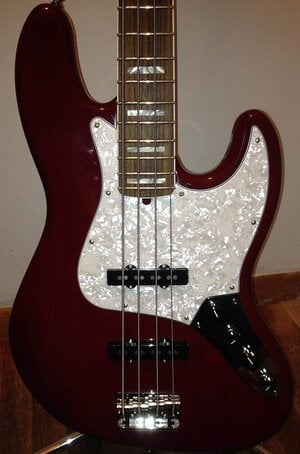
I currently have one bass that I will never sell. It is a 2011 MIA Jazz Deluxe. It was a gift from my wife. The bass is wine red with rosewood fretboard and block inlays. I wanted to swap out the electronics so for my birthday last year, my wife bought me a set of Lindy Fralin pickups, new pots and capacitors. For Christmas, she bought me a white pearl pickguard to replace the original black one. It plays and sounds amazing, I get a lot of compliments on my tone and since the bass and all upgrades were a gift from my wife, I will never sell it.
 

Attachments

  • 2011 Jazz (2).jpg
    2011 Jazz (2).jpg
    94.6 KB · Views: 134
I've said, "I'm never gonna' sell this bass" on several occasions. I think they're all gone now, so I don't say that anymore. There are some that I might say, "I don't think I'll ever sell this one"; but at some point, I probably will...
 
"Ahhh Value." There are $5,000 basses that don't have it and $300 basses that do have it. It's that rare elusive quality that some instruments have. You pick up a mangled used instrument at GC, plug it in, play that first note and smile. You sigh and say "Ahhhh." What does it for me might not do it for you. The one that makes me say "Ahhh" is my keeper.
 
Inspiration. The bass that begs you to play some more.

I have had a bunch of basses over the years, but I can't part with an ugly-ass MIJ JBass I have. I might even be relocating to the USA and one of my first thoughts was "SELL ALL THE THINGS! And buy better gear in the vastly superior US market".

But when push comes to shove, I think I'll be flying to the USA... with that ugly ass JBass in tow. It's been defretted, refretted, flats, rounds, steels, nickels, whatever, but it's still here with me after 15 years. Because every once in a while I think I have THE bass in my hands (last one is a custom made dual MM active that smokes, burns and destroys everything in its path), but then I play ONE song with the JBass and... that tone, that comfy feel and fit in my hands. I brought it as backup for the Roaring dual MM active for my last gig, played one song at soundcheck with the jbass... and wound up playing half the gig with the jbass. That's our bond, and that's what makes it a keeper. Often I wish it was prettier (dunno, pretty natural/trans grain instead of black paint finish, tort guard instead of 1-ply white, maybe pearloid blocks and binding instead of boring cream dots) but I rarely wish it sounded or played any different.
 
Several times I've thought I'd found a keeper and I've never kept a single one. I guess it's just me. On the other hand, I've never owned a Sadowsky or an Alembic, or anything really high-end, so it could be that I'd have to get to that point before I really even started calling anything a keeper.
 
On the other hand, I've never owned a Sadowsky or an Alembic, or anything really high-end, so it could be that I'd have to get to that point before I really even started calling anything a keeper.

I will say from experience... the name doesn't always indicate keeper status. I had a Sadowsky for a week (Metro). It wasn't a keeper... then again, the bass I kept instead ended up not being a keeper either.

One thing I will say, and this goes with the "I wouldn't change a thing" comments: If you feel like a bass needs to be changed a lot, it's probably not going to last.
I've mod'd plenty of basses, but if they still left me wanting, post-mods, it was a sign that the bass wasn't meant to be for me.
 
  • Like
Reactions: mav
For me it's kind d of intangible but the keepers all have one thing in common. They said "Hi, honey, I'm home!!!" the first unamplified note. The first one said it in early April '83. A LPB Fender Vintage Series '62 P. The next one was around '99 when I played a used Lakland Deluxe 4-94.

It's a combination of the inherent sound of this specific chunk of wood and metal, the feel of the neck and the ergonomics (NOT the "playability" as that's primarily about set up which I do myself), and how it all works together.

John
 
my 72 p bass has always been "it" for me.

It was the kind of bass my hero played...

that being said, when I was a young'n, fresh to the music thing, I was in our local shop, and in between all of the Hondo's and other entry level brands sat this beat up "non-new and flashy" looking 72 P bass. I had been mowing lawns for a while, and had the money saved up, so I bought it. I had found THE "idol" bass of my childhood

That feeling of buying something that I knew was really cool with my own money at that age (15), and that it was just like Steve Harris' bass was huge. It also sounded great, felt great and had the right mojo. I was lucky that I got to have that bass as my first, and never ever thought of letting it go.

Since then I have added basses, but will never get rid of it.
 

Attachments

  • P-bass.jpg
    P-bass.jpg
    113.9 KB · Views: 159
:cool:

Playability, Feel, Tone, weight.
If a bass has all the above, it maybe a keeper.
Looks are nice, But I've never keep a bass just on it's looks.
My 1970 P-Bass is a Keeper.
My Roger Fritz Custom, is becoming a keeper.
I'm still looking for the perfect Jazz Bass.
And my Stambaugh 6-string may well be that keeper too.
 
They can only be called "keepers" if you keep them around for years and years. I've had 7 basses in my 23-year playing life... still have 3 of them and hope to have them forever. They have my mojo on them and in them. They are true "keepers."

1. My Jazz (1975. Had it for almost 16 years.)
2. My Ric 4001 (1976. Had it for 15 years.)
3. My Hagstrom Swede (1973. Had it for a few months and love it.)

GAS is the worst, but I'm loyal. And most importantly, happy.
 
I've said, "I'm never gonna' sell this bass" on several occasions. I think they're all gone now, so I don't say that anymore. There are some that I might say, "I don't think I'll ever sell this one"; but at some point, I probably will...

I'm like that too. The only thing I've kept for a really long time is a 1985 Fender Strat that I've had for almost 30 years and a Fender Deluxe re-issue that I've had for 20 years.

I think I finally have a couple of keeper basses, but I can't seem to stop scratching my GAS. :D
 
Any instrument that makes me happy to play it,and brings some unique tangible quality to my attempts to make music with it. I love trying out new instruments,but a lot of what i buy gets "recycled" after 3-6 monthes if it doesn't just click. Sometimes,even if i do like certain aspects,there is a glaring fault that makes it go away. The Italia Rimini bass I owned was fabulous,and sounded great,but i did not like the jumbo frets sticking out of the binding on the neck. (Didn't like the neck binding,for that matter),so off it went. My 3 Ricks are keepers,as is my Carvin ac40 fretless. The latest newbie,an 8-string Fernandes is still in the honeymoon phase.......
 
This one is easy, yet difficult.

The basic principle is whether the bass "makes you want to play." That's going to be a combination of playability, ergonomics, and tone in two different senses - is it a tone that is pleasing to you, and is it a tone that fits with the playing that you do with others.

Now, the hard part: we and our musical contexts and interests change over time. Physical developments may alter ergonomic preferences - age, weight, weakness, or maybe getting stronger, injuries…

Musical interests may change - that P-bass with flats won't work so well in a high-energy funk-jazz thang, nor will the MTD-535 sound right covering early Neil Young. If your playing interests migrate over time, or if you are active in a lot of genres, at a high level ,then you'll probably end up with some specialist axes…or maybe not - doesn't Jimmy Johnson manage to cover everything from James Taylor to Alan Holdsworth with his Alembic 5-strings?

Then there can be value issues - an axe that you don't dig but that appreciates due to collector cachet, an axe that you got for so, so cheap that you could not possibly replace it at the same value.

Over 7 years as an active hobbyist I've probably been in and out of 35 basses, 4 vs. 5-string, fretless/fretted, different shapes, woods, price points, # of frets, string-spacing. I've learned a huge amount about what I like and don't like; certain pre-conceived notions about certain woods and electronics have been shattered, and I've learned how small things (fret wire!) can make a huge difference in sound and feel.

Also, I could simply be fussy beyond belief. I was a pro trombonist a long time ago, and talk about an instrument where you have to have a good physical connection with your axe. Plus I've always had strong interest in good sound and keep a good home sound system with lots of vinyl, so I just might be nuts.

My holy grail - one fretless and one fretted that can cover most things that I do. And I have three axes that are likely keepers:

Yamaha BB2000 fretless. Neckthrough with a lot of the same characteristics of a good Pedulla, for 1/3 the price. A little bit heavy, but with DR flats, a tremendous sound that can cover upright bass territory with some authority. The Pedulla buzz basses are phenomenal, but I can't get deal with the ergonomics of the body shape. This BB2000 isn't going anywhere else!

Lakland prototype, 34" 5-string fretless, ash/ebony, with only an MM pickup, a Nordstrand 5.4. I am way lucky to have found this axe, which is a gem. Currently using light Sadowsky flats, may go to nickel rounds at some point. A game-changer, both in terms of Lakland ergonomics (really good for me) and the fretless thing.

Sadowsky Metro 5/24 Modern, Nordstrand big singles, alder/morado. Purchased from a great upright player I used to work with as a bone player back east. After 5 years, I've yet to find anything else that seems to be so useful, and at a relatively reasonable price - I've had a few Sadowsky NYC axes in the house, and this axe has equalled or exceeded them in many ways. But will I keep it forever? I don't know - I'm starting to bump up against it's limits based on the aggressive pickup placement, the Lakland ergonomics may be better for me (body shape, compound radius, thinner neck, smaller fret wire), and am thinking about options. I have a couple of fretted axes in the house, but would like to get that down to one axe I can pretty much use for everything.

And gotta give a shout-out for three axes that could have been keepers, but for ergonomics. The Xotic J-type 5 string was not for me (big J-style body, weight), but probably the hippest electronics I've been exposed to, great workmanship, great active tone that tracks the passive tone rather than shouting "preamp!" at you. If they made the same axe with a smaller body, I'd probably be done. Next, a Music Man 5HH with ebony board - if it had 19mm string spacing, I'd have been done. Finally, the Roscoe Beck basses, 4 and 5-string, have some great design features, particularly the ability to run single/parallel/series on each pickup, independently…some serious smorgasbord of tones there..but could not get comfortable with the neck on the 5-string, along with the big J-body.

Final note - some poster above suggests that they all are fungible commodities and "the more you know, the less you care." Can't say I agree. Great players can make anything sound great, but they certainly have their preferences!
 

Latest posts