• TalkBass has been independent since 1998. Add your voice.
    Create a free account to reply to discussions, view embedded media, and browse with fewer display ads.
    Join freeLog in
    Want zero display ads or expanded classifieds tools? Compare plans.

What pro's use on the road vs in studio

It's the difference between being a customer and being an employee. If you're the one paying the studio you'll probably have the clout to use the bass you want. You're the customer. If you're a working bass player who's been hired for the session you're going to have to play whatever the producer/recording engineer wants. You're an employee. It also matters where the money is coming from. If your band is coming up with the money, you'll have a lot more control. If a record company is paying for the session you could end up having much less of a say in what equipment you record on.
All of my recording projects were paid for by the band no label involved...
 
If you are the artist, and artist I mean either solo or a member of the band and not a hired gun play whatever you want. The producer works for you, you pay them to produce, you play what you want.

If you are a hired gun, ask the artist you play for if they have a preference, if not okay what you want. They might ask you to connect with the engineer/producer but if they are decent they can make even a Spector sound good.
 
Equipment choices on pro tours and equipment choices for studio are two different worlds. A third world is personal equipment. Sometimes they may over-lap. I personally know touring pros that use "cheap" instruments on tour, that would not even consider taking their $6000 fiddle (or whatever).

At bluegrass festivals I do see a lot of high-end instruments.

But in arena rock / country / pop where the stage volume is so high, a lot of pros use cheaper instruments.
 
  • Like
Reactions: FlatwoundFunk
Interesting. So what happens when said new band goes to the studio and the Bass player doesn't have 50 instruments for the producer to choose from? Is there a fail safe?
The fail safe is whatever the producer considers "industry standard" for the genre. Often this means a p bass or a jazz bass for 4 strings or a stingray for 5 string. The more you record with good/expensive studios the more you'll get sick of hearing that term "industry standard" because the joke of it is there really isn't much of an music industry anymore. So to say industry standard is kind of ********
 
So the current band I have been in for the past 7-8 months is starting to get serious, booking gigs, talking about studio time,etc I'm looking to get a professional quality tool after the first of the year. I have few basses in mind but I decided to go back and look at what my favorite professional players use, and what the bassists of the bands we cover, and style of music we play. Two brands consistently show up, warwick and spector.

I have read a lot of guys have a set of studio instruments and then they have their working instruments and they're not always the same thing. Anybody know what the chances are of what you hear in the record is the same bass you see them playing on stage with?

There is a lot of variation on instruments and all the gear and gear concepts really for bass in the studio.

Live most people try to simplify things, for example they'll often use their favorite DI for the PA, some actually send a dry DI to FOH which is then reamped in protools or other software.

Recording wise a LOT of people record with different basses than they use
Live. Often times what they use live is more "cosmetic" for example if you watch some the sevendust cold day memory making of video, the boss is clearly playing a p bass, even though I've seen sevendusts live a dozen times (love me some 7dust) and I've never seen him play a fender onstage. Ryan from mudvayne is mostly known for playing warwick thumb basses live, but a lot of people don't know that he actually used some Pedullas on some of their stuff. Lamb of gods bassist has a signature Jackson bass he played when I saw him play live and he used to use peavey millenium basses live but I've seen footage of him in the studio playing a Warwick, inflames bassist has signature ibanez basses but when it came to tracking some fretless stuff he used what looked to be a fretless peavey Cirrus.

Amp wise a lot of pros don't even use amps in the studio. Often times it's a combination of DIs which are mixed together. For example I've got a video of inflames tracking bass and he had multiple DIs going; a couple mxr bass DIs even a track that was an mxr dimebag distortion. A pretty popular bassist I know personally used a radial rack unit to split his signal to 3 sans amps; one set clean, one set dirty and one set in between with a very subtle reverb. The advantage of doing it like that is later on when it comes to mixing the album you can mix different channels of bass to get a tone that fits better. For example you might record and then after the fact think I wish this part was cleaner or I wish that part was dirtier, well when pros do it they split the signal and track multiple channels of bass at the same time using crazy routing to different DIs which they can mix later on so if the bass tone isn't dirty enough they just bring up the the dirty channel and or lower the clean channel and so on.

For me personally sometimes I've recorded tracks that don't even end up getting used on the album. What actually gets used also has changed from album to album based on what sounds good with the drum sounds and what guitars and amps the guitarists used.

For me personally my live tone is mainly my stingray, my compressor and the wet xlr from my sans amp rbi, my cab rarely ever gets a mic live. In the studio though on our last record the bulk of the bass sound was a channel that was a mic on the cab in an ISO box and the dry xlR out of the sans amp RBI. The sans amp RBI and rpm are particularly nice I the studio because they have dry 1/4 outs or in other words dry thru outs like a plain DI, this allows you to feed another colored DI without any phase issues. On our last record there were some parts I wished were cleaner, so this time I plan to use that out to feed a cleaner DI like a eden wdti, ebs microbass, or aguilar tone hammer or something
 
Last edited:
And that was another thing I thought of was endorsements.

I guess really for that genre its hard to go wrong with either one. Was just something I was thinking about since for example with Jason Newsted he has played sadowskys pretty much exclusively since the early-mid 90s but I know I've seen him in the studio with Spector's and alembics,
He never really used the Alembics in the studio. The Bob Rock albums were mostly a Spector with some songs performed on a P. AJFA was a Steinberger XM2, I believe, and Garage Days was an Aria SB. In fact, most of what Bob Rock produced in the late 80's up to the mid 90's was done with a Spector, regardless of band or player. You can't argue with the end results, to be fair.

Regarding bassist vs producer, if you're an independant band and you hire a producer, surely it's on the basis of you liking the sound of his previous work and wanting your work to sound something similar? If so, it's worth listening to what they have to say. Everybody involved in your recording should only be there because they want the finished product to be the best it can be and everybody should have a good idea of what the end result will be before you walk in the studio door.
 
  • Like
Reactions: Klonk
Quiet, in tune and easy enough to play are the primary criteria. String height is higher than my live action basses where I like a little clank.

.

Ha! Glad I read this... I thought I might be a little weird, as I do exactly the same thing.... higher action on my recording bass. It also reminds (forces) me to play a bit more deliberately and perhaps a bit simpler. If I have any recurring self-critique of my recording, it's that I COULD have played less, perhaps to greater effect.

I also have a story about live vs. recording. I met a well-known new-metal bassist a few years back, and we were talking about our favorite basses we owned. He had a few nice, unusual pieces, and I asked him if he ever played them out. He said, "Hell, no... I just call (insert endorsing manufacturer) and order a few black five-strings when we go out. I ain't takin' any of my GOOD stuff on the road!".
 
Only advice can really give is music/sound is subjective and some people may think the are hearing a P bass when infact its a Spector. I was a long time Warwick player and loved the tight low mid's my thumb basses gave me. Problem is a P bass (in the studio) with the eq boosted at 250 Hz gave could give me the same low end punch the Warwick had but had different overtones. Depending on who was listening the player would be the deciding factor as to how good it would sound. I love the tone of warwicks but am happy as a fender guy now but would tell you you couldn't go wrong with one. Keep in mind a backup or "can I afford to replace this bass if something happened" if you plan to build your sound around one type of instrument. At the time Warwick were cheaper and I could afford to replace mine if something happened. I prefer Warwick to Spector but you would be amazed what a studio engineer can do with a standard studio P Bass. I'm a jazz bass guy but for most of my home recordings a p bass would be a better fit, I just don't like the neck and feel of a P bass. I hope you find what makes "you" happy!
 
Interesting. So what happens when said new band goes to the studio and the Bass player doesn't have 50 instruments for the producer to choose from? Is there a fail safe?

You can never go wrong with a P. Good for any style of music, just choose your strings accordingly (rounds for metal/hard rock - despite what you read here, you can play a P with rounds on it). There is a reason they have been used on so many pro recordings.
 
  • Like
Reactions: FlatwoundFunk
What your favourite players use on stage is not necessarily any indication of what they use in the studio. A lot of it simply depends on what the producer wants.
Cuz what the world needs now is another producer...
I think it would be nice to hear bands producer-less, less fluff more gruff.
I find this interesting as I'm sure if we actually knew what went on behind the scenes we'd cringe.
Do most of these bands actually play their parts or is it going back to a wrecking crew style again? I can't imagine Pete Wentz playing his signature model in the studio let alone him a actually playing in the studio.
 
Cuz what the world needs now is another producer...
I think it would be nice to hear bands producer-less, less fluff more gruff.

A different discussion really, but I do agree with you. I really hate the way most rock music is recorded/mixed today. Guitars mixed way down, drums too many effects. More pop mixes than rock. And it all pretty much sounds alike. It seems like they use the same presets for everything. Bland, boring, lifeless. They take all the rock out of rock.
 
Not from my own experience, but I sold a Sandberg P bass, 5-string (the one to the right in the picture), to a well-known Norwegian bass player, playing in a band that does around 60-70 gigs a year, mostly festivals and summer gigs. We ended up chatting a bit, and he told me he had a 63 P bass at home that he used for most recordings, but he didn't want to take it out on the road, so for that he was looking for a reliable, easy-to-play, work horse bass, and my Sandberg fitted that bill well, so he bought it.
 

Attachments

  • Sandberg VS5.jpg
    Sandberg VS5.jpg
    68.5 KB · Views: 67
  • Like
Reactions: MobileHolmes
The Precision tone is perfect for recording. I´m telling from a sound guy point of view. The way it fits in the band and locks with the kick is amazing.

In order to copy a Precision tone with my Adamovic I use the neck pick-up soloed in single. But the Adamovic it´s too clear and defined so I have to mud it a bit by adding harmonic distortion.

I´m thinking of buying the Ampeg SCR-DI to achieve this. I played through an Ampeg portaflex the other day and I really liked the tone.
 
I have only been hired for one session gig in my life, and that was to record 10/12 tracks for an album. I only owned one Schecter bass, and a fretless I was not good with.

I still own the fretless, but now I have a brand new P bass and a J I'm trying to sell to afford the cost of the P I just bought. I really want to be able to just have one or two basses. Is a P and a fretless (Ibanez, J config pups) gonna do it or do I need to keep that J? What with the P basically being regarded as the holy grail of bass, I'm conflicted on whether or not to sell my J.

OP, I can't imagine why you couldn't use a bass live and in studio. I mean, if the bass can do the job live, why not in the studio, where you have time to redo your tracks, editing software, etc?
 
I think it's a matter of the two scenarios (live and studio) have different requirements. In the studio, you want a bass that sounds good, is quiet/no hum, no (unwanted) clanking from frets, et cetera. Live, the sound and no hum obviously still matter to some degree, but to a lesser degree, because live is there-and-then. In addition, other factors enter the equation, like looks, durability/reliability, and playability. Not to mention the risk of an accident occuring (bass = ruined) or even theft.

If you can find a bass that does both well, good. I would take my Fender CS 59 P or my Sandberg VS4 to the studio because of their quality and sound, but I would deem them too risky to bring on a tour (not that I tour), so I would probably bring a stock MIJ Fender P instead.
 
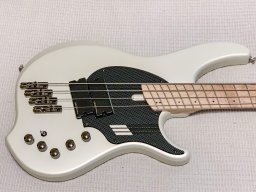
I'm certainly not a pro but I have one go-to bass for live: 5-string Dingwall Super P. It's super comfortable, fairly neutral looking once you get past the fanned frets and sounds great.

In the studio unless I have to play highly technical stuff (which doesn't ever happen) I would have no problem using a less comfortable bass I might not necessarily own (like a hollowbody, a fretless or a Rickenbacker) if that's the tonal flavour the song is calling for. It may be a little harder for me but I only have to get it right once. Also looks are totally irrelevant in the studio.

I have to admit a producer handing me a Fender Precision is likely to get the "Dingwall or I'm out" reaction though.
 
I have never worked with a hired actual "producer" who wasn't either 1) the artist himself , or 2) the owner of the studio.
But if I were in that situation, I'd probably treat him/her with respect and play whatever instrument they wanted me to play. They are hired to get the best sound down, I'm hired to execute/create whatever parts I need to play to contribute to the song. THAT's my contribution.
My "art" doesn't trump their craft.
 
  • Like
Reactions: FlatwoundFunk