
Define "better." Sure looks like they use Eminence ceramic speakers, baltic birch, and black tolex, just like Ampeg.
Better becomes subjective very quickly, I would agree.

TalkBass has been independent since 1998. Add your voice.
Create a free account to reply to discussions, view embedded media, and browse with fewer display ads.
Join free Log in
Want zero display ads or expanded classifieds tools? Compare plans.
Define "better." Sure looks like they use Eminence ceramic speakers, baltic birch, and black tolex, just like Ampeg.
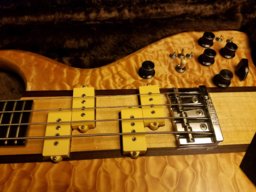
 , also I think I joined the wrong branch of service now that you told me this(LOL we don't get to keep any basses), I suspect the air force has more $$$$ than the army does....
I'm glad you enjoy it. It's good stuff and I did say/imply that all that stuff is nice and artisan crafted and is valued for more than just sound-producing ability.
I started just responding to the "kid at GC" which didn't ring true. Im not a paid musician but I can have good taste in sound and certainly I can counter an assertion that doesn't ring true, despite my being unpaid for my musicianship. Thanks for your Army service by the way. You guys are baaaad in the music skills department.
As a related aside and not to attempt to discredit anything but just pointing out that people get blinders on and their perceived experiences are biased by their previously determined conclusions rather than being based on open-minded reality... we used to have an Air Force band keyboardist/MD at church and he told me that the bassists have access to EVERYTHING all sitting on a rack at base. Any bass imaginable can be had and all the standards are stocked. He said that at the time the current bassists each use Fodera (each guy can order whatever he wants after x amount of service time and the Air Force buys it for him to keep... one must wonder, based on that financial arrangement, if the bassists would have such scrutinizing tastes if they had to pay for their equipment. But that's another tangent.... as a former military person and a current public service worker, I am not out of line in saying that I know very well how the "it's not my money, I'm underpaid so screw it, give me the expensive one" mentality works). Anyway, he said the Stingrays just sit on the rack because "they just have one sound." That notion is comical, a cursory review of YouTube, iTunes, etc will show that Stingrays can be used anywhere (just like almost any other bass) and made to vary widely in sound. End of tangent.
The diminishing marginal returns/gig volume stuff in last post was not directed at you but in response to the sentiment of people (and the OP, apparently) who don't understand that off-the-shelf, big guy stuff is, indeed, frequently great for all practical purposes. Yes, we ordinary knuckleheads can be wrong and misguided by advertisement and herd mentality but how do we explain that the vast majority of pros are using big guy stuff.... not because they need a free $600 cab or a few thousand endorsement dollars? It's because the stuff truly works exceptionally well for them, and they certainly would be using boutique stuff if it really was a significant difference in real world gig situations and if it earned then more respect and gigs from their musician/producer peers- let alone if it better pleased their own discerning ears (and "nobody" seems to be mic'ing cabs in studio anymore so...).
Sorry for the misunderstanding that it seemed directed at you. On TB, one must close all holes when opining lest one become fodder for trolls who seek out gaps that most sensible people fill in correctly with reasonable-minded assumptions of the poster's intent. And, in this case now, only to be thorough here so that I don't have to reply to trolls who would now be inclined to say I was nitpicking/trolling you, if they are true to usual form; I replied to your explicit "GC kid" example with my experience that says it was not accurate since most cheap cabs CAN reproduce mistakes just as good as an expensive one.
Peace.
Bingo!I don't know...this may be a crazy idea, but maybe people like the regular bass cabs better?




With all the new technology and know-how that is out there, it seems surprising that the traditional bass amp makers, Fender, Mesa, etc etc have not embraced these new ideas and incorporated them into their lines; perhaps as a 'premier' brand? With their greater economies of scale, they could then market them at premium prices.
Maybe Bergantino, Baer, Barefaced, Greenboy etc might license some designs to get them into the game. I am sure there must be compelling reasons why the big boys continue to sling raw drivers into boxes.
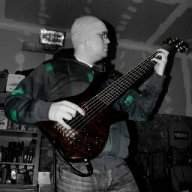
Programmed...LOL! Well I sure am glad you're smart enough to see through the smokescreen so you can educate everyoneIn all honesty this argument applies to consumers in all areas of audio reproduction. Bose has been selling the same crappy 3-4" speakers for 40 years, but they tune them to accentuate freq. that make them stand out. They sound really amazing for a 4" listening to them alone, but sound like utter crap next to a real quality hifi speaker.
Same goes for beats headphones, and why subs are the first speakers replaced in a car and the importance of the other 19900hz are totally ignored.
The average consumer is exposed to what they are told "sounds good" and never take the time to experience or learn what good sound is. Most people can only experience what is readily available at best buy or GC. If they can't experience it easily they will never know what they are missing.
After a while they are programmed and used to it so when the do hear an accurate full range representation it sounds thin or sterile.


Nothing wrong about that, but it is a matter of perspective. I come from a world of enthusiast hifi, and can sympathise with your view.I don't really understand what is so shocking about a musician who wants to hear a faithful reproduction of their instrument, amp, effects etc. particular voicing.
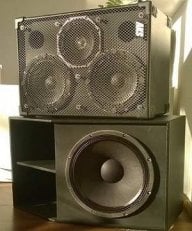
As for us little guys, I don't believe it's any magical cabinets and crossovers that make our cabinets perform they way they do. The "magic" lies in the use of very expensive premium drivers. Sure, there might be a difference between a cheap $10 crossover and one with a higher degree of engineering that cost $40 to build, but the difference between a $40 and $60 crossover gets harder to hear.
Programmed...LOL! Well I sure am glad you're smart enough to see through the smokescreen so you can educate everyone
Nobody's programmed. The people have spoken and they've chosen hyped sounds. They like big bass and drum sounds, and they like bright cymbals and vocals. I always add bass and treble to my radios and stereos for that reason. Near-flat hi-fi response is available for anyone who wants it, but the reason that hyped sound sells has nothing to do with bring programmed...people simply like it better. I pretty much never play with a flat EQ. There's always at least a little bit of scoop in my favorite tones, and sometimes a pretty significant bass boost, too. Most of my favorite bass tones from others aren't flat response, either. Your claim assumes mass stupidity, but the market has had every opportunity to choose hi-fi flat response and by and large they choose hyped tones. They like good systems, but they want hyped tones coming out of them.

I don't know where OP got the notion that Mesa cabs weren't fantastic.

Better becomes subjective very quickly, I would agree.
exactly. if you want a mass produced fearful just go buy a hifi audio speaker, same thing. they've been doing the 3 way 5 way 12 way etc design for longer than fearful has been a company. for those of us who play bass and not an audiofile stereo, well play the standard offerings.

As an aside, it has always been amazing to me that certain band members, throughout my long and illustrious (ha ha) career, have thought a bass is SUPPOSED to sound like thump thump thump. I have always preferred, even before "modern" became "modern", more punch, growl, and sustain. When asked can't I do thump thump thump I always just say no (well, unless is pays to say yes).I think a lot of it has to do with peoples perception and expectations.
Someone pointed out that many of us expect a bass to sound like
a P played thru an SVT.
.....
The whole concept of what an electric bassist "really sounds like" seems unknowable, perhaps it's something just made up by people who want to put down others who dislike their favorite gear. Even if Fearfuls were perfectly flat (which they're not, of course, although they're very good cabs that make a lot of players happy), there are so many other elements that impact how a bassist sounds--choice of instrument, modding the electronics, use of active EQ and/or the passive tone knob, string choice, amp choice, use of the amp's EQ section, pedals, etc. The idea that everything before the cab is what a bassist "really sounds like" seems silly, honestly.Fire proof suit on
I think the guys that call cabs "sterile" are finally hearing what they really sound like. and not digging it.