DiabolusInMusic
Functionless Art is Merely Tolerated Vandalism
UM Les Paul is a Signature guitar... I think that was before the Eric Clapton
We're talking about Fender here, focus people!


TalkBass has been independent since 1998. Add your voice.
Create a free account to reply to discussions, view embedded media, and browse with fewer display ads.
Join free Log in
Want zero display ads or expanded classifieds tools? Compare plans.
UM Les Paul is a Signature guitar... I think that was before the Eric Clapton


I think the world would eat up a Fender "Black Beauty" Precision. There's no intellectual property infringement there because it is not an original name. Fender wouldn't even have to mention JJ at all.
Bad mojo?

I think the world would eat up a Fender "Black Beauty" Precision. There's no intellectual property infringement there because it is not an original name. Fender wouldn't even have to mention JJ at all.
Bad mojo?

DEE DEE'S DEAD???!!!!
CLIFF BURTON'S DEAD???!!!


Didn't Gibson have a Black Beauty Les Paul with three pickups in it?
Hard to find someone more into JJ than I am - I wouldn't buy one.

the problem was fender was using his namesake to make money, the family sued and won i believe (they weren't getting a cut of the bass sales). the 62 RI is the same thing now, just doesn't have his name or labella strings on it.

Actually he is the subject of an Ultra Black military project concerning human shaped aliens inhabiting Earth.CLIFF BURTON'S DEAD???!!!
How many versions of a bog standard 62 P bass does the world actually need? That the man's playing is as relevant today as the era it was recorded and it still makes people shake their asses is the the best honour we can give his playing, not another pointless cash-in sig.

Okay, that's what I thought.Actually he is the subject of an Ultra Black military project concerning human shaped aliens inhabiting Earth.
I'd buy a "Black Beauty".I think the world would eat up a Fender "Black Beauty" Precision. There's no intellectual property infringement there because it is not an original name. Fender wouldn't even have to mention JJ at all.
Bad mojo?

Copied from my post in 2008. This should help clarify:
The James Jamerson Tribute Bass and Jaco Pastorius Signature Bass were commissioned exclusively by The Bass Centre in Los Angeles (Studio City) and built by the Fender Custom Shop. John Page was manager of the Fender Custom Shop at the time, and the master builder in charge of the project was J. Black.
We started this project in 1990, and I believe the basses were produced in 1991. We worked with James Jamerson, Jr. on the Jamerson bass, and (after gaining permission from the Attorney's of Jaco's Estate) with Kevin Kaufman (who maintained, repaired, and eventually re-built the "Bass of Doom.") I had also spoken with Jim Roberts (Bass Player Magazine) and John Goodwin about some details early on as well. I think it was John who put me in touch with Kevin.
The original idea was to commission the FCS to do the Jamerson bass, and then we came up with the idea to do the Jaco bass immediately thereafter. The intent was to have the FCS reproduce a limited run of basses that was modeled after both the "Funk Machine" and the "Bass of Doom." This was years before the FCS began building "relic'd" instruments (which would have been SWEET!) Each bass was to be limited to 100 pieces, and include an accurate vintage-type case as well as a signed certificate of authenticity. The Jamerson Family and the Pastorius Estate were both paid a royalty whenever a bass was sold.
All told, I believe no more than 50 of each instrument was actually produced, and the quantity may be closer to 35. I left The Bass Centre in July of 1993 (I went to work for Kaman Music as the western U.S. product specialist for Trace Elliot amplification & Hamer Guitars shortly thereafter,) and the store closed in January 1996. When I left, I believe we had already sold about 20 JJ bases, and had about 15 left in stock. I don't remember the quantity on the Jaco basses. Alan Morgan (the owner of the Bass Centre in LA) was not convinced that we would sell 100 of each, so we only committed to a quantity (at the time) of 50. He was right.
Details on the Jamerson Bass:
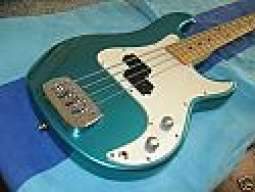
1962 Precision Bass, sunburst. Per JJ, Jr, the Funk Machine had a very wide, flat neck. I don't recall the correct Fender size (A, B or C) but it was also referred to as the "blade" neck. This was different from the neck shape that was used on the standard 1962 re-issue, which was a bit more chunky. This had a rosewood, slab fingerboard with clay dots. We also contacted La Bella and ordered the 1954 flatwound strings to be installed on each bass. Each neck plate said James Jamerson Tribute Bass and was individually numbered. The case for ordered for the JJ bass was the black 1962 type case with the orange interior. This was a bit of a disappointment, as the cases actually came with a red interior, as the orange material apparently could not be sourced at the time. The numbered certificate of authenticity was signed by James Jamerson, Jr., and by yours truly.
Details on the Jaco Bass:
1962 Jazz Bass, sunburst. The biggest detail on this bass was the lined, fretless neck covered with epoxy. It was decided to use a cream-colored plastic to fill in the fret lines (rather than putty as Jaco originally used,) as the plastic would not shrink & crack over time. A clear epoxy was used to cover the fingerboard, and then the bass was strung with Rotosounds. P-bass knobs were installed to be accurate, and the case was to be the brown vintage case with the correct interior. We were fortunate to receive several copies of Jaco's signature from His estate, so Jaco's signature (John Francis Pastorius - maybe John F Pastorius) was engraved on the neck plate along with the serial number. Again, the correct interior color was not available, so a yellow-gold interior was used for the brown case. The numbered certificate of authenticity for the Jaco Bass was signed by Kevin Kaufman and by me.
Kevin Kaufman was very instrumental in creating the Bass of Doom. Kevin was fantastic, and we spent a lot of time on the phone nailing down the details. When the prototype was ready, we flew Kevin from Florida to California to review the finished product, and to meet John Page and J. Black at the FCS. Here is a link from Kevin's website that featured an article about both basses that was done by the industry magazine Music and Sound Retailer: [Invalid or Expired Link Removed]
The article is dated 1999, but this was actually done originally in 1991 or early 1992.
Chris Maury