• TalkBass has been independent since 1998. Add your voice.
    Create a free account to reply to discussions, view embedded media, and browse with fewer display ads.
    Join freeLog in
    Want zero display ads or expanded classifieds tools? Compare plans.

Worship Bass Pedalboards

SVTDI’s are harder to come by, but the KHAN VTDI is more readily available and for some is an even better alternative. But I’m loving what the SVTDI brings to the table, which is volume, fatness, girth, and Ampeggy goodness.
I would think the Khan VTDI always a better alternative? As I understand it, Obeid Khan was commissioned by Ampeg to design the SVTDI. It was a huge hit and, years later, Obeid started to build them on his own as the Khan VTDI. The first ones had a black enclosure and some changes from the original SVTDI: Obeid eliminated some of the switches and upgraded the components. (This is what he told me when I asked him last fall.) More recently he released the red version, which is a slightly smaller enclosure that also has the 115/230 switch for world travel. He also removed the relay that made it revert to a passive DI if AC power was lost or the unit was turned off because, as he put it, he figured if you were buying a tube DI you would always want the tube sound and the passive DI feature wasn't seeing use.

How do you use the Alma versus the Empress? And the SB versus the Solarian? Just different flavors or you do have them set up for different functions?
 
  • Like
Reactions: Miles_ONeal
I would think the Khan VTDI always a better alternative? As I understand it, Obeid Khan was commissioned by Ampeg to design the SVTDI. It was a huge hit and, years later, Obeid started to build them on his own as the Khan VTDI. The first ones had a black enclosure and some changes from the original SVTDI: Obeid eliminated some of the switches and upgraded the components. (This is what he told me when I asked him last fall.) More recently he released the red version, which is a slightly smaller enclosure that also has the 115/230 switch for world travel. He also removed the relay that made it revert to a passive DI if AC power was lost or the unit was turned off because, as he put it, he figured if you were buying a tube DI you would always want the tube sound and the passive DI feature wasn't seeing use.
It's quite possible the Khan is better than the SVTDI. I dunno. No skin off my back if it is. I can see some obvious ways that it's better. It's smaller, for starters. The SVTDI is an absolute tank. And perhaps some of the switches on the SVTDI are superfluous, but I enjoy them. The -6DB pad has proven quite useful already, though the Khan has that as well. And I personally like the "direct vs tube" option. That way if the tube craps out, or if for some other reason the power to the SVTDI somehow fails (and yet for some reason doesn't also fail to everything else in my chain), the passive option is great. Plus, then I can practice with it running direct into my Rolls without having to actually turn the SVTDI on, and save some wear and tear on it and its tube. Necessary? Enough of a reason to buy an SVTDI over a Khan? Maybe not. YMMV. I got what I got because I landed a significant deal on it, and I'm pleased. If I had the choice between an SVTDI and a Khan for the same price, I probably would have picked a Khan due to form factor and being newer and having lower miles on it. But those are subjective qualities. Plenty of old stuff is great. Like me. The SVTDI is killer. At least that's my opinion after one worship set. We'll see if I still have it in a few months, or if something else tickles my fancy.
How do you use the Alma versus the Empress?
I had the Alma first. Well, technically I had an Empress BC first a couple of years ago, but sold it, then got an Alma, and then bought an Empress again. I love the Alma. Super tone fattening compression. But I wanted something to tame the ridiculous hot gain coming out of my G&L 2500 that was a bit too hot for the Alma to handle directly. I was going to get something like a Southampton All Things Equal, but then decided to get an Empress BC again, remembering how much I loved it, and how handy the metering came in when mixing between different output basses. That input knob is highly functional. Now, when I plug the G&L in, I just turn down the input knob on the Empress BC until it matches the level I'm seeing on the meter from my other basses. It works fantastically in that regard. And everything else basically stays the same. But then I also decided that I loved how the two sounded running together at lower compression levels, so now I run them both full-time. The "Tone & Colour" switch on the Empress is just to die for. It's something I have not been able to replicate with straight EQ or other effects, though maybe I should be able to if I was a tad bit more technically savvy.
And the SB versus the Solarian? Just different flavors or you do have them set up for different functions?
Yes, different flavors of always-on awesome sauce. Studio Boost is always on at the end of the chain to give that lovely Neve color to everything. The Solarian is pretty much set and forget as well. I don't change it much unless I want a tiny bit more grit in my tone. But I almost never touch either of them. Everything on my board is always on, with the exception of the Scorpion, which I only kick on for a little grit when I'm playing with a pick. Most other tonal changes are done within the Stomp.
 
It's quite possible the Khan is better than the SVTDI. I dunno. No skin off my back if it is. I can see some obvious ways that it's better. It's smaller, for starters. The SVTDI is an absolute tank. And perhaps some of the switches on the SVTDI are superfluous, but I enjoy them. The -6DB pad has proven quite useful already, though the Khan has that as well. And I personally like the "direct vs tube" option. That way if the tube craps out, or if for some other reason the power to the SVTDI somehow fails (and yet for some reason doesn't also fail to everything else in my chain), the passive option is great. Plus, then I can practice with it running direct into my Rolls without having to actually turn the SVTDI on, and save some wear and tear on it and its tube. Necessary? Enough of a reason to buy an SVTDI over a Khan? Maybe not. YMMV. I got what I got because I landed a significant deal on it, and I'm pleased. If I had the choice between an SVTDI and a Khan for the same price, I probably would have picked a Khan due to form factor and being newer and having lower miles on it. But those are subjective qualities. Plenty of old stuff is great. Like me. The SVTDI is killer. At least that's my opinion after one worship set. We'll see if I still have it in a few months, or if something else tickles my fancy.
I had the Alma first. Well, technically I had an Empress BC first a couple of years ago, but sold it, then got an Alma, and then bought an Empress again. I love the Alma. Super tone fattening compression. But I wanted something to tame the ridiculous hot gain coming out of my G&L 2500 that was a bit too hot for the Alma to handle directly. I was going to get something like a Southampton All Things Equal, but then decided to get an Empress BC again, remembering how much I loved it, and how handy the metering came in when mixing between different output basses. That input knob is highly functional. Now, when I plug the G&L in, I just turn down the input knob on the Empress BC until it matches the level I'm seeing on the meter from my other basses. It works fantastically in that regard. And everything else basically stays the same. But then I also decided that I loved how the two sounded running together at lower compression levels, so now I run them both full-time. The "Tone & Colour" switch on the Empress is just to die for. It's something I have not been able to replicate with straight EQ or other effects, though maybe I should be able to if I was a tad bit more technically savvy.
Yes, different flavors of always-on awesome sauce. Studio Boost is always on at the end of the chain to give that lovely Neve color to everything. The Solarian is pretty much set and forget as well. I don't change it much unless I want a tiny bit more grit in my tone. But I almost never touch either of them. Everything on my board is always on, with the exception of the Scorpion, which I only kick on for a little grit when I'm playing with a pick. Most other tonal changes are done within the Stomp.
Good point about the power failing and the SVTDI's passive option. That's a pretty niche situation, but if it's a concern (maybe someone frequently performs in a venue with sketchy power) then I can see that being useful. My point was that they're the same pedal (albeit the Khan VTDI has some refinements) because your earlier post intimated they were similar but different. I don't really see them as alternatives to one another so much as different generations of the same product, if that makes sense?

I've yet to explore dual compression, mostly because compression doesn't excite me like some other effects do. I always find it interesting to read posts from the folks that are compression nerds though. I've learned a lot from the compression megathread. I have two Empress Bass Compressors and I agree with you about the "tone and color" switch. I use it all the time in church.

I haven't tried the Studio Boost, but I did try the Studio Boost Mini and the Solarian. Excellent pedals, though neither stuck around. In the case of the former because I've found I prefer transparent clean boosts to colored ones and in the case of the latter because I prefer clean boosts to dirty boosts. Or else I just stack dirt. You've found a way to use them as part of your always-on tone which is cool! I tried that with the SBM, but I didn't think the 1073 sound was significant enough to justify the space and power consumption. Probably because I was already running some Lightning Boy 2020s, an [sfx] micro-thumpinator, and the Khan. If I need more always-on breakup I can turn on the Quicksilver. Or maybe you just have a better ear than me :)
 
Good point about the power failing and the SVTDI's passive option. That's a pretty niche situation, but if it's a concern (maybe someone frequently performs in a venue with sketchy power) then I can see that being useful.
Incredibly niche situation, indeed. In 35+ years of playing, I have only had quasi-similar things happen maybe two times that come to mind:
1) An Aguilar Tone Hammer that all of a sudden decided to no longer work via phantom power and I didn’t have an external power supply.
2) One time the tube in my old Demeter rack pre went all microphonic mid-gig.

Those are the kind of things that, though incredibly rare, only have to happen once before you learn to have a backup plan. But yeah, the passive relay will maybe never actually be needed in the real world, but I’m glad to have the option if it is. And if nothing else, it’s nice to use it in my headphone practice setup without even turning it on. Not necessary, and maybe not even a selling point, but it’s convenient.

My point was that they're the same pedal (albeit the Khan VTDI has some refinements) because your earlier post intimated they were similar but different. I don't really see them as alternatives to one another so much as different generations of the same product, if that makes sense?
Accurate. I would probably consider the current Khan the SVTDI V3. New and improved. Let’s say there was the original Ampeg SVTDI 1.0, and then the original larger black Khan, which we’ll call the Khan 1.0/SVTDI 2.0. And then the current smaller red Khan 2.0/SVTDI 3.0. The Khan I had a while back was the larger black Khan 1.0. It looked more like the SVTDI cosmetically and sounded fantastic. I only sold it because I decided to switch back to my rack setup. Which, of course, I later decided to ditch again. The Khan 1.0 also had a passive option. The red Khan 2.0/SVTDI 3.0 does not.

I've yet to explore dual compression, mostly because compression doesn't excite me like some other effects do. I always find it interesting to read posts from the folks that are compression nerds though. I've learned a lot from the compression megathread. I have two Empress Bass Compressors and I agree with you about the "tone and color" switch. I use it all the time in church.
Yes. That little switch is good. Really good. And yet if you want completely transparent compression - just your bass sounding exactly like your bass, but compressed - it does that remarkably well too.

I haven't tried the Studio Boost, but I did try the Studio Boost Mini and the Solarian. Excellent pedals, though neither stuck around. In the case of the former because I've found I prefer transparent clean boosts to colored ones and in the case of the latter because I prefer clean boosts to dirty boosts. Or else I just stack dirt. You've found a way to use them as part of your always-on tone which is cool! I tried that with the SBM, but I didn't think the 1073 sound was significant enough to justify the space and power consumption. Probably because I was already running some Lightning Boy 2020s, an [sfx] micro-thumpinator, and the Khan. If I need more always-on breakup I can turn on the Quicksilver. Or maybe you just have a better ear than me :)
Yeah, I don’t think anyone NEEDS something like the Studio Boost that, in the manner in which I use it, isn’t used for drive or anything. Just slight coloration. With everything else in my chain, the effect of the Studio Boost is pretty subtle. The average person would struggle to hear it. I doubt an average church sound man would notice. An average congregant certainly wouldn’t. But when I turn it off, it makes me sad. It definitely makes a difference. Subtle though it may be. Probably very similar to the 2020s x2.

The Solarian, on the other hand, adds some great harmonics and a treble cut that is very delicious and adds to the warm, vintage thing I’ve got going on. I could not do without that one.
 
Last edited:
  • Like
Reactions: SemiDriven
Well, the new board is being pieced together slowly.

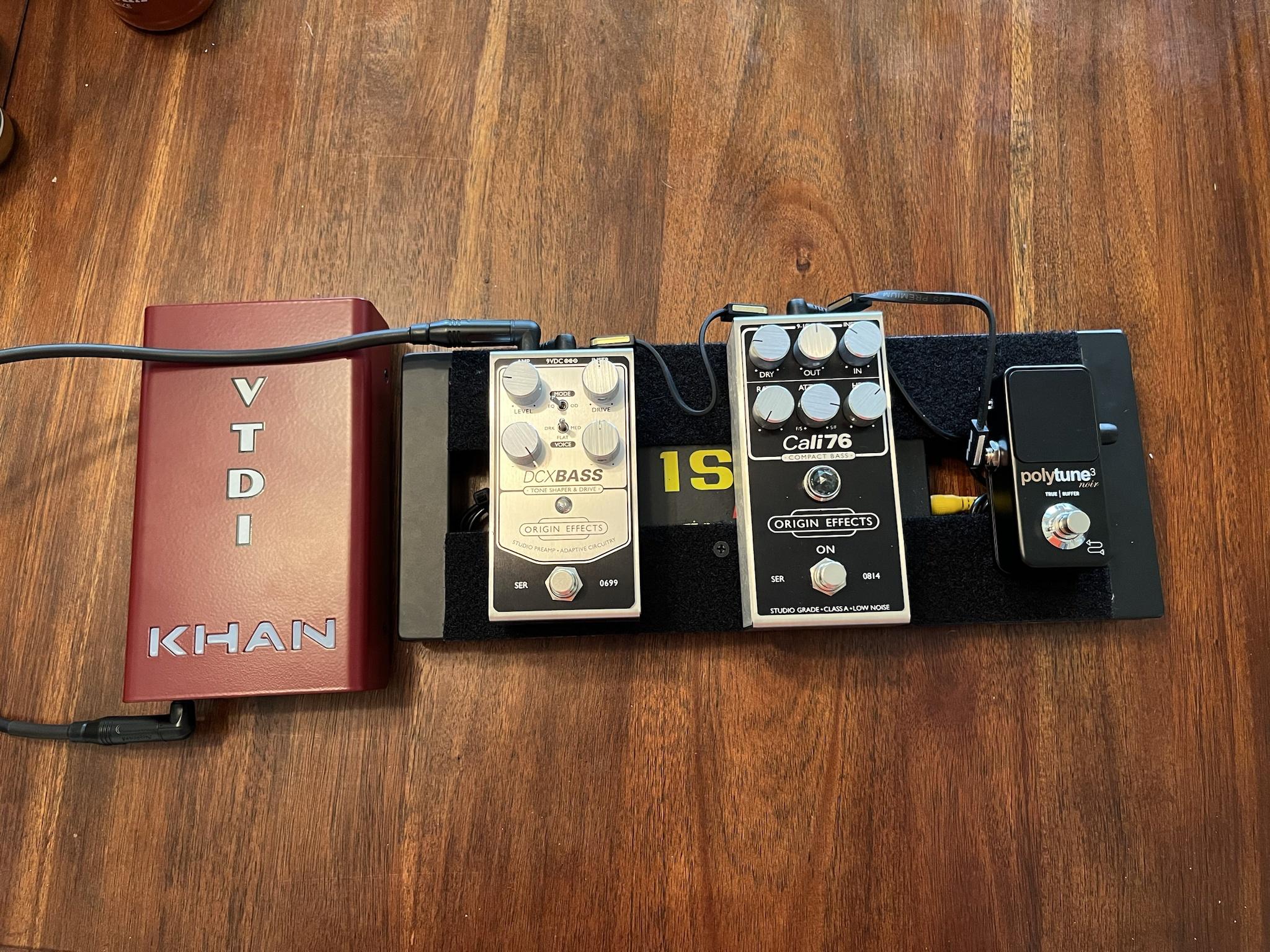
the khan vtdi and DCX bass will be here this week. I’ll toss my nano board together with tuner, cali76 cb and DCX bass and carry the khan separately till I figure out what else I need (or would like to have, rather).
That sounds like a perfect small board. Let me know what you think of the DCX please. I'm currently using the super vintage
 
That sounds like a perfect small board. Let me know what you think of the DCX please. I'm currently using the super vintage

for sure. I currently run a tuner, comp and BDDI. I would like to keep that on the nano but I’m not buying another pedalboard and power supply till I’m more set on what I’m going to do with it.

I don’t really need the EQ, so I didn’t want to get a full blown preamp again… (like the SV, tonehammer, bddi, etc…) but I’m thinking the DCX can do the dirt thing for me when I want it. I’m scared I’ll like the clean/EQ section of the pedal and then I’d have to get a second one :eek:
 
That sounds like a perfect small board. Let me know what you think of the DCX please. I'm currently using the super vintage

I don’t really need the EQ, so I didn’t want to get a full blown preamp again… (like the SV, tonehammer, bddi, etc…) but I’m thinking the DCX can do the dirt thing for me when I want it. I’m scared I’ll like the clean/EQ section of the pedal and then I’d have to get a second one :eek:
I've been using the DCX Bass in church for the past few weeks. It's brilliant. Easily in my top 5 overdrives of all time (and I've owned/played a lot of overdrives) and probably top 3. I expected to like the dirt side of the pedal more, but I've actually been using the clean/EQ side. With the drive pot around 2 o'clock it produces the mild overdrive I want and it keeps the adaptive voicing engaged.
 
Incredibly niche situation, indeed. In 35+ years of playing, I have only had quasi-similar things happen maybe two times that come to mind:
1) An Aguilar Tone Hammer that all of a sudden decided to no longer work via phantom power and I didn’t have an external power supply.
2) One time the tube in my old Demeter rack pre went all microphonic mid-gig.

Those are the kind of things that, though incredibly rare, only have to happen once before you learn to have a backup plan. But yeah, the passive relay will maybe never actually be needed in the real world, but I’m glad to have the option if it is. And if nothing else, it’s nice to use it in my headphone practice setup without even turning it on. Not necessary, and maybe not even a selling point, but it’s convenient.
I think I'm wired differently than you haha. My backup plan would be to bypass the Khan if it somehow failed. I'm not one to change my setup to account for such rare instances. On a tour, sure. But in church? There's always an extra DI I could grab. Plus it feels like something is always going wrong. I've served in mobile churches for so long I've learned to just roll with whatever is acting up.

Accurate. I would probably consider the current Khan the SVTDI V3. New and improved. Let’s say there was the original Ampeg SVTDI 1.0, and then the original larger black Khan, which we’ll call the Khan 1.0/SVTDI 2.0. And then the current smaller red Khan 2.0/SVTDI 3.0. The Khan I had a while back was the larger black Khan 1.0. It looked more like the SVTDI cosmetically and sounded fantastic. I only sold it because I decided to switch back to my rack setup. Which, of course, I later decided to ditch again. The Khan 1.0 also had a passive option. The red Khan 2.0/SVTDI 3.0 does not.
This is how I categorize each iteration as well.

Yes. That little switch is good. Really good. And yet if you want completely transparent compression - just your bass sounding exactly like your bass, but compressed - it does that remarkably well too.
That's why I use the Empress above all: my bass sounds great so I want that to come through, especially when using a bunch of effects. But when I'm just using compression alone and the song is slower or just has a less busy bass line, I'll flip the switch to the left for that 550Hz mid cut; when the song is compression + drive, I'll flip the switch to the right for the 2kHz boost.
 
I've been using the DCX Bass in church for the past few weeks. It's brilliant. Easily in my top 5 overdrives of all time (and I've owned/played a lot of overdrives) and probably top 3. I expected to like the dirt side of the pedal more, but I've actually been using the clean/EQ side. With the drive pot around 2 o'clock it produces the mild overdrive I want and it keeps the adaptive voicing engaged.
Go on then… you can’t throw that kinda hyperbole around without sharing *drumroll* @Erithon’s top 5 drive pedals of all time… :)
 
for sure. I currently run a tuner, comp and BDDI. I would like to keep that on the nano but I’m not buying another pedalboard and power supply till I’m more set on what I’m going to do with it.

I don’t really need the EQ, so I didn’t want to get a full blown preamp again… (like the SV, tonehammer, bddi, etc…) but I’m thinking the DCX can do the dirt thing for me when I want it. I’m scared I’ll like the clean/EQ section of the pedal and then I’d have to get a second one :eek:
I've thought about getting one and using it the way I do the SV as an always on dirt and when I dig in it reacts.
 
I think I'm wired differently than you haha. My backup plan would be to bypass the Khan if it somehow failed. I'm not one to change my setup to account for such rare instances. On a tour, sure. But in church? There's always an extra DI I could grab. Plus it feels like something is always going wrong. I've served in mobile churches for so long I've learned to just roll with whatever is acting up.


This is how I categorize each iteration as well.


That's why I use the Empress above all: my bass sounds great so I want that to come through, especially when using a bunch of effects. But when I'm just using compression alone and the song is slower or just has a less busy bass line, I'll flip the switch to the left for that 550Hz mid cut; when the song is compression + drive, I'll flip the switch to the right for the 2kHz boost.
Now we need that top 5 list
 
  • Like
Reactions: Miles_ONeal
Go on then… you can’t throw that kinda hyperbole around without sharing *drumroll* @Erithon’s top 5 drive pedals of all time… :)

Now we need that top 5 list

I'm not sure how helpful my rankings will be since they reflect my signal chain, my technique, and my ear. Your use-cases and preferences may be different. But who am I to deny the people what they want lol? Here you go:
  1. Broughton Audio Sunray
  2. Origin Effects DCX Bass
  3. Free The Tone Black Vehicle
  4. Damnation Audio MBD-2
  5. Flattley Effects Bass Chief
To be clear, I'm only ranking overdrives here. Not dirty boosts, distortions (unless they excel as an overdrive as well), or fuzzes.

Broughton Audio Sunray
There are only 20 (maybe 25?) of these. It's a highly unique tube distortion--yes, it has an actual tube built into the circuit--because the right sound is generated by defective tubes. And only one in ten vintage 6AL5 tubes have the right sort of defect. So even sourcing replacement tubes is insanely time-consuming and expensive because you have to tube roll over and over and over to identify even one replacement. For that reason I'm told Josh has said he'll never make more. Even he doesn't want to have to deal with that.

Because of its scarcity--and the fact so many knowledgeable folks on here say it's their favorite dirt pedal--the Sunray is extraordinarily difficult to obtain. It's worth the effort, though: the Sunray is the real deal. It's better than I even expected and that was both a huge relief and wonderful surprise. The gain increases saturation without raising the volume which is nice, but the tone pot is the most useful feature: CCW is a more aggressive, crunchy drive and CW is a more grindy, hairy drive. Of course, the real magic is the tube and wow am I impressed by that. It isn't farty at all; it's just warm, tubey breakup. The Sunray sounds completely different from my other drive pedals because of that tube (exception: Broughton Quicksilver, but I don't consider that an overdrive; it thrives at the edge of breakup and can be an always-on pedal, but it gets farty if you turn up the gain). My other drives use diodes or IC to clip. Even the ones that emulate tube sounds don't quite capture the real thing that the Sunray brings to the table. I'm just sad I didn't have it sooner. I'm really happy with it.

Origin Effects DCX Bass
I think Origin Effects absolutely knocked it out of the park with this one. I bought it to use as an overdrive so I was expecting to stay on the OD mode, but so far I prefer the EQ mode with the gain around 2 o'clock and voice on "medium." That gives me plenty of mild drive and keeps the adaptive voicing engaged. I'm a very big fan of the adaptive voicing: all three toggle settings are musical and useful, and they work just as Origin claims. I've played preamps and pedals in the past where the bright is too bright or the dark is too dark; that is not the case here. The low end is always full and present so you don't need to worry about the drive burying your notes in a wash of excited harmonics. The manual states that the OD mode "ranges from classic overdrive to fuzz-like, cranked vintage console tones," but I think the DCX Bass sounds best at low to medium drive. If you want fuzz or "fuzz-like" there are better options out there.

Take all this with a grain of salt because the I've only had the DCX Bass for three weeks. Perhaps I'm blinded by the honeymoon phase. I don't really think that's the case because I'm quite picky above overdrive--more so than any other effect--and I've played enough examples to know what I'm talking about. But it is worth stressing I'm still getting to know this pedal while others, like the Free The Tone Black Vehicle, I've had for years.

Free The Tone Black Vehicle
The Black Vehicle uses an IC design to simulate tube saturation and it does an excellent job. Sunray aside, it is the most tube-like of all the pedals on this list. If you are familiar with the Fairfield Circuitry Barbershop or the Spaceman Saturn VI, it's like those only with a more articulate low end thanks to its mix control. You can use that to dial in the balance of your clean tone and overdriven tone. It also has a bit more sizzle to its trebles than the DCX Bass so if you are looking for something with a little more high-end bite, this might be a better option. Like the DCX Bass and the Bass Chief, it has a 2-band EQ instead of a tone pot so you have that added flexibility. At higher gain settings I find the Black Vehicle too farty so I want to stress this is a true overdrive. If you are looking for distortion or fuzz, this is not the pedal for you.

The coolest and most unique feature of the Black Vehicle is its secondary stompswitch: it has a boost that you can set to be pre- or post- the drive stage so it can be a gain boost or volume boost. I set mine to be a low-gain overdrive (just past edge-of-breakup) and then have the boost turn it into a medium-gain overdrive for intensifying a bridge or second chorus. The secondary stompswitch does mean this in enclosed in a 1590BB (turned the long way) rather than a 125B so it will take up a bit more space on your board; at the same time, that boost option gives you two gain-stages in one so it might actually save you space by removing the need for a separate boost or second dirt pedal.

Damnation Audio MBD-2
Although this is labeled a distortion, it works extremely well as an overdrive. Its clean blend is the best out there because it's low-passed, and low-passed in a magical way that adds resonance in just the right places. It sounds so big and so full. I wish this the MBD-2's blend was on all my dirt and modulation pedals (yes, I know about the Bloop and the Dirtfixer). The Depth pot is a fun and useful feature (quite similar to the Depth pot on the Broughton Scorpion). The 20dB switch is great for drastically changing the amount of gain on tap, and also for establishing a higher input for passive basses (if you so desire). The Shift switch doubles the tonal possibilities of the Tone pot, making its EQ flexibility albeit it in a different way from the 2-band EQ of the DCX Bass and Black Vehicle.

If you are concerned about having a pedal from a company named "Damnation Audio," I encourage you to consider that this is not something crude, crass, or offensive. I suppose you could read Damnation Audio as "this pedal makes sounds from Hell" (and, literally, it does not--I doubt Hell sounds like overdriven harmonics), but for me that is subordinate to several other things:
  1. the pedal is being used to facilitate worship, and there is no more sacred purpose (and the Bible is full of God using imperfect tools to accomplish His will)
  2. theologically speaking, damnation is part of the system God established so, while it's not something positive for the damned, in-and-of-itself it has no moral valence
  3. nothing about the pedal is glorifying anything infernal or profane
  4. the name on the MBD-2 is hardly very prominent so it's not about to "stumble" anyone who glances at your board
The MBD-2 comes in a few color varieties--sparkle charcoal, black, and hammertone blue. It's out of stock at the moment, but can frequently be found used in the classifieds.

Flattley Effects Bass Chief
Even more so than the MBD-2, the Bass Chief is a modern sounding overdrive. What I mean by that is it has very present, defined trebles. That helps it cut really well and also maintain a rich drive sound when playing upper register notes. I've found that I generally prefer warmer, darker sounding dirt and that's why the MBD-2 and Bass Chief are last on this list (but still in my top 5); if you are someone who like brighter dirt, then this is the pedal for you. Like the MBD-2, the Bass Chief has a lot of gain on tap and can easily serve as a distortion if you need it to.

It has a clean blend (yay!), a 2-band EQ, and also the best art (pink sparkles with Mexican sugar skulls!). The art is indicative of the next-level details Flattley brings to all their pedals. The halo-ring LED and stompswitch topper are further examples. The former will never blind you and while also outline where to stomp (perfect for live performance); the latter gives your foot a slightly bigger target (also ideal for live performance) and gives the whole pedal a refined look.
 
Last edited:
I'm not sure how helpful my rankings will be since they reflect my signal chain, my technique, and my ear. Your use-cases and preferences may be different. But who am I to deny the people what they want lol? Here you go:
  1. Broughton Audio Sunray
  2. Origin Effects DCX Bass
  3. Free The Tone Black Vehicle
  4. Damnation Audio MBD-2
  5. Flattley Effects Bass Chief

Broughton Audio Sunray
There are only 20 (maybe 25?) of these. It's a highly unique tube distortion--yes, it has an actual tube built into the circuit--because the right sound is generated by defective tubes. And only one in ten vintage 6AL5 tubes have the right sort of defect. So even sourcing replacement tubes is insanely time-consuming and expensive because you have to tube roll over and over and over to identify even one replacement. For that reason I'm told Josh has said he'll never make more. Even he doesn't want to have to deal with that.

Because of its scarcity--and the fact so many knowledgeable folks on here say it's their favorite dirt pedal--the Sunray is extraordinarily difficult to obtain. It's worth the effort, though: the Sunray is the real deal. It's better than I even expected and that was both a huge relief and wonderful surprise. The gain increases saturation without raising the volume which is nice, but the tone pot is the most useful feature: CCW is a more aggressive, crunchy drive and CW is a more grindy, hairy drive. Of course, the real magic is the tube and wow am I impressed by that. It isn't farty at all; it's just warm, tubey breakup. The Sunray sounds completely different from my other drive pedals because of that tube (exception: Broughton Quicksilver, but I don't consider that an overdrive; it thrives at the edge of breakup and can be an always-on pedal, but it gets farty if you turn up the gain). My other drives use diodes or IC to clip. Even the ones that emulate tube sounds don't quite capture the real thing that the Sunray brings to the table. I'm just sad I didn't have it sooner. I'm really happy with it.

Origin Effects DCX Bass
I think Origin Effects absolutely knocked it out of the park with this one. I bought it to use as an overdrive so I was expecting to stay on the OD mode, but so far I prefer the EQ mode with the gain around 2 o'clock and voice on "medium." That gives me plenty of mild drive and keeps the adaptive voicing engaged. I'm a very big fan of the adaptive voicing: all three toggle settings are musical and useful, and they work just as Origin claims. I've played preamps and pedals in the past where the bright is too bright or the dark is too dark; that is not the case here. The low end is always full and present so you don't need to worry about the drive burying your notes in a wash of excited harmonics. The manual states that the OD mode "ranges from classic overdrive to fuzz-like, cranked vintage console tones," but I think the DCX Bass sounds best at low to medium drive. If you want fuzz or "fuzz-like" there are better options out there.

Take all this with a grain of salt because the I've only had the DCX Bass for three weeks. Perhaps I'm blinded by the honeymoon phase. I don't really think that's the case because I'm quite picky above overdrive--more so than any other effect--and I've played enough examples to know what I'm talking about. But it is worth stressing I'm still getting to know this pedal while others, like the Free The Tone Black Vehicle, I've had for years.

Free The Tone Black Vehicle
The Black Vehicle uses an IC design to simulate tube saturation and it does an excellent job. Sunray aside, it is the most tube-like of all the pedals on this list. If you are familiar with the Fairfield Circuitry Barbershop or the Spaceman Saturn VI, it's like those only with a more articulate low end thanks to its mix control. You can use that to dial in the balance of your clean tone and overdriven tone. It also has a bit more sizzle to its trebles than the DCX Bass so if you are looking for something with a little more high-end bite, this might be a better option. Like the DCX Bass and Bass Chief, it has a 2-band EQ instead of a tone pot so you have a that added flexibility. At higher gain settings I find the Black Vehicle too farty so I want to stress this is a true overdrive. If you are looking for distortion or fuzz, this is not the pedal for you.

The coolest and most unique feature of the Black Vehicle is its secondary stompswitch: it has a boost that you can set to be pre- or post- the drive stage so it can be a gain boost or volume boost. I set mine to be a low-gain overdrive (just past edge-of-breakup) and then have the boost turn it into a medium-gain overdrive for intensifying a bridge or second chorus. The secondary stompswitch does mean this in enclosed in a 1590BB (turned the long way) rather than a 125B so it will take up a bit more space on your board; at the same time, that boost option gives you two gain-stages in one so it might actually save you space by removing the need for a separate boost or second dirt pedal.

Damnation Audio MBD-2
Although this is labeled a distortion, it works extremely well as an overdrive. Its clean blend is the best out there because it's low-passed, and low-passed in a magical way that adds resonance in just the right places. It sounds so big and so full. I wish this the MBD-2's blend was on all my dirt and modulation pedals (yes, I know about the Bloop and the Dirtfixer). The Depth pot is a fun and useful feature (quite similar to the Depth pot on the Broughton Scorpion). The 20dB switch is great for drastically changing the amount of gain on tap, and also for establishing a higher input for passive basses (if you so desire). The Shift switch doubles the tonal possibilities of the Tone pot, making its EQ flexibility albeit it in a different way from the 2-band EQ of the DCX Bass and Black Vehicle.

If you are concerned about having a pedal from a company named "Damnation Audio," I encourage you to consider that this is not something crude, crass, or offensive. I suppose you could read Damnation Audio as "this pedal makes sounds from Hell" (and, literally, it does not--I doubt Hell sounds like overdriven harmonics), but for me that is subordinate to several other things:
  1. the pedal is being used to facilitate worship, and there is no more sacred purpose (and the Bible is full of God using imperfect tools to accomplish His will)
  2. theologically speaking, damnation is part of the system God established so, while it's not something positive for the damned, in-and-of-itself it has no moral valence
  3. nothing about the pedal is glorifying anything infernal or profane
  4. the name on the MBD-2 is hardly very prominent so it's not about to "stumble" anyone who glances at your board
The MBD-2 comes in a few color varieties--sparkle charcoal, black, and hammertone blue. It's out of stock at the moment, but can frequently be found used in the classifieds.

Flattley Effects Bass Chief
Even more so than the MBD-2, the Bass Chief is a modern sounding overdrive. What I mean by that is it has very present, defined trebles. That helps it cut really well and also maintain a rich drive sound when playing upper register notes. I've found that I generally prefer warmer, darker sounding dirt and that's why the MBD-2 and Bass Chief are last on this list (but still in my top 5); if you are someone who like brighter dirt, then this is the pedal for you. Like the MBD-2, the Bass Chief has a lot of gain on tap and can easily serve as a distortion if you need it to.

It has a clean blend (yay!), a 2-band EQ, and also the best art (pink sparkles with Mexican sugar skulls!). The art is indicative of the next-level details Flattley brings to all their pedals. The halo-ring LED and stompswitch topper are further examples. The former will never blind you and while also outline where to stomp (perfect for live performance); the latter gives your foot a slightly bigger target (also ideal for live performance) and gives the whole pedal a refined look.
Wow thank you for the in depth list!! One of my good friends and fellow bassists swears by the MBD-2. Says it's his favorite of all time and his board is huge with a lot of dirt and I know all the pedals he's had over the years and it's just about anything you can think of and some you've probably never heard of.
I'm very interested in trying a DCX
 
Here’s my new setup.
IMG_4911.jpeg
 
Hey all! I'm trying to build a guitar/bass pedalboard for myself for our worship team and the main intent is to make switching from bass to guitar and vice versa as easy as possible.

The main piece will be the HX Stomp for which I have a bass and guitar preset. I just have trouble figuring out all the input holes on the HXS mean and do...if I want to connect other pedals to it like a delay or OD....do I just go through the classic L/Mono jacks?
 
Hey all! I'm trying to build a guitar/bass pedalboard for myself for our worship team and the main intent is to make switching from bass to guitar and vice versa as easy as possible.

The main piece will be the HX Stomp for which I have a bass and guitar preset. I just have trouble figuring out all the input holes on the HXS mean and do...if I want to connect other pedals to it like a delay or OD....do I just go through the classic L/Mono jacks?
If you plan to be going in mono, then yes.