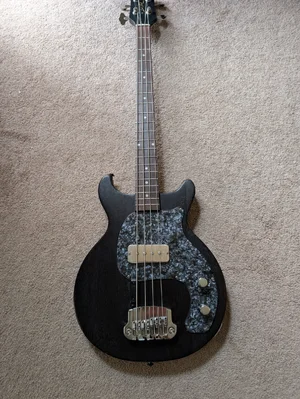
Q6 Update.
This is where I am after spending more time researching and hearing from people.
The Mule didn’t just “kind of work”, when it was set up and behaving, it actually played and sounded fantastic. The neck, spacing and balance were perfect for me.
What didn’t hold up was everything around it.
The tuners and bridge eventually gave out, and even before that, just getting strings on it was a problem. There weren’t proper 6‑string double‑ball sets at the time, so the only way to run it was cutting and soldering strings just to make a workable set.
Sure, you could play it, but it wasn’t something you could maintain or rely on long term.
It’s easy to see why. Adding that sixth string pushes everything harder. More tension, more load across the neck, more stress on hardware that was really designed around five strings. That’s probably why you don’t see this carried into the lighter XL or later Q2 bodies. They just couldn’t handle it.
The Mule being the heavier Q body actually makes a lot more sense; it needed the extra mass just to stay stable.
Interesting side note, an XL 6‑string conversion popped up, and by all accounts it plays and sounds great. But even there, the owner mentioned neck relief / bowing issues and ended up putting the 5‑string bridge back on it.
So it’s not really about whether it can be done.
It’s whether it can be done in a way that actually holds up.
And that's where the weak link was, the bridge.
Not tweaking one, not modifying something existing… actually building something that can handle six strings long term, stay stable, hold tuning, and still feel right to play.
Once you go there, you’re into new design, tooling, and real cost. The number that keeps floating around (secondhand, but consistent) is somewhere in the ~$20K range just to tool it properly. At that point, this stopped being a conceptual idea and became an engineering problem. That’s when the Mule was put out to pasture.
What’s interesting now is that the constraints that stopped it back then don’t necessarily exist in the same way anymore.
The Mule is now in the hands of Jeff Babicz, working alongside RWB Precision, to see if the hardware issues that originally halted the development of a 6 string Steinberger bass can finally be solved properly.
I’m excited to see where they take it.
Anyway — that’s where I’m leaving it for now.