• TalkBass has been independent since 1998. Add your voice.
    Create a free account to reply to discussions, view embedded media, and browse with fewer display ads.
    Join freeLog in
    Want zero display ads or expanded classifieds tools? Compare plans.

Precision and Tele bass wiring comparison

I have a Squier Telecaster bass (wide area Humbucker) that I have modified to have a regular split P type pickup. The Squier is passive with V/T controls, and the Humbucker is wired to have just 2 wire output. 2 wires are jumpered together.

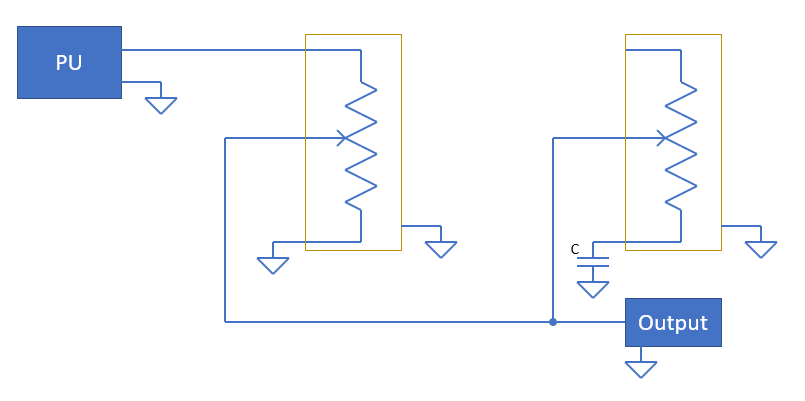
This is how I think the Squier is wired based on the photos I took:
1783885874610.png


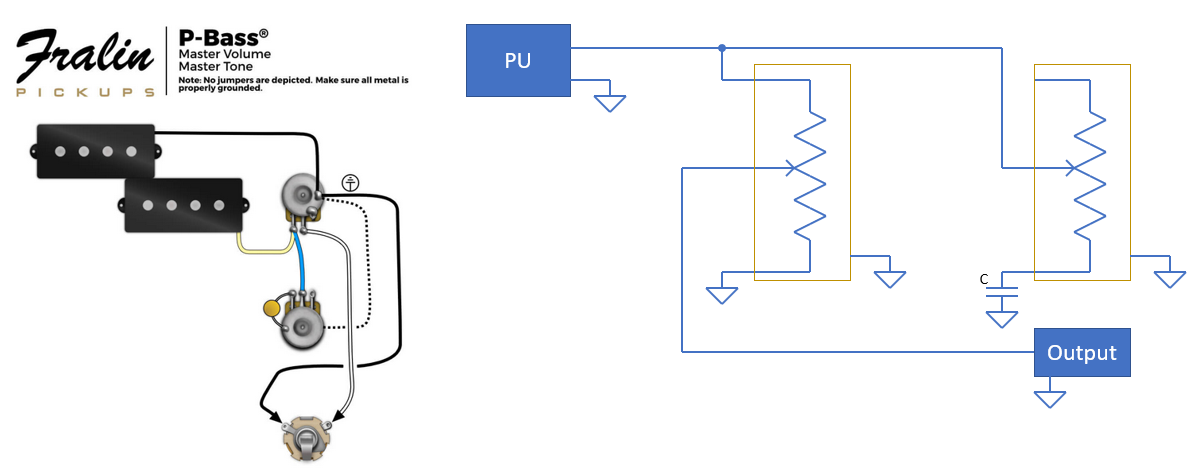
I looked at several standard P bass wiring diagrams and think they are normally wired this way:
1783885899635.png


I wired the split P just like the Humbucker was originally wired and thought it sounded a little different, so I started looking into these details.

I know the pickup doesn't behave like an ideal source, but if you think of it that simplified way, the Tele circuit divides down the signal and then conditions only the divide part with the Tone RC. The standard design conditions the signal directly from the pickup with the RC (the full signal) and then passes a divided down portion of that to the output.

Anyone know why Squier would use this circuit? The Tele bass is very "dark" - does this have something do with it? I haven't checked the C or R values (pots) so that may affect the sound. I'm thinking of switch it back over to the "standard" wiring for comparison but it's a bit of a hassle to disassemble.

Diamond Rio bassist Dana Williams

Thanks JnF and y’all! With almost 60 years of bass playing under my “strap,” and 30+ years playing 5 string almost exclusively, I still haven’t seen a Roscoe Beck in the wild. I’m not a chunky neck fan, so they’re probably not for me anyway. But they certainly sound great!
These didn’t seem all that easy to come across when Fender was making them, they seem almost impossible to find now.

Getting my 2nd Bass

Got the Sterling Ray35. Thank y'all!

Neck definitely feels faster than the BB735A. String spacing diff is barely noticeable lol.
Idk if its slimmer or fatter lol maybe a tad?
I've also read that the Ray35 is on the heavy side, tho its actually lighter than my BB735A.

Tone is wild lol! I normally use the same patch (on hx stomp) for my BB735A or a jazz bass but with Ray35, i had to make new ones lol.

Fender Modern Player Dimension Bass w/ Triplebucker

so am in the only person who liked this bass? the first time i tried it, i thought it sounded great - really great. after reading about how people feel about the triplebucker, it appears that i am one of the few or only people who thought it sounded good.

btw, i also think the bass looks great, particularly the almost black one, and the offset waist made it comfortable to play as i have problems with most long scale basses due to shoulder issues, but this one was a pain free experience.

so does anyone else like the fender modern player dimension bass with the triplebucker or is it just me?
I have a white one. I like the narrow jazz style neck and the tinted color. Also the tribucker gives you a huge range of sounds!
  • Like
Reactions: pcake

Help Identifying Old BBI Pickups

I've had these BBI pickups for quite a few years and am interested in finding out more about them. From what I've gathered, they're most likely BBI Hi-Teks from the 1980's, made by Barcus Berry. The Barcus Berry Hi-Teks are very popular with acoustic guitar and dobro players, but there's virtually no information out there about their electric guitar and bass pickups. Help me out, TB! :thumbsup:

IMG_8178.jpeg
IMG_8179.jpeg

Double Bass Looking for an issue of Bass Player

Sometime in the 1990s, I wrote a letter to Bass Player in response to an interview in a previous edition. I was responding to some famous player who had said that people should always play original music and not play other people's music. I responded that I loved being able to play various styles of music with lots of different people in lots of settings. I liked being a jack-of-all-trades. I think that it was in the mid-1990s. The byline was probably "Bob McKinney, Starkville, Mississippi." I don't suppose that any of you fine folks would be able to find it in your stash and send me a photo, would you? Many thanks!
Do you remember who was featured on the cover?

The neglected tone factor

Not sure if this is the forum for this, but I realized last night that the room has a far bigger effect on tone than expected. People fuss over tonewoods, pickups, strings, etc, but the space surely matters a lot also.
We jammed at a different house this week in a smaller, less sound-reflective room (carpeted for one thing). I used the same bass as the last 2 times at our usual place, with the same amp settings, but it sounded much better: rich, deep, but clear.
Admittedly, it's harder to control, but it was a nice experience.
I often shake my head(and sometimes laugh)at those players who harrumph and get all dagnabbity about amps that have more tonal options beyond bass and treble. They often say, “I can’t deal with twiddling a bunch of knobs”…well, how hard can that be? You only do it once, at sound check, and maybe make a slight adjustment later.

Every room is different, PA rigs have extensive EQ controls, and as bass sound is complicated in its own right, it’s advantageous to have those options, to sculp one’s sound, if need be. Better to have ‘em and not need them than the opposite. Primarily, aside from whatever sonic anomalies any given room has to offer, you have to paint around the screaming midrange of the guitars, and the boom of the kick drum, especially if the PA is not carrying the entire load. I’ve never understood this obsession with “flat”, either.
  • Like
Reactions: Sponson Thrisby

Spector performer fretboard repair

Someone’s selling a Spector Performer 5 that was converted to fretless. I’ve always wanted one of these basses and they are willing to let it go for 250. Just trying to feel out how difficult it would be for me to get the fretboard looking proper again. I hate that they didn’t stain the wood filler to match. How much of an effect would this have on the bass as far as playability? I don’t mind keeping it fretless if it plays nice and plan on trying it, but would a simple touch up pen from Home Depot be enough to stain this back to normal? How extensive of a repair would it be to make this fretted again? Any advice is appreciated. Is it worth the $250 in components alone?
Well that’s about the hackiest hack job on that fretboard I’ve seen but yeah you can try staining it and it’ll blend it in better. The professional approach would be to sand it all back and fill everything and then refinish but if it plays well and you want to refret it then it should be ok. Personally I’d probably just refret it and touch up the finish and play on. If you don’t like the end result you can find a neck to put in and it shouldn’t cost more than it would be to pay a luthier to fix the ugly.

Double Bass dampits

on the topic of hydrometers being inaccurate, for me the solution was to purchase a few. one relatively expensive one, two cheap ones.

it's not perfect but it gives 3x more information and you can tell the one that reads consistently low does just that.
obviously a really high-end one properly calibrated would be ideal, but I think buying several cheap ones from different brands is pretty reasonable.

on the topic of dampits, I sort of agreed with what seemed to be the advise some years ago that if it ever drips inside the bass it'll cause real damage and they're generally more trouble than they're worth.

i've always just been very careful about humidity at home (in new york) and in ~20 years of caring for double basses I can only recall having one open seam - on a finicky old german flatback.

Filled-in for bassist last night

So Anyway, sounds like your efforts paid off.

One of my buddies has an old Vantage bass, but he says it's not one of the models that would bring a high price if he sold it. I used to play it at rehearsals.
It's a nice bass...and I didn't have to bring my own. :cool:
I remember Vantage basses. This is a VINTAGE Pro Shop Custom.
  • Like
Reactions: Hurricane Jimmie

Epiphany: I've been playing my 5 like a 4 with an extra string

The E on the fifth fret sounds fatter than the open E and I use it way more. Many people think all you've got is 5 more notes below E. There's much more to it than that. Your fretting hand can access notes across the neck instead of moving along the neck. I play above the fifth fret a lot because it gives me greater access. Try playing a two octave E scale and you'll soon see how 5 strings makes some things much easier.
You also get nice fat grace notes below when you're playing in E or G and drop downs to the low C# from A sounds great. I use the B string a lot.
I've seen some 5 players mainly go to the B when they want to accentuate something on the bottom. That string definitely has a different sound, and anything played on it sticks out.

It's almost the reverse of how upright players use their G string, which has greater clarity, and sings out from the rest of what they are playing on the lower strings.

That said, I'm happy with my 4, even happier with my fretless 4.

Double Bass Upright bass fingerboard

I started on a fingerboard using a length of hardwood flooring timber from the local hardware shop. It's not that hard. I used a Stanley no.6 handplane to get a straight reference. 3 flat sections, one in the centre and two either side as a start to the curved finger board. Once you get these sections flat use a scraper to work in the scoop. Cut 4 notches at the nut end and 4 at the wide end to hold a strong thick bit of cotton about the line the strings will take. A weight on the end of the cotton allows you to check quickly between scrapes. If you want say 2mm of scoop overall you can use the fact that the clearance under a straight edge reduces as the square of its length. IE if the finger board is 840mm long you will expect 0.5 of a mm under a 420mm straight edge. At any position if you want even scoop. I used shorter straight edges than that even. Shine a lamp on a white background to see the gap. You can get a feeler gauge from the auto spares shop. You aim for the same gap as you move up and down the finger board. Plenty of youtubes on how to tune a handplane and how to sharpen and burnish the edge of a scraper.

I made the finger board just over 20mm thick, the same as my reference double bass, a Stentor 1950. I've got just under 2mm of scoop measured at the 7th fret E string, the Stentor is just over 2mm. Just under 1mm under the G string, the Stentor is also 2mm here. (I'd read somewhere you need less scoop under the lighter strings).

Then I needed somewhere to test it. Edgar Russ Violin maker of Distinction has a youtube video on timbers for violin family instruments. Violins need to be made from Spruce from the north side of trees from a certain altitude in the mountains of Cremorne. He said it becomes less critical as you go up in size. "By the time you get to double bass you can make them out of anything". So I built a double-bass-shaped object out of plywood. I suspect he is right. I've set the height of strings at the 7th fret to 5mm E string and 4 mm G string. a bit of buzz with any less, and they sound better with a bit more height. Strings make all the difference, D'Addario helicore pizzicato. I recycled the old ones from the Stentor. They say double bass strings are expensive but they last. No they don't. One and a half years on the Stentor, what a difference new strings make!

Favorite P Bass With Flats Recordings?

I was expecting to see only James Jamerson, Bob Babbitt, "Duck" Dunn, Carol Kaye, and other old school R&B bassists on this thread. But you're speaking my language as a metalhead! As much as I personally don't like Roto 77s, there's no denying that Steve Harris played all of Iron Maiden's bass lines on a P Bass with flats.

Here are my picks:
Login to view embedded media
  • Like
Reactions: Vinny_G and Crackle

Latest Classifieds

Up for sale is a 1965 German made (Rubner), Double Bass, 3/4 sized, valued at $18,000 AUD in excellent condition.
AU$18,000.00
Location
Melbourne Victoria, Australia
For sale Nordymutes
Two Nordymutes for sale
$40.00
1 watching
Location
Charlotte North Carolina, United States
5 strings Multiscale J bass with active preamp
$700.00
1 watching
Location
Dallas Texas, United States
Gretsch humbucker
$50.00
Location
Charlotte North Carolina, United States
APeterson (+23 /0 /-0)
Expires
Views
22
This is an outstanding amp in excellent condition - very musical clean sound with with plenty of punch and headroom. Reluctantly releasing this...
$1,099.00
3 watching
Location
Bloomington Illinois, United States

Filter