What a killer Monster!!!

TalkBass has been independent since 1998. Add your voice.
Create a free account to reply to discussions, view embedded media, and browse with fewer display ads.
Join free Log in
Want zero display ads or expanded classifieds tools? Compare plans.
What a killer Monster!!!
NOW THATS A AMP PEOPLE!!!!!Reiner Amplification Saturn V #02 flat out the best amp I have ever owned, and I've owned a lot!
Specs lifted from the FB page
Specs:
- All tube, high voltage, hand-wired, shock-mounted, low noise, original preamp design with active four-band, tube-driven inductor EQ
- Premium Jensen DI with pre/post and ground/lift.
- 10 lbs 4 oz, compact (chassis is ~12”x12”x3”)
- 600 watts RMS at 8 ohms, 1200 watts RMS at 4 ohms @1% THD+N, 20Hz-20kHz
- STABLE to 2 ohm
- Hand-built in U.S.A., premium construction throughout (teflon wire, stainless hardware with nylock nuts, Switchcraft and Neutrik jacks, premium capacitors, Tung Sol and JJ gold pin tubes with dampers, metal film resistors)
View attachment 3621913 View attachment 3621914 View attachment 3621915


My latest, Ampeg SVT-PRO 6.
View attachment 4237949 View attachment 4237950 View attachment 4237951 View attachment 4237952
- RMS Power Output (8 Ohms): 750-Watts.
- RMS Power Output (4 Ohms): 1100-Watts.
- Preamp: Tubes (2 x 12AX7)
- Driver Tubes: 2 x 12AU7, 2 x 12AX7.
- Power Amp: Solid State.
- Tone Controls: Bass and Treble.
- Mid Tone Control: 4-Band Semi-Parametric.
- Ultra Low/High Boosts: Yes

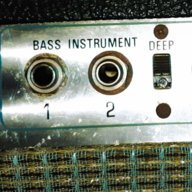
I think it was just a cosmetic revamping, Traynor is a brand own by Yorkville.Hey, that looks eerily similar to the Yorkville XS400H!And yeah, it sure does sound good. The tube drive is really versatile with the separate gain, drive and blend.
View attachment 3951048


My latest, Ampeg SVT-PRO 6.
- RMS Power Output (8 Ohms): 750-Watts.
- RMS Power Output (4 Ohms): 1100-Watts.
- Preamp: Tubes (2 x 12AX7)
- Driver Tubes: 2 x 12AU7, 2 x 12AX7.
- Power Amp: Solid State.
- Tone Controls: Bass and Treble.
- Mid Tone Control: 4-Band Semi-Parametric.
- Ultra Low/High Boosts: Yes
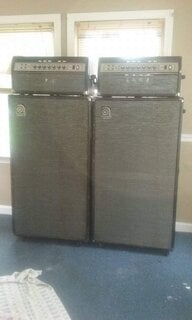
I lot of grunge at the top right. That would drive me nuts.

Ha, the SVT-Pro 6... Did you had the fan issue?
Mine had a failed fan speed regulator and apparently it was a common unresolved issue.
Also, I kind of miss his power but I sold it because i found the EQ useless and the sound too dark.







There's a lot to be said for simplicity. Right on.I'll do the comic relief.... Peavey Minx 110.
100% serviceable, from simpler days.
View attachment 4467650