• TalkBass has been independent since 1998. Add your voice.
    Create a free account to reply to discussions, view embedded media, and browse with fewer display ads.
    Join freeLog in
    Want zero display ads or expanded classifieds tools? Compare plans.

Are used costs hurting our community?

I build guitars and basses, but it's not something that I can do to support myself. There's just not a lot of money in it and too much competition.

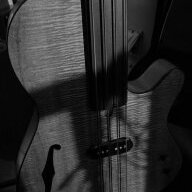
I built this a while back:
View attachment 4071344

If I sold it for $2500.00, I'd be making about 22 bucks an hour. That's not full time pay either, that's for this piece, and I'd have to sell them consistently all year to make money. Ive found most people haven't got the first clue what it takes to build, how much is involved and what the real costs are. If anything has devalued the market, its buying cheaply made items with overseas labor and charging regular made in the USA prices for them.

So this is actually a good post to use as a jumping off point for generalized discussion.

Depending on skill level, that bass could take more or less time. More skill equals less time, so if you hold the price and quality of the bass constant, then the person who has higher skills makes more than the person with lower skills.

Then there are economies of scale - if you are cranking out a lot, you can get better deals on wood, tools, etc. The more you make, the better your margins are.

Of course, not all parts of the job require the same level of skill. Instead of having a skilled woodworker stringing it, or putting on knobs or tuners, you could have a lower skill person doing that. Again, here is where size helps.

But shift to the buyers' side of things. Can I get a bass of equal quality for less? Can I get a bass of lower quality for less, where the decrease in quality relates to thinks I don't actually care about?

At the end of the day, your ability to command $22 an hour is dependent on the buyers. Someone has to want to pay you $2500 for that bass...and if they don't, your choice is to accept less or eat the cost of labor and materials.

None of this takes into account the capital you put at risk, nor other fixed costs you might have.

At the end of the day, you hope that there is enough of a market for the instrument you make, but there is the real potential for excess capacity. The only way to resolve it is for people to either fail or to cut back production.

I have no idea whether the boutique market is a viable business model, and who will thrive and who will fail. My main point here is that efficiency and scale are your friends, but excess capacity relative to demand can still sink you.
 
I think something to consider too beyond the obvious skill labour of smaller builders and needing to be compensated, tools don't magically get cheaper scaled down from a full production factory. That's a lot of upfront cost for builders and when many of them aren't moving at volume we have to consider that. FMIC and other production factories will always have a scale to cost advantage so we can't expect any builder to match.
 
I would like people's opinion on the subject.
Today scrolling through the classifieds.... I think about how much builders are charging for instruments based on resale. I believe we Basses builders to charge ridiculous prices for their work by over pricing the used market.
Same as always.
Used basses with good prices are selling.
Overpriced used basses are not.
I can't even count how many sellers have basses lingering on Reverb, for example, month after month after month.
When they end the sale and relist, the same thing happens.
Great used basses are available for the right price time and time again.
I just bought the bargain of the year and had to put off buying another incredible deal this past month.
New basses sell for what the sellers think they're worth, not for what they might be worth used and certainly not based on what other used basses are or are not selling for.
 
Last edited:
Absolutely. These are nonessential items and people should price them however they wish. If the prices were actually ridiculous no one would buy them. The markup on them is far less than countless things we take for granted, and why shouldn't a master craftsman who has spent decades honing their craft make a fair amount of profit for their hard work?

These sorts of threads are always funny to me- makes me wonder how person A who complains about instrument prices would feel if person B started a thread saying A doesn't deserve the money they make and the should be paid less.

+1
 
If you really want to get into the subject of how we small builders price our instruments, and how much money we make, here's a classic old thread from 2012 (!):

How much should a custom luthier make per hour?

Here's my main post from the thread, on page 6. There's a lot of great discussion in there, including posts from Fodera.

I'm a pro Luthier/Builder. Most of you would consider me successful at it. I've been doing it nearly full time for 21 years, I have a good reputation, and I usually have a waiting list for my basses and services. But let me enlighten you with the ugly financial reality of this business. The net income numbers some of you are tossing around are pure fantasy. Most of us Luthiers make a net hourly pay less than minimum wage. When I visit my tax accountant every year, he shakes his head and tells me to shut it down and go get a real job. I'm not kidding.

First things first: I've set a basic rate of $45 per hour. This is not my "pay", it's what's called an Hourly Composite Rate for the business. I need to make an average of about $30 per hour for 40 hours per week, just to pay the overhead (rent on my building, utilities, insurance, etc.). Those are fixed costs that have to be paid each month. So, if I charge $45 per hour, and complete 40 hours of Billable Work (see below) in a week, my actual pay is really only $15 per hour. That's $600 per week, which is less than most people with real jobs make.

But here's the missing part: Trying to complete 40 hours of Billable Work in a week is much, much harder than it first appears. I only get paid $45 per hour for time spent actually at the bench, working on an instrument to be sold. I don't get paid anything for answering the door, talking on the phone to customers, writing e-mails, writing on forums, sweeping the floor, sorting lumber stock, ordering parts, driving to the lumber yard, etc., etc. I get paid $0 per hour for all that time, but yet it's all completely necessary to run the business.

For those of you who've never run your own business, that's the fundamental difference between having a job and working for yourself. At a job, you automatically get money for every hour that you are there, almost regardless of what you do or how hard you work or how many parts you successfully make. Working for yourself, how much you make per hour is completely dependent on how many parts you successfully complete per week. You can seemingly bust ass all week and end up making almost nothing. In reality, I work about 80 hours per week, every week, and I'm doing well if I actually complete 40 hours of billable work. That's a 50% ratio of Billable hours to Total hours, which isn't bad for a small business. Many small businesses have a much lower ratio than that, like 20%-30%. But what it means to me is that I actually get paid only $7.50 per hour, for all those hours, and only if I complete those 40 hours of billable work.

Now, most "real" businesses charge a much higher hourly rate. For example, most small auto repair shops charge $75-$100 per hour. The mechanic working there makes $20 per hour if he's good. The rest of it is for the fixed overhead costs and that ratio of Billable Hours to Total Hours, like I described above. By any standard small business model, I should be charging $75-$100 per hour. When you think about it, my business is very similar to an auto repair shop in the size and costs. My next door neighbor used to be a one-man Porsche repair shop, and we used to compare notes. He charged $75 per hour, which he said was the minimum he needed to pay the overhead and take home a modest wage for himself. He thought I was completely nuts to be only charging $45 per hour. I mean, we had identical size shops, with the same overhead rates. I'm older than him with much more education and experience. I even used to be a Porsche mechanic!

Okay, so why don't I charge $75-$100 per hour, like I really should? Because you guys (the customers) won't pay that much. It's as simple as that.

Look at it from the cost side:
A hand-made custom bass neck takes 8-12 hours to build. I'm not speculating. I've built hundreds of them, and I keep very accurate time records. The raw materials (wood, metal, and fretwire) cost about $60. So, at $45/hr plus materials, I price a 10 hour neck at $510 plus shipping. That's just for a basic custom bass neck. If I charged $75/hr, it would be $810. At $100/hr, it would be $1060. So, how many of you would pay $1060 for a custom neck? Just about none. But is that unreasonable? It's the same quality of neck that you'd find on a $2000-$3000 bass. But if you read TB, you'd know that any neck over $250 is waaaay overpriced and not worth it. That's the way this business is. Most instrument customers are completely spoiled by two decades of very cheap imports, and don't appreciate the work and costs that go into building a custom bass. That's the main reason why I no longer build custom necks at the retail level. It doesn't make any sense financially.

Full instruments are the same way. My new AMB-2 Scroll Bass, which I've just developed and introduced this year, takes me about 60 hours each to build. The materials costs are $320: (Case: $110; wood: $50; metal: $30; purchased hardware: $90; plating: $40). So, with those materials costs and charging $45/hr, I need to sell them for $3000. That's about right for the market (I hope!), in terms of what customers are willing to pay. But at $75/hr, I'd have to get $4820, and at $100/hr I'd have to get $6320. It would be very hard to sell them at those prices.

And that's my simpler, lower-priced model. My fancy Series IV AUB-2 models that I built from 2006-2011 took 110 hours to build with about $400 in materials. I was selling them for $3900 and losing my ass on every one. That's why I stopped building them. If I priced them at $100/hr, they would be $11,400. That's nice to dream about, but not realistic.

Now, I'm a little unusual as a builder, because I build almost everything myself. I make most of my own metal hardware (bridges, tailpieces, etc.), plus I build my own pickups from scratch, and do all my own painting, in addition to the woodworking. So, my cost numbers have higher labor hours and lower materials costs than most builders. If I were to offer a custom made high-end Fender-like bass, using purchased hardware and pickups, and still painting it myself, the costs would be around $700 for materials and 35 hours labor. At $45/hr, I'd have to sell it for $2275. To me, that's about as low as you can go, a minimum realistic price for a custom made, basic pattern instrument. To me, any builder who sells for less than that hasn't really counted up the labor hours. Or they have a shop situation with no overhead. More likely, they are trying to set their prices based on what customers are telling them, and not understanding how much money they are losing.

Again, that's the nature of the business. Being a Luthier is a "Glamour" business. Lots of guys want to do it because it looks like fun. And it is fun and rewarding building basses. As a hobby or a tax-writeoff sideline. But trying to do it as a rational business to make a living from is just nuts. The finances don't add up.

If all of the above isn't depressing enough, that all assumes that everything goes great. Unfortunately, this business also has an enormous risk factor. When building an instrument, there are hundreds of ways that you can make a small mistake, and end up ruining weeks or months of work. A small slip in a router fixture, a bad piece of wood, misreading a dimension, dropping a tool on a finished paint job, forgetting some feature that the customer asked for, etc., etc. These tiny things can instantly cost you an entire weeks' worth of billable hours, or more. Remember, this is a fixed-price business. If I agree to build you an AMB-2 for $3000, that's assuming that it's going to take me 60 hours to build. But that's the best case scenario, with no mistakes. If I get a couple of spots of contaminant in my spray gun and end up having to repaint it twice to get it right (a true story), I end up spending 90 hours on that instrument. And nobody is going to pay for those extra 30 hours. While I'm repairing that damage, I'm not working on other billable hour jobs. And the overall problem is that there are so many fussy steps involved in building an instrument, that it's nearly impossible to go all the way through the process without making any mistakes. Only after years of making the same instruments do you eliminate most of the mistakes. The financial penalties are huge, and you can easily get into a position where you've already lost so much money on an instrument that it seems pointless to finish it. If you know that you're going to make less than $5 per hour, and you still have a long way to go, is it even worth it? Meanwhile, the customer is calling you every day asking if it's done yet. See the thread about MikeysWood.

Also, custom build jobs always have ten times the potential for mistakes and labor over-runs. Trying to do custom builds on fixed prices is setting yourself up for huge losses. There are so many ways for things to go wrong and wipe out any money you would have made. That's why I stopped doing custom builds a long time ago. Happy customers, beautiful basses, and $5 per hour. Most Luthiers, if they survive more than a few years, eventually move to building only their own models with a fixed set of options.

I hope this helps you understand how the finances work in this business. And why we Luthiers can sometimes be cranky and evasive and refuse to answer the phone.

To go back to the original posters' question: Most small shop electric bass Luthiers effectively charge $35-$45 per hour. That's driven by the market; what customers are willing to pay. Established guys like me get "paid" $15 per hour at best. Guys getting started are usually making approximately nothing. You can usually make better money just doing repairs, with some careful management. The setup guy at Guitar Center makes more than I do.

So, you're probably wondering why I keep doing this. In 1995 I was making 100K at a corporate job. Last year, I busted ass all year and grossed about 55K. On paper, my "pay" was less than 5K, for the whole year! I barely paid the overhead and the groceries each month. I work 7 days a week and hardly have any money left over to play with. I couldn't possibly support a family or a wife doing this. But I'm okay with that. I'm a hermit mad scientist wacko type, and I've chosen this lifestyle. It's just me and my dog, in a building full of machines, making cool stuff day and night. This is how I want to spend the rest of my life.​
 
So this is actually a good post to use as a jumping off point for generalized discussion.

Depending on skill level, that bass could take more or less time. More skill equals less time, so if you hold the price and quality of the bass constant, then the person who has higher skills makes more than the person with lower skills.

Then there are economies of scale - if you are cranking out a lot, you can get better deals on wood, tools, etc. The more you make, the better your margins are.

Of course, not all parts of the job require the same level of skill. Instead of having a skilled woodworker stringing it, or putting on knobs or tuners, you could have a lower skill person doing that. Again, here is where size helps.

But shift to the buyers' side of things. Can I get a bass of equal quality for less? Can I get a bass of lower quality for less, where the decrease in quality relates to thinks I don't actually care about?

At the end of the day, your ability to command $22 an hour is dependent on the buyers. Someone has to want to pay you $2500 for that bass...and if they don't, your choice is to accept less or eat the cost of labor and materials.

None of this takes into account the capital you put at risk, nor other fixed costs you might have.

At the end of the day, you hope that there is enough of a market for the instrument you make, but there is the real potential for excess capacity. The only way to resolve it is for people to either fail or to cut back production.

I have no idea whether the boutique market is a viable business model, and who will thrive and who will fail. My main point here is that efficiency and scale are your friends, but excess capacity relative to demand can still sink you.
This seems like it has face validity, but it's pretty academic. The real issue is that our labour is of no comparison to labour overseas. My time is actually worth closer to 40 dollars an hour, but the same labour can be had over there for less than 2 bucks an hour. You can work on economy of scale all you like, its the labour that makes or breaks it. :(
 
Could have to do with shipping. Kind of hard for a buyer or seller to justify $100 shipping on a $400 bass.

This is a fact. Shipping a bass in HSC is $100 give or take $10. People buying one need to realize they are not big corporations like GC etc who can do free shipping, as in - the seller would eat that $100 if "fee shipping" was offered. If that the turns someone off - so be it. The seller shouldn't give their stuff away.
 
Last edited:
  • Like
Reactions: Jefenator
I read a thing on here a while back where a boutique builder broke down all the costs it took him to make the bass plus the hours he had to put in and for something like a 3000 dollar bass he was only making like 7 dollars an hour. Kinda changed my whole perspective on how expensive boutique basses are. That being said, pretty sure brands like Fender and Ernie Ball don't have to charge 2k for some of their instruments, but like other people have said here, cost is driven by the price that people are willing to pay.
 
If you really want to get into the subject of how we small builders price our instruments, and how much money we make, here's a classic old thread from 2012 (!):

How much should a custom luthier make per hour?

Here's my main post from the thread, on page 6. There's a lot of great discussion in there, including posts from Fodera.

I'm a pro Luthier/Builder. Most of you would consider me successful at it. I've been doing it nearly full time for 21 years, I have a good reputation, and I usually have a waiting list for my basses and services. But let me enlighten you with the ugly financial reality of this business. The net income numbers some of you are tossing around are pure fantasy. Most of us Luthiers make a net hourly pay less than minimum wage. When I visit my tax accountant every year, he shakes his head and tells me to shut it down and go get a real job. I'm not kidding.

First things first: I've set a basic rate of $45 per hour. This is not my "pay", it's what's called an Hourly Composite Rate for the business. I need to make an average of about $30 per hour for 40 hours per week, just to pay the overhead (rent on my building, utilities, insurance, etc.). Those are fixed costs that have to be paid each month. So, if I charge $45 per hour, and complete 40 hours of Billable Work (see below) in a week, my actual pay is really only $15 per hour. That's $600 per week, which is less than most people with real jobs make.

But here's the missing part: Trying to complete 40 hours of Billable Work in a week is much, much harder than it first appears. I only get paid $45 per hour for time spent actually at the bench, working on an instrument to be sold. I don't get paid anything for answering the door, talking on the phone to customers, writing e-mails, writing on forums, sweeping the floor, sorting lumber stock, ordering parts, driving to the lumber yard, etc., etc. I get paid $0 per hour for all that time, but yet it's all completely necessary to run the business.

For those of you who've never run your own business, that's the fundamental difference between having a job and working for yourself. At a job, you automatically get money for every hour that you are there, almost regardless of what you do or how hard you work or how many parts you successfully make. Working for yourself, how much you make per hour is completely dependent on how many parts you successfully complete per week. You can seemingly bust ass all week and end up making almost nothing. In reality, I work about 80 hours per week, every week, and I'm doing well if I actually complete 40 hours of billable work. That's a 50% ratio of Billable hours to Total hours, which isn't bad for a small business. Many small businesses have a much lower ratio than that, like 20%-30%. But what it means to me is that I actually get paid only $7.50 per hour, for all those hours, and only if I complete those 40 hours of billable work.

Now, most "real" businesses charge a much higher hourly rate. For example, most small auto repair shops charge $75-$100 per hour. The mechanic working there makes $20 per hour if he's good. The rest of it is for the fixed overhead costs and that ratio of Billable Hours to Total Hours, like I described above. By any standard small business model, I should be charging $75-$100 per hour. When you think about it, my business is very similar to an auto repair shop in the size and costs. My next door neighbor used to be a one-man Porsche repair shop, and we used to compare notes. He charged $75 per hour, which he said was the minimum he needed to pay the overhead and take home a modest wage for himself. He thought I was completely nuts to be only charging $45 per hour. I mean, we had identical size shops, with the same overhead rates. I'm older than him with much more education and experience. I even used to be a Porsche mechanic!

Okay, so why don't I charge $75-$100 per hour, like I really should? Because you guys (the customers) won't pay that much. It's as simple as that.

Look at it from the cost side:
A hand-made custom bass neck takes 8-12 hours to build. I'm not speculating. I've built hundreds of them, and I keep very accurate time records. The raw materials (wood, metal, and fretwire) cost about $60. So, at $45/hr plus materials, I price a 10 hour neck at $510 plus shipping. That's just for a basic custom bass neck. If I charged $75/hr, it would be $810. At $100/hr, it would be $1060. So, how many of you would pay $1060 for a custom neck? Just about none. But is that unreasonable? It's the same quality of neck that you'd find on a $2000-$3000 bass. But if you read TB, you'd know that any neck over $250 is waaaay overpriced and not worth it. That's the way this business is. Most instrument customers are completely spoiled by two decades of very cheap imports, and don't appreciate the work and costs that go into building a custom bass. That's the main reason why I no longer build custom necks at the retail level. It doesn't make any sense financially.

Full instruments are the same way. My new AMB-2 Scroll Bass, which I've just developed and introduced this year, takes me about 60 hours each to build. The materials costs are $320: (Case: $110; wood: $50; metal: $30; purchased hardware: $90; plating: $40). So, with those materials costs and charging $45/hr, I need to sell them for $3000. That's about right for the market (I hope!), in terms of what customers are willing to pay. But at $75/hr, I'd have to get $4820, and at $100/hr I'd have to get $6320. It would be very hard to sell them at those prices.

And that's my simpler, lower-priced model. My fancy Series IV AUB-2 models that I built from 2006-2011 took 110 hours to build with about $400 in materials. I was selling them for $3900 and losing my ass on every one. That's why I stopped building them. If I priced them at $100/hr, they would be $11,400. That's nice to dream about, but not realistic.

Now, I'm a little unusual as a builder, because I build almost everything myself. I make most of my own metal hardware (bridges, tailpieces, etc.), plus I build my own pickups from scratch, and do all my own painting, in addition to the woodworking. So, my cost numbers have higher labor hours and lower materials costs than most builders. If I were to offer a custom made high-end Fender-like bass, using purchased hardware and pickups, and still painting it myself, the costs would be around $700 for materials and 35 hours labor. At $45/hr, I'd have to sell it for $2275. To me, that's about as low as you can go, a minimum realistic price for a custom made, basic pattern instrument. To me, any builder who sells for less than that hasn't really counted up the labor hours. Or they have a shop situation with no overhead. More likely, they are trying to set their prices based on what customers are telling them, and not understanding how much money they are losing.

Again, that's the nature of the business. Being a Luthier is a "Glamour" business. Lots of guys want to do it because it looks like fun. And it is fun and rewarding building basses. As a hobby or a tax-writeoff sideline. But trying to do it as a rational business to make a living from is just nuts. The finances don't add up.

If all of the above isn't depressing enough, that all assumes that everything goes great. Unfortunately, this business also has an enormous risk factor. When building an instrument, there are hundreds of ways that you can make a small mistake, and end up ruining weeks or months of work. A small slip in a router fixture, a bad piece of wood, misreading a dimension, dropping a tool on a finished paint job, forgetting some feature that the customer asked for, etc., etc. These tiny things can instantly cost you an entire weeks' worth of billable hours, or more. Remember, this is a fixed-price business. If I agree to build you an AMB-2 for $3000, that's assuming that it's going to take me 60 hours to build. But that's the best case scenario, with no mistakes. If I get a couple of spots of contaminant in my spray gun and end up having to repaint it twice to get it right (a true story), I end up spending 90 hours on that instrument. And nobody is going to pay for those extra 30 hours. While I'm repairing that damage, I'm not working on other billable hour jobs. And the overall problem is that there are so many fussy steps involved in building an instrument, that it's nearly impossible to go all the way through the process without making any mistakes. Only after years of making the same instruments do you eliminate most of the mistakes. The financial penalties are huge, and you can easily get into a position where you've already lost so much money on an instrument that it seems pointless to finish it. If you know that you're going to make less than $5 per hour, and you still have a long way to go, is it even worth it? Meanwhile, the customer is calling you every day asking if it's done yet. See the thread about MikeysWood.

Also, custom build jobs always have ten times the potential for mistakes and labor over-runs. Trying to do custom builds on fixed prices is setting yourself up for huge losses. There are so many ways for things to go wrong and wipe out any money you would have made. That's why I stopped doing custom builds a long time ago. Happy customers, beautiful basses, and $5 per hour. Most Luthiers, if they survive more than a few years, eventually move to building only their own models with a fixed set of options.

I hope this helps you understand how the finances work in this business. And why we Luthiers can sometimes be cranky and evasive and refuse to answer the phone.

To go back to the original posters' question: Most small shop electric bass Luthiers effectively charge $35-$45 per hour. That's driven by the market; what customers are willing to pay. Established guys like me get "paid" $15 per hour at best. Guys getting started are usually making approximately nothing. You can usually make better money just doing repairs, with some careful management. The setup guy at Guitar Center makes more than I do.

So, you're probably wondering why I keep doing this. In 1995 I was making 100K at a corporate job. Last year, I busted ass all year and grossed about 55K. On paper, my "pay" was less than 5K, for the whole year! I barely paid the overhead and the groceries each month. I work 7 days a week and hardly have any money left over to play with. I couldn't possibly support a family or a wife doing this. But I'm okay with that. I'm a hermit mad scientist wacko type, and I've chosen this lifestyle. It's just me and my dog, in a building full of machines, making cool stuff day and night. This is how I want to spend the rest of my life.​
Fascinating read!
 
The correlation between cost to purchase and and the rarity/talent level/dedication/ difficulty/risk/overall cost of providing a good or service is loose and occasional. The market exerts forces, but they are neither moral nor consistent.
 
  • Like
Reactions: mikewalker
If you really want to get into the subject of how we small builders price our instruments, and how much money we make, here's a classic old thread from 2012 (!):

How much should a custom luthier make per hour?

Here's my main post from the thread, on page 6. There's a lot of great discussion in there, including posts from Fodera.

I'm a pro Luthier/Builder. Most of you would consider me successful at it. I've been doing it nearly full time for 21 years, I have a good reputation, and I usually have a waiting list for my basses and services. But let me enlighten you with the ugly financial reality of this business. The net income numbers some of you are tossing around are pure fantasy. Most of us Luthiers make a net hourly pay less than minimum wage. When I visit my tax accountant every year, he shakes his head and tells me to shut it down and go get a real job. I'm not kidding.

First things first: I've set a basic rate of $45 per hour. This is not my "pay", it's what's called an Hourly Composite Rate for the business. I need to make an average of about $30 per hour for 40 hours per week, just to pay the overhead (rent on my building, utilities, insurance, etc.). Those are fixed costs that have to be paid each month. So, if I charge $45 per hour, and complete 40 hours of Billable Work (see below) in a week, my actual pay is really only $15 per hour. That's $600 per week, which is less than most people with real jobs make.

But here's the missing part: Trying to complete 40 hours of Billable Work in a week is much, much harder than it first appears. I only get paid $45 per hour for time spent actually at the bench, working on an instrument to be sold. I don't get paid anything for answering the door, talking on the phone to customers, writing e-mails, writing on forums, sweeping the floor, sorting lumber stock, ordering parts, driving to the lumber yard, etc., etc. I get paid $0 per hour for all that time, but yet it's all completely necessary to run the business.

For those of you who've never run your own business, that's the fundamental difference between having a job and working for yourself. At a job, you automatically get money for every hour that you are there, almost regardless of what you do or how hard you work or how many parts you successfully make. Working for yourself, how much you make per hour is completely dependent on how many parts you successfully complete per week. You can seemingly bust ass all week and end up making almost nothing. In reality, I work about 80 hours per week, every week, and I'm doing well if I actually complete 40 hours of billable work. That's a 50% ratio of Billable hours to Total hours, which isn't bad for a small business. Many small businesses have a much lower ratio than that, like 20%-30%. But what it means to me is that I actually get paid only $7.50 per hour, for all those hours, and only if I complete those 40 hours of billable work.

Now, most "real" businesses charge a much higher hourly rate. For example, most small auto repair shops charge $75-$100 per hour. The mechanic working there makes $20 per hour if he's good. The rest of it is for the fixed overhead costs and that ratio of Billable Hours to Total Hours, like I described above. By any standard small business model, I should be charging $75-$100 per hour. When you think about it, my business is very similar to an auto repair shop in the size and costs. My next door neighbor used to be a one-man Porsche repair shop, and we used to compare notes. He charged $75 per hour, which he said was the minimum he needed to pay the overhead and take home a modest wage for himself. He thought I was completely nuts to be only charging $45 per hour. I mean, we had identical size shops, with the same overhead rates. I'm older than him with much more education and experience. I even used to be a Porsche mechanic!

Okay, so why don't I charge $75-$100 per hour, like I really should? Because you guys (the customers) won't pay that much. It's as simple as that.

Look at it from the cost side:
A hand-made custom bass neck takes 8-12 hours to build. I'm not speculating. I've built hundreds of them, and I keep very accurate time records. The raw materials (wood, metal, and fretwire) cost about $60. So, at $45/hr plus materials, I price a 10 hour neck at $510 plus shipping. That's just for a basic custom bass neck. If I charged $75/hr, it would be $810. At $100/hr, it would be $1060. So, how many of you would pay $1060 for a custom neck? Just about none. But is that unreasonable? It's the same quality of neck that you'd find on a $2000-$3000 bass. But if you read TB, you'd know that any neck over $250 is waaaay overpriced and not worth it. That's the way this business is. Most instrument customers are completely spoiled by two decades of very cheap imports, and don't appreciate the work and costs that go into building a custom bass. That's the main reason why I no longer build custom necks at the retail level. It doesn't make any sense financially.

Full instruments are the same way. My new AMB-2 Scroll Bass, which I've just developed and introduced this year, takes me about 60 hours each to build. The materials costs are $320: (Case: $110; wood: $50; metal: $30; purchased hardware: $90; plating: $40). So, with those materials costs and charging $45/hr, I need to sell them for $3000. That's about right for the market (I hope!), in terms of what customers are willing to pay. But at $75/hr, I'd have to get $4820, and at $100/hr I'd have to get $6320. It would be very hard to sell them at those prices.

And that's my simpler, lower-priced model. My fancy Series IV AUB-2 models that I built from 2006-2011 took 110 hours to build with about $400 in materials. I was selling them for $3900 and losing my ass on every one. That's why I stopped building them. If I priced them at $100/hr, they would be $11,400. That's nice to dream about, but not realistic.

Now, I'm a little unusual as a builder, because I build almost everything myself. I make most of my own metal hardware (bridges, tailpieces, etc.), plus I build my own pickups from scratch, and do all my own painting, in addition to the woodworking. So, my cost numbers have higher labor hours and lower materials costs than most builders. If I were to offer a custom made high-end Fender-like bass, using purchased hardware and pickups, and still painting it myself, the costs would be around $700 for materials and 35 hours labor. At $45/hr, I'd have to sell it for $2275. To me, that's about as low as you can go, a minimum realistic price for a custom made, basic pattern instrument. To me, any builder who sells for less than that hasn't really counted up the labor hours. Or they have a shop situation with no overhead. More likely, they are trying to set their prices based on what customers are telling them, and not understanding how much money they are losing.

Again, that's the nature of the business. Being a Luthier is a "Glamour" business. Lots of guys want to do it because it looks like fun. And it is fun and rewarding building basses. As a hobby or a tax-writeoff sideline. But trying to do it as a rational business to make a living from is just nuts. The finances don't add up.

If all of the above isn't depressing enough, that all assumes that everything goes great. Unfortunately, this business also has an enormous risk factor. When building an instrument, there are hundreds of ways that you can make a small mistake, and end up ruining weeks or months of work. A small slip in a router fixture, a bad piece of wood, misreading a dimension, dropping a tool on a finished paint job, forgetting some feature that the customer asked for, etc., etc. These tiny things can instantly cost you an entire weeks' worth of billable hours, or more. Remember, this is a fixed-price business. If I agree to build you an AMB-2 for $3000, that's assuming that it's going to take me 60 hours to build. But that's the best case scenario, with no mistakes. If I get a couple of spots of contaminant in my spray gun and end up having to repaint it twice to get it right (a true story), I end up spending 90 hours on that instrument. And nobody is going to pay for those extra 30 hours. While I'm repairing that damage, I'm not working on other billable hour jobs. And the overall problem is that there are so many fussy steps involved in building an instrument, that it's nearly impossible to go all the way through the process without making any mistakes. Only after years of making the same instruments do you eliminate most of the mistakes. The financial penalties are huge, and you can easily get into a position where you've already lost so much money on an instrument that it seems pointless to finish it. If you know that you're going to make less than $5 per hour, and you still have a long way to go, is it even worth it? Meanwhile, the customer is calling you every day asking if it's done yet. See the thread about MikeysWood.

Also, custom build jobs always have ten times the potential for mistakes and labor over-runs. Trying to do custom builds on fixed prices is setting yourself up for huge losses. There are so many ways for things to go wrong and wipe out any money you would have made. That's why I stopped doing custom builds a long time ago. Happy customers, beautiful basses, and $5 per hour. Most Luthiers, if they survive more than a few years, eventually move to building only their own models with a fixed set of options.

I hope this helps you understand how the finances work in this business. And why we Luthiers can sometimes be cranky and evasive and refuse to answer the phone.

To go back to the original posters' question: Most small shop electric bass Luthiers effectively charge $35-$45 per hour. That's driven by the market; what customers are willing to pay. Established guys like me get "paid" $15 per hour at best. Guys getting started are usually making approximately nothing. You can usually make better money just doing repairs, with some careful management. The setup guy at Guitar Center makes more than I do.

So, you're probably wondering why I keep doing this. In 1995 I was making 100K at a corporate job. Last year, I busted ass all year and grossed about 55K. On paper, my "pay" was less than 5K, for the whole year! I barely paid the overhead and the groceries each month. I work 7 days a week and hardly have any money left over to play with. I couldn't possibly support a family or a wife doing this. But I'm okay with that. I'm a hermit mad scientist wacko type, and I've chosen this lifestyle. It's just me and my dog, in a building full of machines, making cool stuff day and night. This is how I want to spend the rest of my life.​
I would consider charging $60 an hour...i agree on repairs and setups as there are plenty of basses sitting around unplayed because they lack a good setup (which likely involves fret dress).

Otoh, i read about super cheap basses with solid setups for under $100!! How can any business compete with that! Its the Amazon world we live in (not me i avoid it when i can and buy used basses then setup myself).
 
  • Like
Reactions: mikewalker
I would like people's opinion on the subject.
Today scrolling through the classifieds.... I think about how much builders are charging for instruments based on resale. I believe we enable builders to charge ridiculous prices for their work by over pricing the used market.

I don't follow that logic. Builders charge an optimum price point to maximize their profit. That price point is the max profit per unit without suppressing volume.

A builder will have a max number of units they can build in a given time period, so if they underprice their product, they will get more orders than they can fill and will miss their maximum earning.

If a builder overprices their product, they will suppress demand and won't get enough orders to hit max earnings. They might make more profit per unit, but still won't make max profit per time period because of low volume.

The optimum price is somewhere in the middle so they can make max profit per unit but still get all the orders they can fill (or all they want to fill). Some builders might price each unit a little higher to suppress orders on purpose, so they can focus on quality, or just work at their desired pace.

I don't see that the used market has much affect on builder pricing, unless a builder takes trade-ins and resells their own used instruments.
 
Used prices have nothing to do with what a builder charges for a new product. Have you tried to ever sell a boutique or custom bass? I have - more than once - and not only do you generally NOT get what you paid (I'm not complaining; just being real), but you have to find the right buyer. Most boutique and/or custom instruments are not Ps and Js. They're not everyone's taste. So you sometimes need to find a needle in a haystack buyer. That takes time.

Even with ones that are Ps and Js, there may be reasons why new it was $X. Sometimes you'll get close to that, other times nowhere near that. As a buyer, you can't ever expect that if you buy something you'll get back the same or more in return.

What @Bruce Johnson wrote is pretty much essential reading if you want to understand the economics of all of this. Why do you think Rob Allen probably got away from truly custom instruments (I'm lucky to have one) and he builds what he does and sells that - no customization? It's an easier business model. I'm sure he'd love to do the older one but it probably didn't scale as much. What I got from Rob does not account for his R&D to devise the basses, etc. I got one of (if not the) first Deep 4 as well as the Solid 4 he made. By now I hope he's recouped that R&D in spades but I know he didn't when I got them.

None of this is the same as food on the table or a roof on your head. People need to make money and be able to live if building guitars is their job. At the same time, it's not for me to judge someone who can afford a bass for $X which may have lots of digits or someone who could barely afford a starter kit. Spend your money - or not - as you see fit. But to say that bass builders are charging too much on speculation made me lol and I doubt most are even worrying about used prices. They need to get new product out the damn door.
 
Last edited:
I have a psychological limit of $1,000.

Me, too, but in the other direction. The only bass I've ever bought that cost less than $1000 was my first, and that only because I bought it new over 25 years ago. $811.00 for a brand new Fender Jazz Bass Plus V Ash, Fender's most expensive bass at the time, in 1994, from Zapf's Music in Philadelphia. It was my main bass until 2012. That would be like buying an American Ultra Jazz V today, which sells for $2099 street price.
 
Me, too, but in the other direction. The only bass I've ever bought that cost less than $1000 was my first, and that only because I bought it new over 25 years ago. $811.00 for a brand new Fender Jazz Bass Plus V Ash, Fender's most expensive bass at the time, in 1994, from Zapf's Music in Philadelphia. It was my main bass until 2012. That would be like buying an American Ultra Jazz V today, which sells for $2099 street price.
I rarely buy new
 
  • Like
Reactions: amper
Used prices have nothing to do with what a builder charges for a new product. Have you tried to ever sell a boutique or custom bass? I have - more than once - and not only do you generally NOT get what you paid (I'm not complaining; just being real), but you have to find the right buyer. Most boutique and/or custom instruments are not Ps and Js. They're not everyone's taste. So you sometimes need to find a needle in a haystack buyer. That takes time.

I have a 2003 Warwick Custom Shop short scale fretless Corvette Proline. I paid over $1600 for it in late 2002-early 2003, when I put the deposit on it and when it was delivered. That same bass would retail for nearly $4000, now, though the street price would be substantially lower. I don't play it often, and it doesn't leave my house, so it's in Like New condition.

But on the used market? I wouldn't get anywhere near that, because how many people realistically are going to be looking for a Custom Shop grade short scale fretless Corvette Proline? I didn't order this instrument expecting to resell it, and I probably never will, unless just the right buyer comes along.
 
  • Like
Reactions: BlueTalon