In the past I used a Digitech GNX 3000, currently using Zoom MS60-B. Would love to try the Fractal AX-8 or Helix, but I would only have a handful of places I would play them out. I'm not spend that kind of coin and putting it on the floor at a bar gig. I could do the rack thing, but then you are getting too large. My Zoom and MarkBass Nano gives me everything I really need.

Enjoy the benefits of a premium membership!
Upgrade Account
-
TalkBass has been independent since 1998. Add your voice.
Create a free account to reply to discussions, view embedded media, and browse with fewer display ads.
Join free Log in
Want zero display ads or expanded classifieds tools? Compare plans.
You are using an out of date browser. It may not display this or other websites correctly.
You should upgrade or use an alternative browser.
You should upgrade or use an alternative browser.
Bass amp modeling?
- Thread starter Warwick Qc418
- Start date
More options
Who Replied?
We can go farther and say that most of the audience don't really care about bass guitar and unless you point them out to the bass line in the mix they can't really tell, but I do. I can definitely tell what amp a bassist is using most of the time and I believed a lot of other bassist can also. I love amp voicing and unless the bassist really tries to tame it, it adds character to the mix.
EXACTLY on both points! I've gotten pretty good at what bass/amp combo is being used; and it doesn't matter to me if it's a "model" or the "real deal"- if anyone's model has convinced my ears that I'm hearing an original SVT Blueline/flatback or an SWR redhead, all the power to them. They've done their homework well (and/or the engineer/sound guy is sympathetic to the plight!).
The only real time my wife (for example) can tell what and where the bass guitar is in the mix is usually with in an instrumental power trio setting (think early Rush or The Who). Other than that (and as with most people), it has to get spelled out for them (or the band breaks down to let the drums and bass go for a bit!
 ).[/QUOTE]
Tried one and REALLY liked it.It's a shame the Variax bass wasn't given a chance but bassists are far too traditional where guitarists will try anything.
The instruments were welled replicated.
Ironically (and maybe, stupidly), the stumbling point for me was that there wasn't a "Ric-O-Sound" option on the Ricky setting!
[/QUOTE]The only real time my wife (for example) can tell what and where the bass guitar is in the mix is usually with in an instrumental power trio setting (think early Rush or The Who). Other than that (and as with most people), it has to get spelled out for them (or the band breaks down to let the drums and bass go for a bit!
Worse yet is when there is an awesome bass line and they think it is guitar. SMH

But does it go up to 11?
No. No digital profiling amp will ever go up to 11.
It will absolutely, convincingly, indistinguishably sound like it does, but it will not.
I like the idea of it, but aside from when I'm recording with a DAW, modeling doesn't come across particularly good live. Digitally simulating a tube head is trying to bend the laws of physics to your will as it is. Trying to reproduce the exact characteristic of a particular tube amp with software in a head or combo seems like a bridge too far. Modeling a SS head is probably easier, but aside from GK, there aren't many SS heads that bass players are gaga for.
It gets even trickier because our cab configs vary a lot more than guitar cabs, so they have a massive impact on tone. You can't simulate a cab tone live.
If you have half an hour, listen to these two guys. They were defeated in the first test, so for the second one they brought in tube heads they knew really well and rigged the studio so they could switch the heads instantly by footswitch.
If you bring a head you know and A/B it against a profiler, the profiler should not stand a chance, should it?
Still, a lot of micro heads are trying to emulate big tube head sound, so the modeling/profiling is still a better solution IMHO at least for versatility and feature. The Markbass multiamp was a modeling/micro amp.
Yeah, that's what I implied by saying it still is a leap for bassists.
The Sansamps for instance make a fairly good job in generating a usable signal for FOH. And they sound SVTish.
But a Kemper will sound SVT, no compromise.
I don't really know where I shall put my standpoint on this. I've seen and heard what a Kemper can do first hand.
I know for a fact that my ears are not good enough to spot the difference between a Kemper head and the original it is simulating. I can make out tiny differences, but It is like hearing two amps of the same model that have been built two years apart.
I've spent Kemper kind of money on gear - so if I really wanted one, I could get one. But somehow I don't.
The Kemper without a profile is just an expensive box with a lot of knobs that does nothing at all.
It is, by its nature, a machine to copy amplifiers.
And maybe I think it is too powerful a tool for me to wield.
- Aug 3, 2007
- 1,678
- 2,146
- Disclosures
- Current: Blackstar, DR strings, Nady. Previous endorsements with: GK, Rotosound, Ernie Ball, Cleartone, EMG, Dean, Dava Picks, Rebel Straps, Dickies
Trying to reproduce the exact characteristic of a particular tube amp with software in a head or combo seems like a bridge too far
If music engineers never tried to push the envelope, how stale would the environment be?
Digitally simulating a tube head is trying to bend the laws of physics to your will as it is.
Humans have been trying to bend the laws of physics since before the beginning of recorded history.
Modeling a SS head is probably easier, but aside from GK, there aren't many SS heads that bass players are gaga for.
Define many... As it stands, very inaccurate.
Regardless of what one's poison is here (modeler, emulator, real deal, vintage, kazoo), there will always be one magick bullet for each player.
The debate (as good naturedly as it has been) thankfully hasn't degraded to name-calling and "your mother's so-" jokes. It does remind me of similar debates/arguments about such things as Analog vs. Digital Recording (even that one gets a sub-debate- sampling rate and word length), LP vs. CD, and more closely to home, Tube vs. Transistor (can we throw Class D vs. everything else in there too? LOL).
Used to be that people argued the vices/virtues of Bipolar vs. MOSFET output stages, at least in the audiophile/hi-fi world (wait a minute, there's tubes there too!)!
Personally, I think it's GOOD to have this (or any) kind of debate- it shows the passion of the players and designers involved (self included). If there were no passion in the players/designers, then there certainly wouldn't be any in the music we make!
The debate (as good naturedly as it has been) thankfully hasn't degraded to name-calling and "your mother's so-" jokes. It does remind me of similar debates/arguments about such things as Analog vs. Digital Recording (even that one gets a sub-debate- sampling rate and word length), LP vs. CD, and more closely to home, Tube vs. Transistor (can we throw Class D vs. everything else in there too? LOL).
Used to be that people argued the vices/virtues of Bipolar vs. MOSFET output stages, at least in the audiophile/hi-fi world (wait a minute, there's tubes there too!)!
Personally, I think it's GOOD to have this (or any) kind of debate- it shows the passion of the players and designers involved (self included). If there were no passion in the players/designers, then there certainly wouldn't be any in the music we make!

Passinwind
I know nothing.
- Dec 3, 2003
- 23,054
- 45,930
- Disclosures
- Designer/Toaster Tech @ Passinwind Electronics
Regardless of what one's poison is here (modeler, emulator, real deal, vintage, kazoo), there will always be one magick bullet for each player.
Cool, hopefully one day I will find that for myself. Haven't come particularly close yet, 45+ years in. Personally, I love the idea of virtual amps that don't make any attempt to replicate what's come before. Still waiting for the reality to catch up to the idea, but I think I can feel that coming. Meanwhile, Non-Magickal bullets will just have to do, I guess. Could be worse.
Another Helix LT player here. Got it a bit over a week ago, and I'm having a LOT of fun with it. My main rig is a Hartke LH 1000, which when EQ'd properly can be very transparent. The amp models and cabs models are just a part of the Helix charm: there's also a WIDE range of effects, which makes set up a lot faster and more reliable (e.g. less cables/moving parts).
The Peavey BAM 210 was a modeling amp. You'll have to look it up my cut and paste isn't working. I don't think it lasted long in the marketplace.
++ to waveman, I have a Zoom MS-60B and I find the 'amp models' quite good. I once even A-B'd their Polytone with a real Polytone I used to have and it was really accurate. From my perspective, why buy a whole amp when even inexpensive pedals can get you interesting sounds? Of course, if only a tube amp will do, or an SS amp with a particular sound, this is not really relevant.
++ to waveman, I have a Zoom MS-60B and I find the 'amp models' quite good. I once even A-B'd their Polytone with a real Polytone I used to have and it was really accurate. From my perspective, why buy a whole amp when even inexpensive pedals can get you interesting sounds? Of course, if only a tube amp will do, or an SS amp with a particular sound, this is not really relevant.
The Bronco isn't a Rumble.
Rumble & Bronco are separate lines.
I was thinking of getting one of those new Mustang GTs, until I found AmpliTube.
Try using the headphone jack from your Peavy modeler to drive your bass amp; the jack will cutout the speaker, so no rattle.

If you're referencing the Peavey Vypyr VIP,
I sold that piece of junk over a year ago.
It's a shame it doesn't do what it says on the tin*, because it was good for guitar, at least with the Sanpera pedal. (integral looper)
but I wanted one amp for both
* - RonSeal joke
I sold that piece of junk over a year ago.
It's a shame it doesn't do what it says on the tin*, because it was good for guitar, at least with the Sanpera pedal. (integral looper)
but I wanted one amp for both
* - RonSeal joke
Last edited:
I use a Zoom MS60B as a preamp into a Behringer NU3000 power amp into two Phil Jones C4 cabinets
I've found a lot of the amp models to be pretty convincing. I'm old enough & been playing long enough to have played through or have owned most of them. I never use the cabinet emulators when using a bass cabinet though. They only seem to work well when going directly in the PA. I've found the SVT,Marshall Superbass,GK800& the Bassman to be pretty close.
I've found a lot of the amp models to be pretty convincing. I'm old enough & been playing long enough to have played through or have owned most of them. I never use the cabinet emulators when using a bass cabinet though. They only seem to work well when going directly in the PA. I've found the SVT,Marshall Superbass,GK800& the Bassman to be pretty close.

I use amp modelling in studio's these days.....many still comment that the love the sound of my old Ampeg when the truth is i have not had it in a studio for nearly 10 years.
i think the 'eye of the beholder' is the issue, rather than the ear of the listener.... if i lined up my Ampeg and software recordings and asked people to choose what is what....i would not be surprised if many got it wrong.
I use a Line 6 HD 400 live sometimes, and a Line 6 studio 110 every time for recording, as well as DB live work, and the afore mentioned Zoom MS60b direct in to a PA or board whenever i can.
And yes agreed that the Variax was a great bass, its a pity Line 6 dropped out of the bass market the way they did.
i think the 'eye of the beholder' is the issue, rather than the ear of the listener.... if i lined up my Ampeg and software recordings and asked people to choose what is what....i would not be surprised if many got it wrong.
I use a Line 6 HD 400 live sometimes, and a Line 6 studio 110 every time for recording, as well as DB live work, and the afore mentioned Zoom MS60b direct in to a PA or board whenever i can.
And yes agreed that the Variax was a great bass, its a pity Line 6 dropped out of the bass market the way they did.
I have been using a Zoom MS-60B (with amp sim) through FOH PA or my own FRFR powered speaker (Alto TS212) for gigging for a while now and it sounds wonderful. It's a wonderfully simple rig that mostly covers my needs but lacks a couple of features that I need:
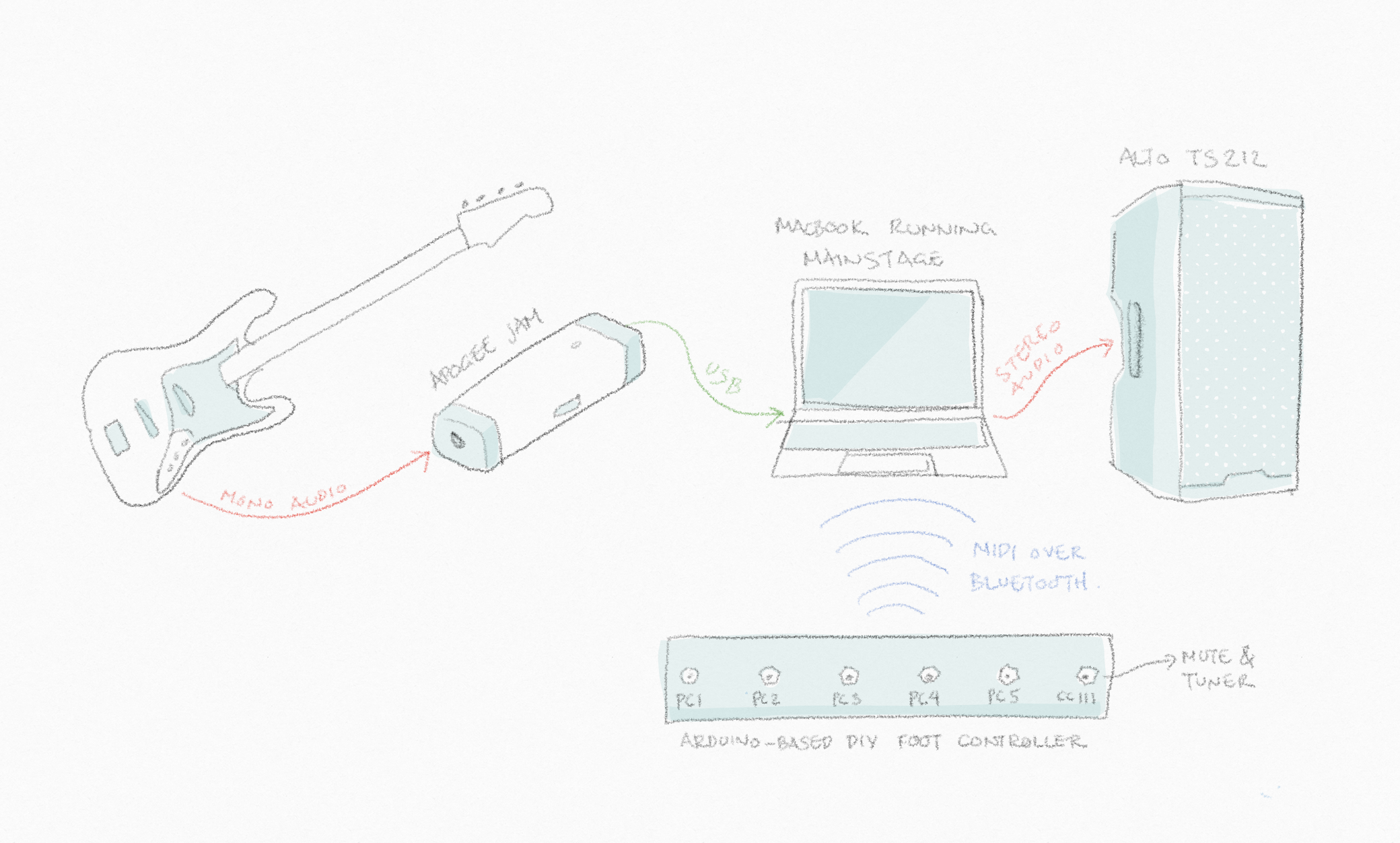
The practicality of this is yet to be decided—my first gig with this rig will be next week. But now I have 5 sound presets at my feet (the 6th sends a MIDI CC message that turns on the full-screen tuner on MainStage and mutes the output). I have an EQ and a light compressor at the input that shapes the sound of my bass, an EQ for each preset (along with a bunch of effects in each), and an EQ at the output, which I can tweak for the room. The output channel also has an amp & cab simulation effect, that I can turn off if I need to play through an actual amp.
I was easily able to replicate the sounds I was using on the Zoom using the built-in effects of MainStage, but if I need more I can always buy Helix Native and use those algorithms instead.
DSP is great these days. I just wish companies would come up with some of the missing bits of gear to make all this work neatly. (The Helix LT seems too big and heavy, the Bass Fly Rig is too limited, the Zoom pedals are cumbersome live because of no easy patch selection and no general EQ...)
- No easy way to EQ for the room. It would require either changing all my sound presets on the Zoom at soundcheck, which is entirely impractical, or buying an extra preamp pedal or going through an on-stage mixer.
- I can't easily move from preset to preset arbitrarily. The Zoom allows you to cycle through presets, but that usually means I have to change the setting for which presets to cycle between at the start of each song.
The practicality of this is yet to be decided—my first gig with this rig will be next week. But now I have 5 sound presets at my feet (the 6th sends a MIDI CC message that turns on the full-screen tuner on MainStage and mutes the output). I have an EQ and a light compressor at the input that shapes the sound of my bass, an EQ for each preset (along with a bunch of effects in each), and an EQ at the output, which I can tweak for the room. The output channel also has an amp & cab simulation effect, that I can turn off if I need to play through an actual amp.
I was easily able to replicate the sounds I was using on the Zoom using the built-in effects of MainStage, but if I need more I can always buy Helix Native and use those algorithms instead.
DSP is great these days. I just wish companies would come up with some of the missing bits of gear to make all this work neatly. (The Helix LT seems too big and heavy, the Bass Fly Rig is too limited, the Zoom pedals are cumbersome live because of no easy patch selection and no general EQ...)
D
Deleted member 165050
Guest
It seems we (bassist) are a lot into FRFR (full range flat response) cabs but not into amp modeling. We hardly see any Line 6 Helix, Fractal or Kemper mentionned here when a lot of guitarist are using them. Granted there are a lot more guitarist than bassist and that these product are aimed toward them but still, it seems any attempt from manufacturers to go this route for bassists have failed.
I just discovered this, I might be dufus...
I had the Line 6 Bass Pod Pro rackmount unit for a while driving a stereo power amp to use the bi-amp facilities. It sounded fine but I just didn't feel any urge to do anything other than find the one sound I liked and stick with it. I guess modern technology is wasted on me


Ac
My one year old got ahold of my phone any typed all those lol.
I’ve been wondering about amp and speaker simulation for quite a while as I run direct to P.A. out the back of my amp and only use my amp for low stage volume monitoring and I use IEM’s.
I read a blog by planet botch (lots of interesting stuff) and he claims that this simulation is really just applying EQ (as a simplification). For example a bass cabinet rolls off the low lows and highs and we end up with a punchy midrange sound. Full range to me has way too much treble. I normally roll my tone knob all the way off with a jazz bass with steel flats and I’ll roll it up a bit if I want a bit more cut. I EQ out a bit of treble as well. I find it works with our setup and what we do and allows me to slot into a lower range and get more oomph without being overly present. With a four band parametric EQ and HPF like on my Soundcraft ui12 mixer (which isn’t our gigging setup) I can come up with a great bass sound and adjusting a low mid bump is a lot like the midrange knob on my SVT CL. With compression and overdrive added you can get very far.
Still there’s that very sweet breakup missing but I’m playing mostly country so clean bass sounds great. I think the difference as someone already pointed out is trying to apply static EQ to get a result that approximates a dynamic system. These modellers must be applying dynamic EQ.
I recently got a sansamp acoustic DI which is the previous version of the paradriver without the drive and without the rumble and air switches to try with my DB and honestly I’m not so impressed. I found the tube tone on my RH450 to be better than the blend knob on the sansamp. The sansamp is also easier to overdrive the input within the pedal and get ugly clipping even though I’m not overdriving the input on the mixer.
I did an experiment and pretty much was able to duplicate my favourite EQ on the UI12 bypassing the mixer EQ and using the RH450 EQ or the sansamp EQ. That’s the beauty of presets that allow you to instantly adjust EQ settings and gain levels.
The conclusion of my very long winded post is that I found if you have parametric mid EQ and the other EQ frequencies are set in nice bandwidths you can really achieve a lot. I bet those David eden world tour preamps sound amazing.
I’ve improved this bit by bit thanks to a lot of great info on TB!
A final note: the thing I really appreciate about the RH450 and ui12 is the ability to save presets. With the sansamp if you change the midrange or “tube drive” it changes your gain and throws off the mix.
My one year old got ahold of my phone any typed all those lol.
I’ve been wondering about amp and speaker simulation for quite a while as I run direct to P.A. out the back of my amp and only use my amp for low stage volume monitoring and I use IEM’s.
I read a blog by planet botch (lots of interesting stuff) and he claims that this simulation is really just applying EQ (as a simplification). For example a bass cabinet rolls off the low lows and highs and we end up with a punchy midrange sound. Full range to me has way too much treble. I normally roll my tone knob all the way off with a jazz bass with steel flats and I’ll roll it up a bit if I want a bit more cut. I EQ out a bit of treble as well. I find it works with our setup and what we do and allows me to slot into a lower range and get more oomph without being overly present. With a four band parametric EQ and HPF like on my Soundcraft ui12 mixer (which isn’t our gigging setup) I can come up with a great bass sound and adjusting a low mid bump is a lot like the midrange knob on my SVT CL. With compression and overdrive added you can get very far.
Still there’s that very sweet breakup missing but I’m playing mostly country so clean bass sounds great. I think the difference as someone already pointed out is trying to apply static EQ to get a result that approximates a dynamic system. These modellers must be applying dynamic EQ.
I recently got a sansamp acoustic DI which is the previous version of the paradriver without the drive and without the rumble and air switches to try with my DB and honestly I’m not so impressed. I found the tube tone on my RH450 to be better than the blend knob on the sansamp. The sansamp is also easier to overdrive the input within the pedal and get ugly clipping even though I’m not overdriving the input on the mixer.
I did an experiment and pretty much was able to duplicate my favourite EQ on the UI12 bypassing the mixer EQ and using the RH450 EQ or the sansamp EQ. That’s the beauty of presets that allow you to instantly adjust EQ settings and gain levels.
The conclusion of my very long winded post is that I found if you have parametric mid EQ and the other EQ frequencies are set in nice bandwidths you can really achieve a lot. I bet those David eden world tour preamps sound amazing.
I’ve improved this bit by bit thanks to a lot of great info on TB!
A final note: the thing I really appreciate about the RH450 and ui12 is the ability to save presets. With the sansamp if you change the midrange or “tube drive” it changes your gain and throws off the mix.


