• TalkBass has been independent since 1998. Add your voice.
    Create a free account to reply to discussions, view embedded media, and browse with fewer display ads.
    Join freeLog in
    Want zero display ads or expanded classifieds tools? Compare plans.

Basses with Good Ergonomics?

Thx. Would you say the fan frets are more comfortable than regular frets? I've never got a chance to try fan frets thoroughly.
For some chord shapes and stuff I play absolutely. For example my band has a song in drop A where for a big driving part I play octaves on both of the A strings on the same frets. Doing that shape is more comfortable for me on the dingwall because I can do it without bending my wrist at all.

I think a lot of people are intimidated by them because they hear 37” and think it’s gonna feel super long. But it actually doesn’t. The high g string is 34” scale and it’s actually more comfortable for me than any 35” scale bass I’ve had and even some 34” scale basses I’ve had like the Warwick thumbs because the thumb basses kind of sit in the middle of your body which makes the necks feel long. Half the extra length of the scale on the Dingwall as actually at the bridge end of the string also. So it really isn’t as crazy as it sounds. And the way they designed the strap button locations it hangs a little farther to the right side of my body and pulls the neck in closer.

here are some pictures so you can see how these different basses hang standing up.

this is a 34” thumb bass. As you can see even though it’s 34” scale the neck feels longer than a lot of 34” scale basses because of the way it hangs.
9C7887BC-070B-46FA-85D4-F9FA710F31EB.jpeg

This is a 35” scale ESP, again you can see my left wrist is bent.
DB7309BD-DEFF-473B-AA47-9542FFE233DC.jpeg

Now check it out with the dingwall. (Also notice the rear strap button location and how it shifts the bass to bring the neck closer)
825BFA2A-6B99-4B9A-9C6B-AEEB570959E8.jpeg


and my Dingwall side by side with my jazz bass

F4E65376-E722-420B-968B-1F21D9B014A9.jpeg
and btw the Dingwall fits in a standard fender hardcase. The outer silhouette of the bass isn’t any bigger than a fender because of the smaller headstock.
 
The New Fender 'Ultra' Precision and Musicman Stingray 'Special' have 'Intentionally' made great moves in the ergonomic direction. The Ultra is the most comfortable easy playing Bass I have encountered [8.5lbs].
So to get good ergonomics you have to pay 2k plus? Surely it should be easy enough to incorporate into more modestly priced offerings.
 
The upper horn length has become a top priority for me, too. If it isn't long enough, it causes the fretboard to set further out to my left (I play righty). Reaching the low frets can call for more of a contortion in my left wrist - this is when I have the strap length set so that the body of the bass is at the "right" height for me; not too high, not too low.

The other thing I keep an eye out for with any bass is the distance between the bridge and the bottom edge of the body, especially if the shape of the body is a little less conventional. If there's a lot of space there, the bass might also force me into more of an uncomfortable reach for the lower frets.

Some years ago I was seduced by the materials and construction of a German Warwick Corvette. I suppose I figured I could get used to it even though it had one or two of those ergonomic red flags. No dice. Now I'm hyper-picky and sort of expect most basses I try to have some sort of shortcoming in terms of their fit.

Keep trying everything you can get your hands on. It's almost impossible to predict a good fit until you occasionally bump into it. No two necks are quite the same. The combinations of width, depth (amount of material under the fingerboard), radius, etc. have to be sampled to be sorted out - you may even want to keep a notebook with some measurements or just your impressions for reference as you look around.
Those are some really good info. Do you have any recommendations then? Thanks!
 
Those are some really good info. Do you have any recommendations then? Thanks!

I generally expect both Precision and Jazz style basses that are influenced by the Fender template to have decent ergonomics, but this is more likely the case with a full-sized body. Some models have slightly smaller bodies that can work okay, but some of these smaller bodies can have smaller upper horns and be more susceptible to deck dive. I can't say which specific models of these to look out for, but I've noticed this general design aspect over the years.

Even if a body has an upper horn that extends up to parallel with the 12th fret on the neck, that bass might not have ideal balance if either the neck's construction is relatively heavy or the body is relatively light. I played a Jazz copy for many years that has a Warmoth neck - very solid and responsive, but also very heavy. Some of Warmoth's necks are reinforced with heavier steel rods instead of lighter graphite rods. I put up with mine for a long time because it was a sweet player for me, but recently the heft and the neck dive prompted a change.

Typical P-basses have more chunky necks with 1 5/8" nut widths, while many J-basses typically include a more narrow neck with a 1 1/2" nut width. Narrow width does NOT guarantee better ergonomics. It really depends on how a bass sits in your hands. I'm actually finding more comfort with wider necks than a couple of the instruments I've played in the past.

The Schecter CV-4 was a big surprise for me when I tried one at a shop. Although it was a little heavier than I'd prefer, its chunky neck let me walk around almost effortlessly and it balanced on a strap pretty well, too. Many of the Yamaha basses I've tried here and there have offered better than average ergonomics. I've always had a soft spot for their inexpensive RBX-170 and might get one used (for cheap!!) so that I can hot-rod it.

For better or worse, the truth is usually in the test drive.
 
  • Like
Reactions: Gare Boo
I've been through an embarrassing amount of basses and the Xotic XB-2 has won me for ergonomics. Perfect balance and positioning on strap or lap. Not even a hint of neck dive and the way the neck and body joins means unhindered access to every fret and short reach to first fret. The neck feels so light it's as if it isn't there. And the whole thing ways 8 lbs. yet somehow feels incredibly robust.

B0805EA3-80C2-49FA-B83A-FDD31AB691E3.jpeg
 
In general, a bass with a long upper horn that lines up with the 12th fret spot always feel comfortable in that you don't have to stretch for the first position or bend your wrist all funky.

Short upper horns always make a bass shift-over putting the end of the neck even further away, and you're plucking over your navel.
 
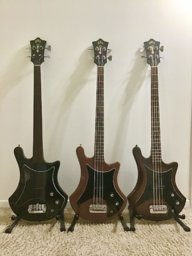
Seems no one has mentioned one I’ve got. The Alvarez ‘Dana’ Bass. Invented by luthier Dana Sutcliffe. Ergonomic “offset” neck. Neck stays up at an angle. No neck “dive”. Very nice, extremely comfortable basses made in Korea around 1992-93. Now can be found for around $500.
A1A618CE-66A9-41FD-A28D-E5D045879664.jpeg