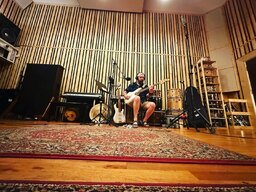
Anyone else think if my daughter had a little soul patch she'd bear a striking resemblance to the architect himself?

Last edited:

TalkBass has been independent since 1998. Add your voice.
Create a free account to reply to discussions, view embedded media, and browse with fewer display ads.
Join free Log in
Want zero display ads or expanded classifieds tools? Compare plans.

Which pickup setting are you using for the Dingwall? For a growlier tonne, I recommend the parallel setting with a goose of the bass knob and perhaps a slight roll off on the treble. Of course', that is for a different dingwall with different electronics. But play with tthe parallel setting. It has sort of a jazz growl on my ABZ with Glockenlang Preamp.The main options on my Kiesel 5 were:
Maple neck, swamp ash body - flame maple top - all-maple neck - back-of-neck satin finish - ebony fingerboard - jumbo frets - 14" radius neck - single coil pickups
I didn't see any "standard options" for string spacing or asymmetrical neck. String spacing is 19mm, which is a little wider than the 17mm I was used to on my previous 5'er.
Dingwall content - the song is nuanced with a restrained feel for the first half. I used the Dingwall for this. In the middle, it gets heavier and trancier (think Tool or Zep's "Kashmir") then finishes with a reprise of the opening but with a heavier feel. As the Kiesel has a growlier tone, I switched to that for the second half.
Been thinking of swapping some single coils into the Dingwall, but I haven't decided yet.
She's waayy to cute for that!!!Anyone else think if my daughter had a little soul patch she'd bear a striking resemblance to the architect himself?
View attachment 848306


Which pickup setting are you using for the Dingwall? For a growlier tonne, I recommend the parallel setting with a goose of the bass knob and perhaps a slight roll off on the treble. Of course', that is for a different dingwall with different electronics. But play with tthe parallel setting. It has sort of a jazz growl on my ABZ with Glockenlang Preamp.
Not sure that's how this older Combustion works. There is a separate tone and volume for each pickup and a toggle. I believe the toggle is for active/passive, though I could be wrong.Which pickup setting are you using for the Dingwall? For a growlier tonne, I recommend the parallel setting with a goose of the bass knob and perhaps a slight roll off on the treble. Of course', that is for a different dingwall with different electronics. But play with tthe parallel setting. It has sort of a jazz growl on my ABZ with Glockenlang Preamp.
Ahhh. I assumed that it had the rotary switch.Not sure that's how this older Combustion works. There is a separate tone and volume for each pickup and a toggle. I believe the toggle is for active/passive, though I could be wrong.
Yeah, this a 4 knobber.Ahhh. I assumed that it had the rotary switch.


Wow, one blend pot? So you go from bridge, middle, to neck as the pot rotates with mixes of bridge-middle and middle-neck right? That seems like it would be quite versatile, but I'd look for the option of neck-bridge (mainly for slap parts).Looking forward to tonight; first band rehearsal with the newly-transformed Z3.
Prior to routing, I messed with different combinations of the original Bartolini pickups, and the series option was undeniably best: bigger, bolder, and rounded off some of the trebly edges.
Then there was the question of how that combination would mix with the P-Tone.
The P-Tone has a DCR of 11.6 kOhms, and each Bartolinis was more in the 5-6k range, so series was the only thing that would hold a candle to the P-Tone, in terms of output.
The P-Tone is also quite a bit brighter that the series Bartolini combination.
Between output and tonality, preserving a lot of single pickup options or individual mixing between A/B/C just wasn't going to add anything useful.
So I just have all 3 pickups connected to a single blend pot. I've had good luck with Bourns 'MN' taper blends, and this was no exception! With the twist of a knob; it goes from a P-Bass to a StingRay -- my two favorite rock bass tones, on a fanned-fret, lightweight, ultra-playable bass.
Tracking down polarity and phase cancellation issues with 12 coil wires and 3 shield wires kept me up past 3am on Friday night, at which point I recognized that I needed to walk away from it and come back with fresh eyes.
Saturday afternoon I had it up and running within an hour.
Tonight will be the REAL test, but I'm confident that the mod was worth the effort.
Not quite; I'm treating the two original Bartolini pickups as one.Wow, one blend pot? So you go from bridge, middle, to neck as the pot rotates with mixes of bridge-middle and middle-neck right? That seems like it would be quite versatile, but I'd look for the option of neck-bridge (mainly for slap parts).
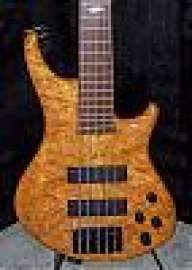

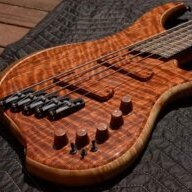

I ordered the ABII and the ABZ with the Luminlay side dots. But the SuperJ I did not add them and am still thinking of calling and have them added.Sheldon has asked if I want to retain the Luminlay side dots, I thought I'd let the brain trust here weigh in. My thoughts are that they are not really needed with the blocks. I've been playing long enough I don't spend much time looking at the neck, and don't see myself playing dark stages anymore. Still, they have a coolness factor and the cost is minimal, so what do you all think?


