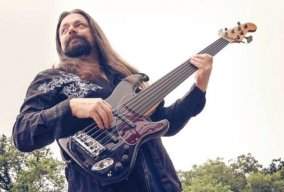
Read the rest of my point above. Why is the DROP tuning necessary, not down-tuning. I know various reasons that can validate tuning down.
The link I posted was drop tuned.

TalkBass has been independent since 1998. Add your voice.
Create a free account to reply to discussions, view embedded media, and browse with fewer display ads.
Join free Log in
Want zero display ads or expanded classifieds tools? Compare plans.
Read the rest of my point above. Why is the DROP tuning necessary, not down-tuning. I know various reasons that can validate tuning down.
How so?
Read the rest of my point above. Why is the DROP tuning necessary, not down-tuning. I know various reasons that can validate tuning down.

And again, its not applicable to bass playing. A bassline for either of those pieces could be played without drop tuning. If any of the basslines demonstrated by the people claiming drop-tuning is necessary, involved complex chordal patterns that physically couldn't be played without the drop tuning, the point would be valid, but, unlike in those guitar videos, it just isn't the case. In those videos, the drop tuning was used because it enables chords that couldn't otherwise be played to be used. What benefit does it provide to the bass player over standard tuning?
From what I've seen, its mostly just done because the guitar player is doing it and its easier to ask him what fret hes playing than to ask what note and know where that is on your neck.
So whats wrong with tuning to C standard? That seems like a much more sensible option to me.

So whats wrong with tuning to C standard? That seems like a much more sensible option to me.
So whats wrong with tuning to C standard? That seems like a much more sensible option to me.
This is what i find is the problem with people against drop tuning. Most of them just see it as only being used in Death Metal and things of the like, whereas its used in alot more genres than that. My band plays punk and we play in Drop D (DADGBE) and Drop D Standard (DGCFAD) and also used to use Drop C (DGCFAD) along with Standard E, even for our calmer songs we were tuned to Drop C for some of them. We don't play in C anymore as we have no need to.
Liam
And that's why you don't like drop tuning, because you don't understand in what context it is useful.
Wait, so you're telling me now that I can't handle drop tuning?
And why would anyone want to follow what the guitars are doing? A lot of the times I don't even play with guitars. Guitars are annoying. I have my own brain i'll follow my own basslines & guitars can follow me if they want.I play with more keyboardist/organ players and horns.
I'm not sure why you're questioning my ability as a musician. You're becoming the reason people look down on your drop tuning. I never said others can't do it, or shouldn't do it. And yes, I've never come across anyone who drop tunes in reggae/dancehall/ska. Maybe there are, but i've never seen it, and i don't see a reason to ever need it.
now all you drop tuners that were looking to hate on someone who has the opposite view can hate on me, I'm not insulting what you do though..
" In std E and for most basic covers it's a free for all and who knows what the end results are. Which are usually wrong/sour notes. " I'm not sure I understand that...

It also addresses the post of someone earlier about how a classically musician could learn whatever another posted in a matter of a week.
If someone like Segovia would arrange some of the greatest composers in history to a drop tuning, why should we be such snobs? I would think Segovia knew what "correct" means in regards to learning tunes.
Another one. John Williams:
The only issues I have with drop tuning have nothing to do with the actual act of drop tuning. In high school, my buddies and I used to rip on the guys who for four years ONLY played in drop tuning and ONLY so they could play one finger power chords, and not even for speed reasons. They had no desire for musical development, or playing heavy chugging riffs in drop D, just for the "efficiency" of playing one finger power chords. That's the only black mark on downtuning IMO.
That said, several of the bands I've played in over the years have used drop D tuning as a tool, and it helped me get pretty good at tuning quickly and accurately by ear, which is always a good skill to have.
I'm going to have to try tuning to 5ths as was previously mentioned in this thread. I remember thinking about it when I was messing around on a mandolin I used to have, but never got around to it. Thanks for the reminder, I'm gonna go do that right now.

BigOldHarry said:Yes... but let's be honest here: This thread is NOT about detuning a bass or guitar to fit a piece of music; It is about drop-tuned *metal*, from the first post, and is yet another example of the basic insecurity which metal fans find themselves gripped by.
I already know why people do it. I just know it isn't required. There are no songs that cannot be played in standard tuning. All that the guys doing this are accomplishing is to relocate the notes under each fret. This isn't a complicated concept.
Imagine a drummer stopping between songs to put the snare drum at his foot and his bass drum by his hands all to avoid having to learn how to play the Snare on 1 and 3 rather than 2 and 4.... That is essentially what you are doing.
Good luck with that......
-eSmith.
Yes... but let's be honest here: This thread is NOT about detuning a bass or guitar to fit a piece of music; It is about drop-tuned *metal*, from the first post, and is yet another example of the basic insecurity which metal fans find themselves gripped by.
lucas vigor said:But the examples of classical guitar are not all that common. With the current drop tuning craze, you have whole bands that do it routinely, and all the time!
The original point of this thread was to ask why is this practice looked down on.
And I remember a few years back, some other thread where some people were talking about what their bands tune in, and they were saying stuff like C#, Aflat, d#, G flat (I am exaggerating, of course)....what they were saying made no sense, and I was just wondering why they would do such a thing.
I think the low tuning stuff is fine...and I totally get it. It creates a different mood, different texture, but using the weird intervals in your tuning is just, well, weird....and to me, it seems like cheating to make certain riffs or chords easier to play.
Someone asked me if I only like and respect challenging or technically advanced music...no....but I think as a musician, there should be a certain amount of "job knowledge", and I feel it should be within normal parameters.
There is a difference between a good singer songwriter, and one not so good, for example...and that difference sometimes means one is cheating by using a capo all the time. Let's face it, it means they can learn 4 chords and play in any key on their guitar. And like using "auto tune", it''s cheating.