Hello All,
Happy New Year.
This is a long one. Maybe someone who reads it all will find something useful.

Sorry, but I don't have any sound clips.
My first test drive of the Jule Amps Monique bass preamp
Last night, finally I got organized enough to unpack my newly arrived Monique and try it out.
Disclaimer: Currently I monitor my bass playing only with headphones. Nice, open air ones, but headphones nonetheless. Still, in my former home studio, I used to track and mix through these phones, alternating with monitors, so I have a good sense of how their sound correlates to instrument or stereo speakers and amps.
Disclaimer: I am not suggesting that anyone modify their Monique preamp in any way. If you break or diminish any equipment of yours by trying something I describe here, I am not responsible.
The significance of octal preamp tube types
When I learned of the Monique preamp, I read all I could find about it online. I was surprised not to see any mention of the Monique’s octal preamp tubes as being significant. As a collector of both miniature and octal preamp and power tube types, I thought this would be one of the main selling points.
As I started corresponding with Jule, preparing for my order of a Monique, I mentioned this to him:
"The 6S?7 I use in 12A?7 slots via custom adapters. I have found this to be a great way to impart 1960s and 70s preamps with an aspect of the 1940s tube audio sound. In my experience, current day musicians usually are not familiar with the sound of octal preamp tubes and big bottle power tubes. Luxurious and slow, with an enormous sound field (even in mono) that features spatial presentation of bass frequencies. That’s how big bottle tubes sound to me.
So when I read about your bass preamp, believing it hinged on at least two octal preamp tubes, I knew I wanted to try it."
Jule agreed and gave me some background:
"Good to work with someone who knows the value of an octal tube… Truly as you describe… A much larger tonal envelope than any of the 9 pins. Beautiful… It did take me a while to "tame" them. One does not substitute them directly without getting some bruises. But I have been using them for a long time."
Design and build quality
To me, in person the Monique looked smaller and “tighter” than in photos. In person, I saw why players relate to the Monique emotionally as an object of desire, and not only as a tool for doing work. Simple, elegant, classic design, and clean, tight, solid fabrication and workmanship. It is an excellent package. No fluff. All substance.
Inside the chassis I saw more of the same. Wiring and soldering were tidy and solid, and the layout looked rational (to a layperson like me). Many components were gooped. At first I thought this was for secrecy or to prevent modifications, but then I saw that probably it mainly was to give structural support to heavier components, namely the larger electrolytic capacitors.
Overall the Monique looks to have been crafted to be rugged enough for mindful, but typical real world use, including gigging.
Equipment for the test
For bass guitar, my headphone amp is “The Enabler” by 3Leaf Audio. If you don’t know it, The Enabler is a Swiss Army knife-type audio tool for bass guitarists, in pedal form. Basically, with respect to workflow, it is a tiny, solid state equivalent to the Monique, but with the addition of a more flexible EQ section, an aux audio input for practicing with tracks, and a headphone amp. And what a headphone amp. This pedal sucks real power, then uses it to drive headphones with authority and clarity. Sadly 3Leaf recently discontinued production of The Enabler. So if you are considering trying one, I suggest buying it soon since they still are around.
For my first test of the Monique, I used no processors. The path was bass guitar into the Monique, line out into The Enabler, headphone out into the phones.
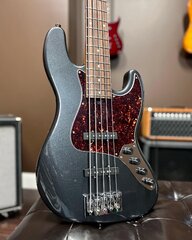
My only passive bass guitar is in storage. A 1969 Fender Precision, I meant to get it for this test, but was deterred by snowfall. So I used a Suhr Classic J, its preamp flat by default, then sometimes added bass with the guitar’s preamp.
Test plan
The test plan was unstructured at first, but ended up being this:
With The Enabler flat: Monique stock
sensitivity 0 dB or +4 dB, low gain
sensitivity 0 dB or +4 dB, high gain
flat EQ
varied EQ
With The Enabler flat: Monique with vintage tubes
sensitivity 0 dB or +4 dB, low gain
sensitivity 0 dB or +4 dB, high gain
flat EQ
varied EQ
For each test case above, remove the Monique from the path and simulate its settings on The Enabler.
I spent little time in the high gain cases, hearing the value of higher gain settings, but strongly preferring the low gain response. My intent in alternating between the Monique and The Enabler as a primary preamp was to reveal the characteristic differences in the Monique’s tube audio voice to The Enabler’s solid state voice.
Vintage tubes
All but a few of my hundreds of tubes are in storage, so I used what I had on hand at home. That included only one 6SL7, but four 6SN7. The complement of vintage tubes I used were these:
V1: 1944 Ken-Rad JAN-CKR 6SL7GT VT-229 NIB
V2: 1955 CBS Hytron 5692 NIB
V3: 1950s GE 6CA4 NIB
V4: 1950s GE 12AU7
(NIB means “new in box”. 5692 is an industrial version of 6SN7GT. VT-229 is a military version of 6SL7. Allowing for taste, it is safe to say that the two octal tubes in that set, the Ken-Rad and the Hytron, are among the very finest ever made of their types. Older aficionados of vintage tube amps will fall into hushed reverence when the names Hytron or Ken-Rad are mentioned. GE also made many fine tubes, and of course had the good sense to buy Ken-Rad’s tube plant in the early 1940s. Similarly, CBS, which company never made any receiving tubes, I believe, was smart enough to buy Hytron pretty early on.)
I removed all the tube retainers. (Sorry, Jule, but I don’t like retainers.) Anyway, the big sockets especially were so tight that no tube ever could escape them once inserted. Someday, if Jule is willing to, I will request that he build me a Monique using vintage tube sockets and capacitors.
Alternative preamp tube types
6SN7 is to 12AU7 as 6SL7 is to 12AX7. Most people think of “gain” only when comparing 12AX7 to other 12A?7 types. But with 12AU7, particularly, that is not the whole story or the most interesting part. I assume the same is true of 6S?7, and anecdotally have found it to be so in listening to other applications (instrument and stereo amps or receivers).
I am not an electrical engineer, but once I had this explained to me by someone who knew the science. My understanding is that 12AU7 has ten times the headroom of 12AX7; that is, it will amplify ten times what 12AX7 will before distortion. That is why 12AU7 often is used to feed a power amp. Whenever I see a 12AU7 in a modern tube preamp/amp (like the Baer Valkyrie) or preamp (like the Jule Amps Monique), I smile and say “Good choice. They knew.” I own a 1960s Harmon-Kardon receiver that uses a single 12AU7 in this way.
Having only one 6SL7 on hand, and assuming that V2 in the Monique was for the EQ, I felt that swapping a 6SN7 into V2 should yield musical results.
How it sounded
Though I spent about three hours in this my first test of the Monique, it amounts to first impressions. I played the Monique neither with a bass amp stack, nor in a recording scenario, nor using its DI output, nor in an arrangement with other instruments. That said, this is what I thought:
The Jule Amps Monique preamp is a fine instrument. Very responsive to input frequency spectrum and playing dynamics, it features high headroom, loud and clear output, the perfect amount of natural tube audio compression, huge bass frequency response when demanded, and an uncanny tendency to smooth all harshness in high frequencies without sounding dull. It has a voice. It is not neutral-sounding. Rather, the Monique is an archetypal “secret sauce” audio processor, in that it respects and retains the audio it is given, then interprets that input in a certain musical way.
A few special points
- Used with passive pickups, the +4 dB input is seductive and easy to overuse, in the sense that it can overshadow the sound of the 0 dB input. Among other things, in the net sound of the +4 dB input is an emphasis of certain high frequencies, giving an impression of increased clarity. The output does sound clearer, but closer inspection shows that (unsurprisingly) it sounds hotter, more “live”. I found myself alternating between the 0 dB input and raising the output level, and the +4 dB input and a relatively lower output level. All the good stuff is in there with the 0 dB input, too, but distributed differently.
- At first, the EQ controls struck me as being too polite. Good, usable frequency centers and response, but not enough change. Later, however, I found that the power of the EQ was not in extreme tone shaping, but in subtly changing the context for the instrument’s native tone. The key here is usable sounds. Yes, what is usable is the opinion of the player. But for a fairly wide range of classic bass guitar sounds, the Monique’s EQ is powerful because its results are musical, natural-sounding, and usable.
- Related to the point about the EQ section is stacking. Oh… my… goodness. Wow! When you start with a nice, fat, well balanced sort of passive bass guitar sound, then add bass frequencies with the instrument’s preamp, with the Monique’s bass EQ rolled up a bit, the result is a fathomless expanse of unflinching ultra-bass. Big. For all this, nothing else about the spectrum changes. If there was nuanced midrange, it will be there still. Likewise articulate highs. Still there. What a great sonic territory for bass guitar. Comparisons are to vintage SVT with deep bass EQ rolled up, but without the edge, and with no cabinet induced limitations; or to playing direct into a good board and monitoring through big, in-wall studio monitors.
- In stock trim, the Monique sounds great, as described above. But with vintage tubes it sounds better. To me. More relaxed and open, yet not less punchy or authoritative. More articulate, with any vestige of harshness removed, yet not too tame. Even more alive and responsive. In any case, whether with modern or vintage tubes, the Monique is a good platform for tube rolling. Run what you like and hear the difference for yourself. In large part, I bought my Monique for rolling my vintage tubes. In this first test, it was exactly what I hoped for in that regard: a fine instrument with a beautiful voice, able to have its fuller potential realized with a simple, harmless modification.
- It was instructional to alternate between primary preamps: any given setting on the Monique and simulation of that setting on The Enabler. I did and still do consider The Enabler a "best of modern analog audio" processor, warm and clear sounding for a solid state circuit. But in this test I was impressed by how mercilessly accurate the sound of The Enabler was compared to the sound of the Monique. Also, though without measurements to quantify, I found it hard to recreate with The Enabler any given perceived net output volume of the Monique. Time and again I set The Enabler to match what must be the Monique's output volume, only to have it feel distant and detached. Comparatively, the Monique produced audio that was present and palpable; that somehow was like an acoustic instrument heard up close. In my experience, this behavior is characteristic of tube audio done well.
My thanks go to Jule for making my new Monique preamp. Good job. I think the Monique is destined to become a classic.
Best,
Snaxster


 Not sure on the footprint of the M700, mine won't be here until Friday, but I am hoping it fits on my MAS45.







 Yes, by input gain I meant the Sensitivity control.