
I can only get 4 or 5 bars in before I have to come up for air...
Scuba...

TalkBass has been independent since 1998. Add your voice.
Create a free account to reply to discussions, view embedded media, and browse with fewer display ads.
Join free Log in
Want zero display ads or expanded classifieds tools? Compare plans.
I can only get 4 or 5 bars in before I have to come up for air...
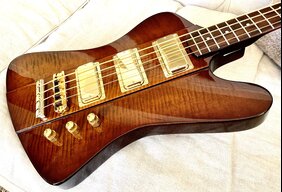
After four or five bars I'm lucky if I can get up out of the gutter much less come up for air.I can only get 4 or 5 bars in before I have to come up for air...
Most bass players don't have as many different licks in their playbook as guitar players but the ones they do have go much deeper.You can play hot licks if you lick your bass strings before playing.
If you don't want to play hot licks and just want to lick your strings...that's o.k.

@Jay2U, great minds think alike...History repeats itself.Leo Fender made 15 prototypes of his first electric bass. Prototype "A" was a complete failure as were prototypes B and C but by prototype D the bass started to take shape. Leo, always the perfectionist continued to fine tune his design all the way through prototype "O" where he finally felt the bass was nearly ready to market. He made one last change and dubed it the "P" bass. The rest is history.


@GBassNorth So now everybody knows this is the one and only true history of the development of Fender basses.@Jay2U, great minds think alike...History repeats itself.

Hanging your bass just one inch above the floor helps a lot.
That's ok, I liked yours better! Apparently, like fine wine, misinformation improves with age.@GBassNorth So now everybody knows this is the one and only true history of the development of Fender basses.
(I really didn't recall your 14 months old post)
In-ear monitors have to be carefully trimmed, with regard to delay. Acoustic sound waves travel at the speed of sound, while the electronic signal travels at the speed of light, which is about a million times as fast. It requires trained specialists to get the timing spot on.
In-ear monitors have to be carefully trimmed, with regard to delay. Acoustic sound waves travel at the speed of sound, while the electronic signal travels at the speed of light, which is about a million times as fast. It requires trained specialists to get the timing spot on.
Ear hairs need to be carefully trimmed too. The crackling noise in the headphones is not static...it's ear hairs...
But there's an easy fix for that - just pour about a cup of sand over the circuit boards once a month and the silicon will absorb back into the components. As an alternative you can spray Raid bug spray over the circuit boards every few weeks to keep the spiders at bay.80% of failures in solid state amps is due to silicon eating spiders.
Her next project will probably be enhancement of the bottom end?My bass playing girlfriend was getting pretty tired of her amp situation - she initially contemplated getting her tubes tied but decided to get a silicone injection instead. She claims her bass playing is in a pretty solid state right now and that the injection cured the sag she was experiencing in her prior set up. The change is really quite noticible. She's now much more forward in the mix and really stands out especially with a hard banging drummer.