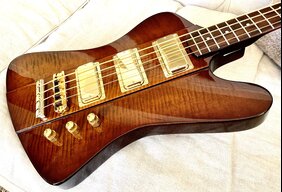
Good luck finding a MIA Fender for $600, but 30 year old Squiers routinely go for over $300 on the 'bay and here in the classifieds.
All the MIA Fenders I've seen on Ebay start at like $800, for a used one.

TalkBass has been independent since 1998. Add your voice.
Create a free account to reply to discussions, view embedded media, and browse with fewer display ads.
Join free Log in
Want zero display ads or expanded classifieds tools? Compare plans.
Good luck finding a MIA Fender for $600, but 30 year old Squiers routinely go for over $300 on the 'bay and here in the classifieds.
Less than six months ago, folks on this board were raving about how good the Fender MIA, MIM, and Squier QC had gotten. So I'm not sure where you're coming from with that

I've played enough Squiers, MIMs, and MIAs (and other brands) to know there are construction, tonal, and playing differences in them all, even among examples of the same basses. I also know that the wood today isn't the wood from 30 (or 29, or 40) years ago. Agathis isn't basswood isn't ash isn't alder, and plywood isn't laminated body pieces
(I know the higher end Squiers are not ply).
Even the MIJ Squier basses from the 80s play, sound, weather, and set up nothing like the Squiers of today. If you can't see past the fact that the bridges are metal, the bodies are wood, and the like, then they will seem the same to you. Oh well.
If you like Squier, that's fine. If you think the Squier you buy today will be worth 10x the purchase price in 20-30 years, then you're free to believe so. History seems to say you'll be lucky if it's worth 1-2x the price. If you want to believe you have to pay at least $900 for a used MIA, or $550 for a used MIJ to prove why a CV or VM is better, so be it. I'm not going to convince you otherwise.



THe Korean Squier II 's from the late 80's had LAMINATED bodies, not plywood. IIRC, they were made by Samick or Young & Chang.
Less than a week ago folks on this board were complaining about how inconsistent Fender QC has gotten
Yeah, I understand that. It doesn't help your position one bit that somehow the wood used in Fenders is consistently "better" than that used in Squiers. I'm curious about what attributes of the alder used in Squiers is inferior to the alder used in Fenders.
I'm pretty sure no Squier basses are currently made from ply. I'm pretty sure that only a few instruments from one Korean factory about 20 years ago were ever made from plywood. But I haven't exactly done a comprehensive study, and I don't think Squier's telling. Frankly, I think it's gained approximately urban legend status.
You made the contention that there was no comparison between the MIJ Squiers and today's CV and VM series Squiers. I still don't understand why you say that.
LOL. I'm pretty sure I never stated either of those positions. In fact, I'm absolutely positive of it.

Read the thread. The positions have been stated as part of this thread, while ignoring the prices real people buy real basses for. I don't believe I said they were your positions, either.
I said the wood's different, not better. Indonesian Squiers have been ply; my buddy has a Squier MII plywood P bass. Ply, not laminated. He found that out when he routed it for a J pickup. It's only urban legend for Squier fanbois.
Since you've ignored the fact that wood ages for several posts, I don't expect you would hear any difference between the old MIJ Squier's and the CV and VMs of today.
EDIT: You might want to read up on grades and cuts of wood within the same types, or different approaches to lamination, to talk about better woods or methods of construction..
That is not typical of Squiers, not anymore. Not even their low end Affinitys are plywood. Affinities are solid Alder. The rest of their lines are either two or three piece solid basswood, agathis, or in my case of my two MII VM's two piece soft maple. And whether or not the wood on either is "better" to he point of making one or the other a superior instrument is strictly a matter of opinion.
Well, opinion and physics, but yes, just opinion, if one ignores how electric guitars work in general. What I mean is that there is transfer of energy from string to neck to body to string (maybe a different one), so there are acoustic properties to consider.
Affinities are solid alder, as in one piece? I'm not sure anything but maybe some Custom Shop is one piece anymore. Even MIAs are 2 or 3.
Not that that's necessarily bad. Lamination can be done well, but each glue joint is another acoustic boundary in the wood. I think this is the biggest reason for the differences between supposedly identical instruments.

Well, opinion and physics, but yes, just opinion, if one ignores how electric guitars work in general. What I mean is that there is transfer of energy from string to neck to body to string (maybe a different one), so there are acoustic properties to consider.
Not for nothin' but I just read a post on another thread where someone was saying (with a straight face, I assume) that a Lakland Skyline Duck Dunn he recently played was comparable to his CV Squier. Squier fans love their basses... They may be a little delusional at times, but their love their stuff. What's next - SX = Fodera?
But back to the OP - "In that situation, what would be the reason(s) for getting the Fender?"
The reasons are better resale value, better electronics, better hardware, better decal ;-) Since tone didn't matter much to the OP, I'd go with the one that had better resale value.
Whether or not someone may like their Squier more than an expensive Lakland is puerly pesonal taste, and to say that they are delusional because of that preference is a little insulting. Sure, a Lakland can be technically considered superior to a Squier, but if the Lakland doesn't appeal to someone as much as a Squier, who is to say they are wrong?
And as far as resale value, not everyone gives a toss about that. Some people care more about being comfortable with a bass and would like it keep it as long as possible if they enjoy it. And, If the OP isn't obssessing as much about tone either way as a lot of us do, then it doesn't matter which bass he gets, because whether or not the Fender has better tone is entirely subjective.

When you say you can get a new Squier for $200 or a used Fender for $500 you are describing a New Squier Affinity or a "good deal" on a used MIA Fender. It's not fair to comare a $200 bass with a $1,200 bass. Now if your talking about a new Classic Vibe Squier against a used MIM Fender, then that is a different comparasion. I might go for the Squier. Yet, I don't like to buy new, I let someone else take the 40% depreciation.
Rocky
The OP asked what were the reasons to go with the Fender and I gave some. Whether or not the OP cares about resale value is irrelevant because resale value is one reason to choose one over the other.
The difference between Squire and Lakland is as simple as the difference between Pete Wentz and Darryl Jones.

notverygood said:It's not very hard or expensive to change hardware on a Squier. Why pay double for comparable tone just for hardware. It's not like Squier's hardware doesn't work. Both mine have no problems staying in tune and one is a bronco. tuners don't get much cheaper than that. My advice to the OP would be to honestly look at what the bass will be asked to do. If you tour multiple states and have good sized gigs, do the odd recording once an a while, or plan on making your living playing bass, save up and get a MIA. Maybe a Geddy Lee or even a G & L. If you're playing in a cover band down at the bar and taking it to jams with your friends, a Squier VM or CV will deliver what you need. And you'll not be sorry. Just play it before you buy.
That's a one-way trip and unless you plug the wood into an energy source to drive a wooden amplifier - no way does the wood shake the string hard enough to get 'energy' back into it.
Gads - that's a killer! Who writes your material?
I guess there'd also be dead people walking by the same logic; just play their favorite song and they'll get up and dance.
Hoohah!
NO acoustics involved - a sound-sink fer sure - but no reanimation of the strings - no way - no how.
Pardon me - I have to go now and replace the alder batteries in my wooden amplifier! I had them on the Bubinga charger all day.
Hoohah!