I agree. Andy and I have set up MANY blindfold tests in product development. I would usually be the tester as he and Jeff changed things around.
Blind testing is easy to do.
But sure gets a lot of hate.

TalkBass has been independent since 1998. Add your voice.
Create a free account to reply to discussions, view embedded media, and browse with fewer display ads.
Join free Log in
Want zero display ads or expanded classifieds tools? Compare plans.
I agree. Andy and I have set up MANY blindfold tests in product development. I would usually be the tester as he and Jeff changed things around.
 !!!
!!!



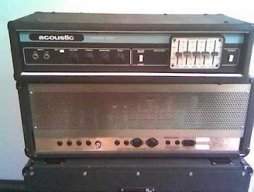
i plan on trying the different Ciare woofers i have > 2-15" , 2-12" , 4-10" and a FaitalPro 18" 18xl1600 to see which ones i like best. i'm also going to try different size combos. i want smooth deep undistorted bass and the Ciare speakers and that FaitalPro give that. i know a guy that has a KT-88 Hiwatt sla 200 he will sell me. i might just buy thgat one and build the 4 input preamp from the Hiwatt schematic i have. i could easly add the preamp section to the slave since all the pot and tube holes are already there. what would be real neat is to buy the slave and then find a DR201 and buy it and use a Ashly xr-1001 electronic crossover to biamp 2 different size woofers.For a DR-201, I would be temped to go to a full range 2X15" cab.
EV's, JBLs, Fanes, I'd have to try them.
i plan on trying the different Ciare woofers i have > 2-15" , 2-12" , 4-10" and a FaitalPro 18" 18xl1600 to see which ones i like best. i'm also going to try different size combos. i want smooth deep undistorted bass and the Ciare speakers and that FaitalPro give that. i know a guy that has a KT-88 Hiwatt sla 200 he will sell me. i might just buy thgat one and build the 4 input preamp from the Hiwatt schematic i have. i could easly add the preamp section to the slave since all the pot and tube holes are already there. what would be real neat is to buy the slave and then find a DR201 and buy it and use a Ashly xr-1001 electronic crossover to biamp 2 different size woofers.
He did an instructional video with a guy named Henry Kaiser, who's this really bad guitarist who hides behind the pretense of being original

that looks my my old Dynaco 50 watt mono block and old tube tv's we owned in the 60's and 70's that my dad would fix when they broke. my dad still has my grnadmothers 1963 rca color tv that he watches.Hand-built, point to point wiring. Please let's not return to this. It worked for gear that was never moved or subjected to shock or vibration.
View attachment 410826
Where's your sense of adventure?

Is the envelope MORE important than the timbre?gaffster787 said:I think most of the "color" that differentiates amps (especially class d audio + switching PS, from Linear AB + transformer PS) actually comes from the transient or impulse response of the system. The attack and decay properties are so important, yet so hard to characterize.
Maybe a standard test waveform could be adopted to provide comparisons, however it would have to be measured after the speaker, as it is in integral part of the transient response.

My first amp, an ancient Univox, looked like that.Hand-built, point to point wiring. Please let's not return to this. It worked for gear that was never moved or subjected to shock or vibration.
View attachment 410826
(snip)....
The 2 biggest differences I have experienced:
A all tube amp has a more "solid" low mid to low end, and in most cases a much more alive liquid dynamic response. If you AB, with a SS, the SS will sound pretty likely a bit, hollow weak and dead, you tend to turn the SS up louder. I dont say it is like that, its just very likely that most people will hear it this way. Tubes tend to over emphasize that area a bit.
As for Class D, my experience is:
flat non 3D, squashed, overtone swallowing, brittle in one case very rough in the bass. the worst part was that the overtones were gone. A sample based piano which has already compressed sounds, was so dead that it hurt the ears.
Almost all cheaper class D amps I heard, has at least one of those problems.
Its possible that these filtering problems became solved better by now, there might also be some exceptions.
Bottom line is, its always question of the costs.
What can one expect for $199 ?
These days at this price point, probably not much more than terrible sounding disposable hype gear, I would say. What ever suits you ...
Of course it works, until it does not.
Usually you keep it alive until the warranty is over
Engineering is quite advanced these days
At the moment Im looking for a poweramp for my Read Purity and Im a bit torn between getting a couple of light high quality ClassD Modules for almost 700 bucks making my own 1U 1400W (bridged) power amp, or buying a LAB IPD2400 which is unfortunately not bridgeable and cost 3 times as much ... buts its finished...
Or is it better to go for a older design LAB FP2600 or a Crest 5200Pro, which is double the weight.
Or should I try a Crest Pro light ?
I guess the modules mentioned above, which cost almost double than the Crest Pro light must be better quality.
I think quality has its price tag, but not all high price tags have high quality attached... so keep your eyes and ears open
That special kind of advanced Engineering, which has a defined life span as one of the really important design goals is quite interesting, dont you think ?

You mean those engineers that did the study in the early 80s were wrong?Not true.

God help us. These are the kind of massive generalizations, holding NOTHING constant (preamp voicing, power levels, hi passing, cabinet used, setting, volume level, bass used, player, etc., etc.) that lead to many TBers who have not had a chance to play a lot of amps and rigs to adopt these views. Pretty much disagree with everything in the post
I think he means that you misread, misinterpreted or misunderstood something you read somewhere.You mean those engineers that did the study in the early 80s were wrong?