• TalkBass has been independent since 1998. Add your voice.
    Create a free account to reply to discussions, view embedded media, and browse with fewer display ads.
    Join freeLog in
    Want zero display ads or expanded classifieds tools? Compare plans.

Please educate me on fretless side markers...

Consider yourself lucky. Every Fender and MusicMan fretless I have and the Ibanez I used to own are in standard fretted position. (More than 10)
But that's easy to work around.
The thing that isn't as easy is the "12". On Fenders and most others there are 2 dots at the octave. These dots are nearly 1 cm apart, linear on the fingerboard edge.

Huh! I'd consider you unlucky then! Weird you found the opposite of me with the same brand. Shows the wonderful consistency of the brand, assuming yours were actually factory fretless.

I owned an early 2000s Ernie Ball USA fretless that was lined up properly. I rented a fender precision usa back in the mid 80s that was lined up properly (markers on frets for both).

The 2 dots at the octave, from my experience, will line up in some way though that you can work with, in these cases... either equidistant on either side of the invisible fret line, or one dot will be on the line and the other on one side or the other (I played a yamaha like that).
 
Last edited:
Not in my experience. I've never played a factory fretless where the markers were between the frets (like on a fretted instrument). In EVERY case, and we're talking dozens of factory fretless basses here, the markers were where you place your finger - where the fret would go.

I've only ever experienced fret markers between frets on a fretless when it was a custom job after being built fretted originally, which is obviously a side effect of converting from fretted.
I’vs been playing fretless for about 38 years, have owned about a dozen, played about two dozen, & still have five. Every manufactured lined fretless I’ve ever Seen has the dots between the lines just as if the neck was fretted. I’d like to see just one lined fretless with the dots on the end of the line.
 
Huh! I'd consider you unlucky then! Weird you found the opposite of me with the same brand. Shows the wonderful consistency of the brand, assuming yours were actually factory fretless.

I owned an early 2000s Ernie Ball USA fretless that was lined up properly. I rented a fender precision usa back in the mid 80s that was lined up properly (markers on frets for both).

The 2 dots at the octave, from my experience, will line up in some way though that you can work with, in these cases... either equidistant on either side of the invisible fret line, or one dot will be on the line and the other on one side or the other (I played a yamaha like that).
You just intonate using a strip of painter's tape for an edge. 1973 factory fretless P.
IMG_2202.JPG
 
  • Like
Reactions: coy garcia
I’vs been playing fretless for about 38 years, have owned about a dozen, played about two dozen, & still have five. Every manufactured lined fretless I’ve ever Seen has the dots between the lines just as if the neck was fretted. I’d like to see just one lined fretless with the dots on the end of the line.
Likewise. Got my first big boy brand fretless in 1982 in high school. A fender J I no longer own.
I can't speak for @dkelley experience. Only my own. And I guarantee Fender did not make separate tooling for fretless necks back then, and they do not now. Even the new TF one. Dots are based on a template and making a different template for every fretless model that represents less than 2% of production is not economically sound.
 
  • Like
Reactions: B-Mac
I’vs been playing fretless for about 38 years, have owned about a dozen, played about two dozen, & still have five. Every manufactured lined fretless I’ve ever Seen has the dots between the lines just as if the neck was fretted. I’d like to see just one lined fretless with the dots on the end of the line.
i was talking unlined! hahaha, that explains it. If I misread or mistyped earlier, I'm sorry, although I don't think I specified in this post. I did say that in an earlier post though, I think also?

Anyhow, I meant unlined. Good stuff - now we're making sense! :)
 
I haven’t read all answers so this might already been said.

Usually what is meant by ‘the dots on the wrong place’ is when you have a lined fretless fingerboard and the dots are placed exactly on the lines at the side of the neck. The ‘correct’ spot would be that the dots are placed between the lines on the 3th, 5th and so on frets.

On an unlined fretboard the dots should be placed exactly where the fret would have been.

So there is a difference between lined and unlined in regards to dot placing!

However some prefer the dots on the lines on a lined neck as well. So there is no right or wrong. Whatever makes you play in tune!
 
  • Like
Reactions: Claymore
I’vs been playing fretless for about 38 years, have owned about a dozen, played about two dozen, & still have five. Every manufactured lined fretless I’ve ever Seen has the dots between the lines just as if the neck was fretted. I’d like to see just one lined fretless with the dots on the end of the line.

Most Wal basses have the dots on the lines. And there are some more. I too prefer it between the lined. But I have both and can play both. It just needs some small adjusting.
 
As always, I'll disagree here somewhat. I'll summarize my reasons, with facts about why, below, one more time (it's in other threads, but since we're on the topic... LoL):

Upright is very different for finding your positions by feel:

- upright is WAY LONGER SCALE LENGTH - so small positioning errors make small pitch errors.
-- electric is WAY shorter scale length - and a tiny position error makes a very audible pitch error. So you MUST be much more accurate with positioning on electric to be equally in tune as on an upright.

- upright has much less neck length from 1st position until you have tactile indicators of higher positions - like the body, heel etc. Also that length covers a smaller note range than the same length (in inches) does on an electric bass.
-- fretless electric cover at least a full 17 or so semitones before the feel changes notably, with no tactile indicators at all of where you are. My electric is 20 frets before feel change.

- Due to the much larger scale length, you have a lot more large muscle movement for each position change on upright. You can base a lot just on your muscle memory.
-- on electric, you move a couple inches laterally for each position change down low, and only around an inch up high.

- on Upright, we rarely if ever play 2 or 3 note chords, and due to large scale length, when we do play them, it's less picky about tiny tuning issues.
-- on electric fretless, I personally play 2 or 3 or 4 note chords regularly (as I do on fretted), and it is much more picky about tiny deviations in position... and this is where fret lines are not only recommended, but are practically required for consistent accuracy.

I guess that’s why you hear so many in tune upright players! :)
 
If you can play a fretted bass without staring at the side dots, you can play a fretless with the dots in the same spot. This is not a big issue. I honestly prefer the dots in the same spot on fretless and fretted. I guess if you were a blank plank purist then that would throw you off, but the only people impressed by no fretlines are a fraction of other bassists. No fretlines makes zero sense from a functionality standpoint and is solely a matter of aesthetics.
I fully disagree. I don’t use unlined necks to visually impress anyone, but I do play better with marker dots at the fret position, so I would hope anyone who is impressed with my playing would be from what they hear, not what they see. No lines with side marker dots is the standard marking method for electric upright basses, and after playing a side dot marked unlined neck on an electric downwrong bass for a while, fretlines become clutter that induce mistakes for me.
 
Usually what is meant by ‘the dots on the wrong place’ is when you have a lined fretless fingerboard and the dots are placed exactly on the lines at the side of the neck. The ‘correct’ spot would be that the dots are placed between the lines on the 3th, 5th and so on frets.

Side dots on a lined fretless board, that are on the lines, are in the correct location. Side markers between the lines are off by 1/4 tone, and in the wrong spot.

On an unlined fretboard the dots should be placed exactly where the fret would have been.

Agreed.

So there is a difference between lined and unlined in regards to dot placing!

No. Lines or no lines, the dot should represent the target note.

However some prefer the dots on the lines on a lined neck as well. So there is no right or wrong. Whatever makes you play in tune!

Yep!:)
 
  • Like
Reactions: Jeff Scott
Side dots on a lined fretless board, that are on the lines, are in the correct location. Side markers between the lines are off by 1/4 tone, and in the wrong spot.

I think you are wrong. It’s a general consensus amongst fretless players that the correct and standard side dot placing on a lined neck is in between the lines not on. That’s why the vast majority of fretless basses have them placed that way.
 
Side dots on a lined fretless board, that are on the lines, are in the correct location. Side markers between the lines are off by 1/4 tone, and in the wrong spot...Lines or no lines, the dot should represent the target note...

I think you are wrong. It’s a general consensus amongst fretless players that the correct and standard side dot placing on a lined neck is in between the lines not on. That’s why the vast majority of fretless basses have them placed that way.

I have seen both on lined boards, but probably more "in-between" than "on" -- though I have a lined, Moses graphite neck that's been sitting around for years, waiting for a project, with the dots right at the line/note (lines are hard to see in this photo, but they're there)...

moses fretless neck dots.jpg


An on unlined board, I very strongly prefer the dots at the note. On a lined board, I can see the rationale for either (I might still prefer them on the lines, but not sure -- might depend on the execution and the specific 'board).

Re. other comments made throughout the thread, I am all for each player doing and using what works best for them on fretless. Lines, no lines, bright lines, dark lines, half lines, dots where you want 'em, even no dots. (Shortly after I put together the fretless Franken-Squier in my avatar -- my first fretless and still the one I have the most time on -- I tried blacking out the dots with a Sharpie. Maybe I'll give that a shot again, sometime, just to see what it does or doesn't do for me now. I'd be interested to see the folks @BurningSkies mentions, who play a totally blank fanned-fretless.)

The idea, though, that the only reason to go with a "blank plank" is out of some immature need to impress others, I don't get. Maybe it makes "no functional sense" for a specific player, but that doesn't mean that that's the case for everyone.

On the whole, I am a better (not amazing, but better) fretless player -- more accurate, more relaxed, more confident and more focused on the music -- without fretlines than I am with. There are situations in which I find lines helpful and ways in which I find them distracting and disorienting. I could elaborate on this and why I think it's the case (and maybe I will at some point), but the point is that, on the whole, unlined has worked better for me so far.

I can absolutely see that others would have different experiences and am not saying I'd never play a lined board (especially if I do something with that neck I've got) or that I'll never change my mind (or use some other sort of marking system that works better for me -- maybe some differentiation between the lines at different points -- I recently got a fretless fiver with tiny hash-marks on the side of the neck and am getting acquainted with it) and am not saying others have to do what I do. Whatever works best for you.
 
Last edited:
I have seen both on lined boards, but probably more "in-between" than "on" -- though I have a lined, Moses graphite neck that's been sitting around for years, waiting for a project, with the dots right at the line/note (lines are hard to see in this photo, but they're there)...

View attachment 3954181

An on unlined board, I very strongly prefer the dots at the note. On a lined board, I can see the rationale for either (I might still prefer them on the lines, but not sure -- might depend on the execution and the specific 'board).

Re. other comments made throughout the thread, I am all for each player doing and using what works best for them on fretless. Lines, no lines, bright lines, dark lines, half lines, dots where you want 'em, even no dots. (Shortly after I put together the fretless Franken-Squier in my avatar -- my first fretless and still the one I have the most time on -- I tried blacking out the dots with a Sharpie. Maybe I'll give that a shot again, sometime, just to see what it does or doesn't do for me now. I'd be interested to see the folks @BurningSkies mentions, who play a totally blank fanned-fretless.)

The idea, though, that the only reason to go with a "blank plank" is out of some immature need to impress others, I don't get. Maybe it makes "no functional sense" for a specific player, but that doesn't mean that that's the case for everyone.

On the whole, I am a better (not amazing, but better) fretless player -- more accurate, more relaxed, more confident and more focused on the music -- without fretlines than I am with. There are situations in which I find lines helpful and ways in which I find them distracting and disorienting. I could elaborate on this and why I think it's the case (and maybe I will at some point), but the point is that, on the whole, unlined has worked better for me so far.

I can absolutely see that others would have different experiences and am not saying I'd never play a lined board (especially if I do something with that neck I've got) or that I'll never change my mind (or use some other sort of marking system that works better for me -- maybe some differentiation between the lines at different points -- I recently got a fretless fiver with tiny hash-marks on the side of the neck and am getting acquainted with it) and am not saying others have to do what I do. Whatever works best for you.

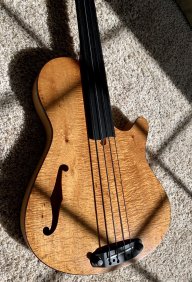
I posted this in another fretless thread. Both of these belong to the same person. Neither have board or side dots.

94030665_643316189851813_6827059308237160448_n.jpg


93625963_639255160257916_3127597289481175040_o.jpg
 
I think you are wrong. It’s a general consensus amongst fretless players that the correct and standard side dot placing on a lined neck is in between the lines not on. That’s why the vast majority of fretless basses have them placed that way.

I think the only reason it may be considered "standard dot placement on a lined neck" is because the neck has been taken off the line before the frets are installed. The fret slots are filled, and the builder can offer a fretless bass with little or no modification to their production process. If there are no frets, the side dots are no longer a fingering target. Use the dots and you will be flat - so to me, they're in the wrong place. I don't know if it's a general consensus or not, could be, as I imagine a good amount of players buy production, lined fretless basses. What ever works.
 
Last edited:
Except, by the time you feel you're off (in other words, you heard it, as did everyone else), it's too late. You've now played out of tune.

I mean, yea, we all correct after we hear it, but a tool that lets you hit it in tune before you hear it out of tune and realize and correct it? That's invaluable.

In the studio - you don't waste everyone's time retaking the bass part so it's in tune on every note.

Live - you can't always hear yourself well on stage... unless you use IEMs, when moving around, etc... so having fret lines can be the difference between playing in tune and not even knowing you were off.

I don't find fret lines to be a tool, I find them to be a distraction.