• TalkBass has been independent since 1998. Add your voice.
    Create a free account to reply to discussions, view embedded media, and browse with fewer display ads.
    Join freeLog in
    Want zero display ads or expanded classifieds tools? Compare plans.

Thoughts on this bass?

The most commonly seen type of pet armadillo is the three-banded armadillo, which includes both Brazilian and southern types. The southern variety of this armadillo was once thought to be extinct due to habitat destruction and the pet trade.

The screaming hairy armadillo is also kept as a pet but it is less popular than the three-banded variety. Its name comes from the noise this armadillo makes when handled or threatened, and it also goes by several names, including the screaming armadillo, the dwarf screaming armadillo (due to its small size), the crying armadillo, and the small hairy armadillo.

The other type of armadillo that you might happen upon as a pet is the big hairy armadillo, which is larger than the three-banded and screaming hairy varieties.
 
The most commonly seen type of pet armadillo is the three-banded armadillo, which includes both Brazilian and southern types. The southern variety of this armadillo was once thought to be extinct due to habitat destruction and the pet trade.

The screaming hairy armadillo is also kept as a pet but it is less popular than the three-banded variety. Its name comes from the noise this armadillo makes when handled or threatened, and it also goes by several names, including the screaming armadillo, the dwarf screaming armadillo (due to its small size), the crying armadillo, and the small hairy armadillo.

The other type of armadillo that you might happen upon as a pet is the big hairy armadillo, which is larger than the three-banded and screaming hairy varieties.
When I was a kid, and most other kids favored dinosaur toys, the Tyrannosaurus or Brontosaurus, etc, I always liked the prehistoric mammals. For some reason, this one in particular.
 
That bass is not played hard it's just nasty and abused. That fret treatment was common back then and was, IMO, not effective. Try to replace them and Ill bet the binding comes with them. 70's basses are not magical mojo monsters and that one is a mess. There is no telling what shape the wiring and truss are in and I wouldn't trust anything that seller says.

Take that 1600 and find a nice used modern MIA Jazz and you'll have way more bass and maybe have some nice change left over.
 
Someone worked very hard but not very intelligently to make the bass look old. The cigarette burn on the headstock is just sad because while on a guitar a cigarette will stick there on a bass it won't. People used to do this to give guitars mojo. Nothing about this thing looks right to me but it is such a mess that maybe it is what they say it is. Not a Fender expert by any means.
I agree this bass is a mess. I disagree about the cig burns. I have personally done it on 2 jazzes (back when i did smoke).
 
  • Like
Reactions: Wisebass
Hi rufus. K :)

I agree this bass is a mess. I disagree about the cig burns. I have personally done it on 2 jazzes (back when i did smoke).

I confirm! Cig stains on Fender basses are doable. (have one on my Avatar Jazz)

On vintage basses that survived the 80s they are quite normal. :smug:

But honestly, this looks like some caveman used the bass as a torch holder!

(How stoned do you have to be, to forget a doobie of that size :banghead: :rollno:)

torch stain.jpg


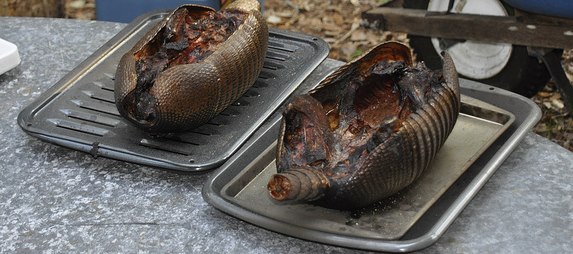
Back on topic: Has someone experience with cig stains on his vintage Armadillo? :laugh:


greetings


Wise(b)ass
 
  • Like
Reactions: rufus.K
I thought they were a protected species!!
I seriously doubt it.

The nine-banded armadillo has been rapidly expanding its range both north and east within the United States, where it is the only regularly occurring species of armadillo. The armadillo crossed the Rio Grande from Mexico in the late 19th century, and was introduced in Florida at about the same time by humans. By 1995, the species had become well established in Texas, Oklahoma, Louisiana, Arkansas, Mississippi, Alabama, and Florida, and had been sighted as far afield as Kansas, Missouri, Tennessee, Georgia and South Carolina. A decade later, the armadillo had become established in all of those areas and continued its migration, being sighted as far north as southern Nebraska, southern Illinois, and southern Indiana. The primary cause of this rapid expansion is explained simply by the species having few natural predators within the United States, little desire on the part of Americans to hunt or eat the armadillo, and the animals' high reproductive rate. The northern expansion of the armadillo is expected to continue until the species reaches as far north as Ohio, Pennsylvania, New Jersey and Connecticut, and all points southward on the East Coast of the United States.

Outside the United States, the nine-banded armadillo ranges southward through Central and South America into northern Argentina and Uruguay, where it is still expanding its range.
 
hi jd56hawk :) talkarmadillo :D


Afaik half of the existing species are endangered (of those who exist only in South America)


Their Asian cousins (the pangolins) are nearly extinct!

Their "scales" are used in traditional abracadabra medicin. :(

They don 't even grill them like uncle Buford! :crying::rage:

greetings

Wise
Yes, there are many species of armadillos that are endangered and/or threatened. There are about twenty different species of armadillos, but of these twenty different species, only one appears to be increasing in number, the nine banded armadillo.
 
  • Like
Reactions: Wisebass
that seller seems like a bit of a kook. Lots of all-caps words and "!!!!!"s lead me to believe he's tired of the thousands of "Weight?" and "What's the radius" messages he's definitely gotten from people who are never ever going to buy the thing.

I do appreciate the amount of armadillo knowledge on display on this thread. I'm learning a lot!
 
I once helped a friend clean out a garden shed, found a bass there that had just been put on the dirt and covered with random other stuff. When I pulled it out it looked like a black bass, after cleaning I found out it was sunburst so I cleaned it up and put on some strings and it played fine.
My friend told me it belonged to a cousin who stored it there for at least 12 years, it looked nowhere near as damaged as this bass. I've played some great vintage basses, yes they are worn, yes they may be a little rough around the edges, this one is just abused, looks like it's been through a fire, a flood and a disrespectful owner. PASS.
 
  • Like
Reactions: ajkula66
Stupid armadillos keep digging up my yard...and they've never found anything that looks as bad as that bass.

You can't blame lawn-diggers for doing what they do. Blame the stuff they're digging for. Usually grubs and bugs. I had non-armadillo lawn digging problems last year (mostly skunk, raccoon, fox, etc.) and realized that you can't do anything to the diggers, you have to go after the bugs. This year I engaged in biological warfare...sprayed nematodes (microscopic worms!! You can buy anything online these days, y'all). Then I spread milky spore (bacteria). This has lowered the population of grubs and thus stopped the critters from digging.

I also have a lovely garden shed...that doesn't hold any basses. The basses get to stay in the house.
 
  • Like
Reactions: Duder