Ahem.For all you slackers, notice all the straight nuts

TalkBass has been independent since 1998. Add your voice.
Create a free account to reply to discussions, view embedded media, and browse with fewer display ads.
Join free Log in
Want zero display ads or expanded classifieds tools? Compare plans.
Ahem.For all you slackers, notice all the straight nuts
Ahem.Sorry, ball ends
The seller is a bozo. Saying it's a tube amp? And Flea used a Grexa reissue briefly. All that said, it looks like it's in really nice shape.No affiliation - just saw it on eBay. local (Santa Fe) pick-up - seems like a decent price if you want this much bass.
Acoustic Corp 360 bass head + cab vintage TUBE amp Jaco, Flea, John Paul Jones | eBay
Not a single tube anywhere in any of those boxes unless somebody dropped one in and it's just rattling around.tube 'pre'amp
The power amp is in the basement, but it's all solid state. A preamp pedal like that might be pretty great. I already have an original 360 preamp and a Grexa reissue 360 preamp to go along with the original 361 Power Plus cabinet and Grexa reissue Power Plus cabinet. Buying one of those would just be gratuitous. It sure would be more portable, plus it would work as a DI.There you go, I always thought tubes were at the bottom of the speaker cab. This is interesting - as it says in the ad; "it is much more portable than the original"
DiCosimo Audio 360+ Bass Preamp (Acoustic 360) | Reverb

I worked at horse-race track in Omaha, Nebraska during the summers in the '70s. One of our jobs was sweeping the grandstands littered with cups, paper-trays, race forms and ticket-stubs after the days races. We saw regular down-&-outs lose big-time every day. Betting's never been in my blood and seeing all that money squandered reinforced my lack of interest.
Mussolini?Exactly. A Roman horse's ass is the driving factor for railroad gauge.
IIRC the one greyhound race track that I’ve attended had the dogs running counter clockwise, the same as our horse tracks here in the US. Not to mention NASCAR oval tracks and many but not all US closed circuit road race tracks, or track and field running and speed skating on ice, motocross and I think even the banked cycling tracks and the roller derby tracks are run counter clockwise here. The exceptions in the US I can think of are Grand Prix/Formula 1 races, Indy runs both ways (fortunately not at the same time) and Watkins Glenn runs Clockwise.Not that I know about. I not really into horse racing but have seen a few.
I suspect that when they started the colony of Melbourne it could have been just as simple as “don’t do what Sydney does”
The greyhounds in Sydney race anti clockwise though. Just to make things less clear, I’m not sure about the trots and pacers though. My dim memory seems to suggest anticlockwise but maybe they switch around track to track. I’m not much into losing money so I really have nothing more that a social interest. Barely that.
Western Europe has one gauge and eastern Europe has another gauge. I only know this because Ukraine is eastern gauges and has been rebuilding destroyed lines to western gauge. I don't know what either is. I believe eastern is wider. I guess eastern Rome had fatter horses' asses.The colonies here had different rail gauges and you used to have to change trains at the border to get on a local sized train. Since Federation (1/1/1901) they found that wasn’t a great idea for fostering trade among the States (which is what the Colonies became). Took years and years but now the Interstate tracks are all the same guage. i think the local cities have kept their odd sizes. NSW I think is standard 4'8.5". But the Govt is rushing a "Metro" into Sydney which I think is standard gauge but driverless and promising service every 4 or so minutes. Started with serving areas that never had ‘heavy rail’ but now about to replace a (relatively short for Sydney) route.
From wiki.
In the 19th century, each of the colonies of Australia adopted their own gauges. However, with Federation in 1901 and the removal of trade barriers, the short sightedness of three gauges became apparent. It would be 94 years before all mainland state capitals were joined by one standard gauge.
The three main railway gauges in Australia are narrow: 1,067 mm (3 ft 6 in), standard: 1,435 mm (4 ft 8+1⁄2 in), and broad: 1,600 mm(5 ft 3 in); a slow progression towards unification to standard gauge has taken place since the 1930s.
Rail gauge in Australia - Wikipedia
Or perhaps more accurately; preaching to the rhythm section...Preaching to the choir, lol.
F1 has tracks that run in either direction depending on their location.IIRC the one greyhound race track that I’ve attended had the dogs running counter clockwise, the same as our horse tracks here in the US. Not to mention NASCAR oval tracks and many but not all US closed circuit road race tracks, or track and field running and speed skating on ice, motocross and I think even the banked cycling tracks and the roller derby tracks are run counter clockwise here. The exceptions in the US I can think of are Grand Prix/Formula 1 races, Indy runs both ways (fortunately not at the same time) and Watkins Glenn runs Clockwise.
I used to do a lot of handicapping for horse races. It’s mostly about probabilities and statistics plus a pinch of intuition. Never had a loosing day at the tracks, I always walked out with more than I came in with. Yes, I lost money on individual races but that was always more than offset by the winnings on the other races that day.I've only ever been to a horse race track once.
In my United Airlines days.
Most of the people i worked with were regulars to that sort of thing.
Long story short.
They asked me to go with them one time.
We made the last 3 races.
They said since i'm a newbie, i should pick the horses.
The first 2, i picked the winners.
The last race i played the trifecta, and one on all 3.
I walked away with 500 or so dollars and those guys made a killing.

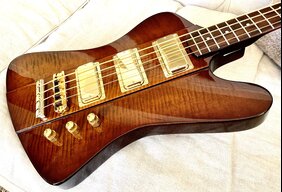
There are three holy grails in the sub $1200 Tbird line up. And any of the three will do what you’re asking, but one will do it in spades. The three are:
1) Epiphone CP - it is a modern Gibson Thunderbird by every measure, in standard tuning it will lay back in the mix a bit more than the other two but is absolutely no slouch. It can be a bit darker in overall tone than the VP. If you are patient you can find mismarked CPs on the used market priced at regular Eppi Tbird prices for a steal but the more common price is up around $800.
2) Epiphone VP - it is very near a vintage 1960’s Gibson Thunderbird in sound and general looks, in standard tuning it will be a bit more aggressive sounding than the CP and should sit more forward in the mix. It can have a bit more grind and growl than the CP. The white VP is very much in demand on the used market so expect to pay a couple hundred dollar premium for it over a black or stained VP, which usually run about $600 on the used market. If it comes with a case it’s a big plus, very very few after market cases are big enough to hold a VP.
3) Greco IV - it is very much a unique monster, neither classic or modern, but a full on balls to the wall hard rocker. Think of it as the demon child of a P bass and a Tbird but possessed and on steroids. Fantastically deep and rich on the bottom end yet still articulate and detailed on the top end all while blasting out volume levels that make the other two basses above blush. The neck is a bit chunkier than the other two but not to P bass levels. It’s a Japanese copy of the Gibson Tbird but varies a bit in construction details. Good deals on these are getting harder to find but basically any all original player condition Greco Tbird under $1200 is a good deal. Important note: the magic of this beast is in the pickups (and the placement of the pickups) if the pickups aren’t original don’t waste your time looking at it.
Personally the order I’d consider these three options is Greco as first choice (extra credit for a late 1970’s model), CP as second choice (extra credit for a 2013 model), VP as third choice (extra credit for an early release pre September model). And any of them in white as first color preference.
Didn’t know that existed. My CP with EBCF needs that big time. The silks are all different lengths and all too long.
I did the opposite when riding most of the time, from what I recall. Left stayed on the pedal and left went on the ground.
Then it's possible it's just tradition began with horses for whatever reason. Are dog races also counter-clockwise?
LOL!….funny you should say that, we used to call him “Face”…
View attachment 5005521
We moved to less than a quarter mile (more like 100-200 yards) from train tracks when I was five. I loved the trains, including all their noises, perhaps because I had heard cowboy and folk songs about them as long as I could then recall. Since the tracks were in the desert with no road crossing them for several miles, some of the trains would fly by. A friend and I would stand as close to the tracks as we could when this happened, bouncing in the wind like trees in a gale.I grew up with trains running about 1/4 of a mile from my house, we used to play around the tracks a lot when we were kids and squash pennies, etc.. A train used to run late at night every night and the whistle used to scare me. One night I was going to quit all my teddy bears which I slept with every night and put them all in the toy box and went to bed. The train woke me up and I went and rescued all my teddy bears because I knew they were afraid.A little projection maybe?
Pricing would be the question...
Unless it's an older, metal tube, it won't rattle intact for long!Not a single tube anywhere in any of those boxes unless somebody dropped one in and it's just rattling around.


