Very informative wood working lesson! Thanks for taking the time to post it.Let me explain that, I think it's very relevant in guitar making and the understanding of how stable they may be. If I can refer to @GBassNorth's picture (Thanks G) below.
Wood as we all know moves with changes in it's moisture content but it doesn't move equally in all directions. Along it's length it hardly moves at all, it's so insignificant we can forget it. Across the grain though it does move but again not equally, it tends to move most in the direction of the annular rings of the wood rather than across them. We all have seen a plank of wood with the end grain that resembles a semi circle and the plank has cupped badly, that's because the shrinkage was following those lines more than across them if that makes sense.
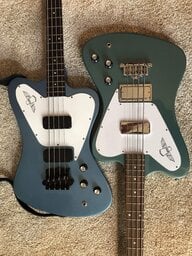
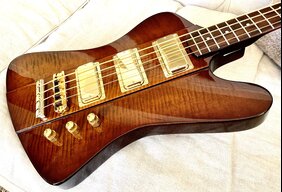
If we refer to G's photo we can see the outer wings have the annular rings orientated almost directly up and down, this is quarter sawn wood, it has been cut very almost radially from the tree. The major movement in this wood will be in it's thickness, so very small, yes it will move from side to side but not so much; that wood is very stable and is ideal for making things that need to be stable: guitars, furniture etc. The downside of quarter sawn wood is it is very plain, it tends to be just straight lines which is why luthiers use a capping timber. That you can now see has it's own problem in that it moves differently to the wood it is stuck to and can cause cupping or telegraphing at the outer edges or in the worst case scenario it can cause self destruction of the object although the chances are near zero if solid wood is used and the long grain is in the same direction. So what gives with G's expensive bass? well the makers are no idiots, they will have chosen a wood for the capping that moves less than the base wood so they even out more, also the capping isn't full width, only over the wings minimizing any movement differences. That isn't the case for every bass on the market that uses a capping wood but now you can make an extra informed judgement on their quality
View attachment 3092071
See how bloody bored I am??!!
Cherry! Always a welcome sight in my collection. Mike Pedulla does it right with figured maple (my only fretless)...My favorite flavor, cherry red...on Honduras Mahogany.
View attachment 3092351
Neck is maple, ebony board, CF reinforcement, headstock trussrod adjust.
But mahogany would be interesting as well.