
Enjoy the benefits of a premium membership!
Upgrade Account
-
TalkBass has been independent since 1998. Add your voice.
Create a free account to reply to discussions, view embedded media, and browse with fewer display ads.
Join free Log in
Want zero display ads or expanded classifieds tools? Compare plans.
You are using an out of date browser. It may not display this or other websites correctly.
You should upgrade or use an alternative browser.
You should upgrade or use an alternative browser.
Thunderbird Club
- Thread starter TBird1958
- Start date
-
- Tags
- club thunderbird
More options
Who Replied?

Guitar shop got back to me, $500.00 to bind my Blackbird body, neck, and head stock in red. That's routing, any paint, and clear coat. Totally worth it, just not in the budget right now.
And now for something completely different:
I'm not sure how many people on here have one but can anyone weigh in on neck stability of the Gibson Blackbird? (I'm not talking about the Epiphone version) By 'neck stability' I specifically mean bow/back bow changes due to temperature swings. This is the situation, and it's repeatable:
70 degree basement to summer heat (80 - 90 deg F) for an hour and the truss rod needs adjustment. I can't leave it in the car at all, it's got to go RIGHT inside, and forget playing outdoors. Guy at guitar shop said it's a known issue specifically with the Blackbird but he also offered to sell me a new bass so I figured I'd check here with y'all.
I like the way it plays and sounds once it's stable but I took it to record something for a friend a couple weeks ago and felt like an ******* because it looked like I didn't have my poopie together sitting on the floor diddling the truss rod. Maybe if I wasn't such a princess about my 6/64 string height it wouldn't be a big deal.
Anybody have this problem with a 'real' Thunderbird? Anyone else have same problem with their Blackbird? Are my expectations ridiculous?
Nikki Sixx has a Twitter account, guess I could try to get his attention on there and see what he has to say about it since it was his specification.
Thanks for your time and any input you can offer.
My 2014 has a sensitivity to humidity as well. That said, my action is a little higher and I just play it and adjust it later. Most Thunderbirds will require a bit more adjustment more so than say the two fender's that I own.
Adjusting truss rod action to tweak string height (if nothing was fretting out) in a "live" situation, seems a bit "Princess and the Pea" to me. I have become much less "precious" about small things since I started gigging fairly regularly again. I can use almost any amp or cab now when previously I "had" to have mine or things were "terrible"!?


I understand recording is bit different but in reality the higher action generally speaking will give you a bit of a fatter tone when recording.
Maybe just set the action a bit higher and acclimate to that? I think the music store guy was hoping to get you trade in your Blackbird and a new bass that didn't have "problems"........


My 2014 has a sensitivity to humidity as well. That said, my action is a little higher and I just play it and adjust it later. Most Thunderbirds will require a bit more adjustment more so than say the two fender's that I own.
Adjusting truss rod action to tweak string height (if nothing was fretting out) in a "live" situation, seems a bit "Princess and the Pea" to me. I have become much less "precious" about small things since I started gigging fairly regularly again. I can use almost any amp or cab now when previously I "had" to have mine or things were "terrible"!?
I understand recording is bit different but in reality the higher action generally speaking will give you a bit of a fatter tone when recording.
Maybe just set the action a bit higher and acclimate to that? I think the music store guy was hoping to get you trade in your Blackbird and a new bass that didn't have "problems"........
My Epi IV is always a smidge out of tune after transporting, but just barely. It’s little different whether that’s a 10 minute drive to church or it sits in my car in the parking garage all day.

Adjusting truss rod action to tweak string height (if nothing was fretting out) in a "live" situation, seems a bit "Princess and the Pea" to me.
You've given me a different perspective, I never thought about simply adjusting the string height. I adjusted the truss rod because I knew that was the problem but the complaint is actually string height.
I understand recording is bit different but in reality the higher action generally speaking will give you a bit of a fatter tone when recording.
I did not know that, thanks for the tip.
I think this weekend I'll spend some time with feeler gauges and actually quantify the amount of change, which I probably should have done anyway.

- Jun 30, 2010
- 49,588
- 221,962
- Disclosures
- musician/artist/owner - Gildaxe
Great! Now I need to change my shorts again...
Stop posting pics of that amazing awesomeness!


Depending upon how and where you're measuring that string height, a 3/32" setting might be the problem. Can you elaborate on how you measure that height (i.e. Is it at the 12th fret on the E string when not depressed, or cappo on fret one and depressed at 17 then measured at 12...). Just want to make sure we're all talking apples to apples. I'm a low action fanatic but haven't had any real problems with neck movement.....Maybe if I wasn't such a princess about my 6/64 string height it wouldn't be a big deal....
Disclaimer: I make it a habit not to ever leave a bass in the car for any significant time (other than transporting). Heat and humidity can swing pretty wildly in a parked car and can do serious damage to some finishes, not to mention wreaking havoc on neck bow.

That's bad a$$!
You've given me a different perspective, I never thought about simply adjusting the string height. I adjusted the truss rod because I knew that was the problem but the complaint is actually string height.
I did not know that, thanks for the tip.
I think this weekend I'll spend some time with feeler gauges and actually quantify the amount of change, which I probably should have done anyway.
I did the same thing with the feeler gauges to establish a "Normal" for when I need to make adjustments. The funny thing is that a couple of times there were no adjustments that were needed, even though to me, things felt "off". It has helped me not value my own opinion so much.....
Over the course of 35 years playing, I've toured across this country from one extreme to the other: hot, cold, humid, dry, etc. In each city, we take out our instruments, tune, level check, play, pack 'em back up and never once think/ worry about truss rod, string height, pickup height or other set up type adjustments.
Do folks have these issues with their house and cars warping in the weather too?
"Can't make it to the party this weekend, I have to adjust the trusses in the attic."
"Sorry, I'll be late for work today, my car sat in the cold all night and I have to wait for the wheel bearings to acclimate to the daytime temps before I can drive the vehicle."
I guess I'll never understand ¯\_(ツ)_/¯
Do folks have these issues with their house and cars warping in the weather too?
"Can't make it to the party this weekend, I have to adjust the trusses in the attic."
"Sorry, I'll be late for work today, my car sat in the cold all night and I have to wait for the wheel bearings to acclimate to the daytime temps before I can drive the vehicle."
I guess I'll never understand ¯\_(ツ)_/¯
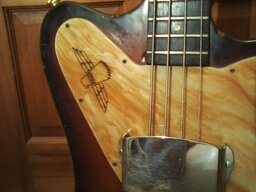
The 67 NR stays in the van(more air circulation)from house to gig-and back. It's never been in a trunk and it's the first thing back in the house after I turn off the alarm system. Still, I've been reluctant to take it to outdoor gigs here, where the heat's been in the 90s and the humidity's about the same.Depending upon how and where you're measuring that string height, a 3/32" setting might be the problem. Can you elaborate on how you measure that height (i.e. Is it at the 12th fret on the E string when not depressed, or cappo on fret one and depressed at 17 then measured at 12...). Just want to make sure we're all talking apples to apples. I'm a low action fanatic but haven't had any real problems with neck movement.
Disclaimer: I make it a habit not to ever leave a bass in the car for any significant time (other than transporting). Heat and humidity can swing pretty wildly in a parked car and can do serious damage to some finishes, not to mention wreaking havoc on neck bow.
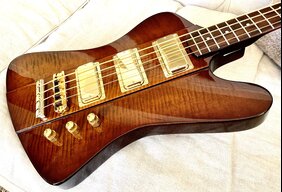
Walnut Wednesday, I can do that...
Spector NS2-J Woodstock Special Edition #10 of 14 made
Highly Figured 5A Flamed Walnut top on a Walnut back...
Oh look... here it is with a THUNDERBIRD shaped object...

- Jun 30, 2010
- 49,588
- 221,962
- Disclosures
- musician/artist/owner - Gildaxe
Great! Now I need to change my shorts again...
Stop posting pics of that amazing awesomeness!
 It was requested! (thanks!) I have been using this bass (Deadlybird IV) for my power-trio project SMF. (original pop-rock) I run it through an SWR 400s head and a 15" driver (maybe JBL? I'll have to check- it's a mongrel cab) The pu poles are aligned to vintage T-bird specs and the (Epi-Goth) body has been majorly chambered/lightened. Pat Wilkins did the satin black finish. It's a bass that delivers all things T-bird, but with (Curtis Novak Darkstar/Bi-Sonic) singles. (500k pots) If you did an A/B test with a bucker IV, it would for sure sound different - but when you play a T-bird related bass (Fenderbird, Spectorbird, Kramerbird, etc) it will always end up sounding like a THUNDERBIRD.
 I love that beast you built! And every time I get a glimpse of it, my brain starts filling up with ideas of new pups, routes, pup switching possibilites and finish on my Epi VP
Can you elaborate on how you measure that height.
String height:
measure and adjust each string to 6/64 at 12th fret.
Neck action (or whatever it's called):
Capo on 1st fret, fret at 17th, make sure I can get a credit card or driver's license between the fret and string at whatever fret is in between those two points, I don't recall at the moment...
Not real scientific at all but I think we're talking about the same thing. The bottom line is that it's stable and plays well until the env changes.
Maybe 6/64 is unreasonable for this bass, I don't know what the 'official' Gibson spec is (or where to find it). That might clear this all up pretty quick.
Thanks!

Gaolee
Official leathers tester and crash dummy
Ah, that explains why Thunderbirds chose you. If you were a Yankees fan, they would have told you to take a hike.And I'm a lifelong Mets fan.
Gaolee
Official leathers tester and crash dummy
It was either that or shoes. Don't you wear nail polish when you don't feel like wearing shoes?Never figured you for someone who wears red nail polish on your toes...
Gaolee
Official leathers tester and crash dummy
I have not had stability problems with Epi or Gibby Thunderbirds so far. None are Blackbirds, so I cannot comment on those. They move a little when the temperature or humidity change, but not so much that they are unplayable. Just a little out of tune for a moment. I'm also not the most sensitive person when it comes to setup. I'll play pretty much anything and be happy, so take that in consideration.Guitar shop got back to me, $500.00 to bind my Blackbird body, neck, and head stock in red. That's routing, any paint, and clear coat. Totally worth it, just not in the budget right now.
And now for something completely different:
I'm not sure how many people on here have one but can anyone weigh in on neck stability of the Gibson Blackbird? (I'm not talking about the Epiphone version) By 'neck stability' I specifically mean bow/back bow changes due to temperature swings. This is the situation, and it's repeatable:
70 degree basement to summer heat (80 - 90 deg F) for an hour and the truss rod needs adjustment. I can't leave it in the car at all, it's got to go RIGHT inside, and forget playing outdoors. Guy at guitar shop said it's a known issue specifically with the Blackbird but he also offered to sell me a new bass so I figured I'd check here with y'all.
I like the way it plays and sounds once it's stable but I took it to record something for a friend a couple weeks ago and felt like an ******* because it looked like I didn't have my poopie together sitting on the floor diddling the truss rod. Maybe if I wasn't such a princess about my 6/64 string height it wouldn't be a big deal.
Anybody have this problem with a 'real' Thunderbird? Anyone else have same problem with their Blackbird? Are my expectations ridiculous?
Nikki Sixx has a Twitter account, guess I could try to get his attention on there and see what he has to say about it since it was his specification.
Thanks for your time and any input you can offer.
From https://www.google.com/url?sa=t&rct...20Manual.pdf&usg=AOvVaw0on9nQhug_13IKdVyk-CcDString height:
measure and adjust each string to 6/64 at 12th fret.
Neck action (or whatever it's called):
Capo on 1st fret, fret at 17th, make sure I can get a credit card or driver's license between the fret and string at whatever fret is in between those two points, I don't recall at the moment...
Not real scientific at all but I think we're talking about the same thing. The bottom line is that it's stable and plays well until the env changes.
Maybe 6/64 is unreasonable for this bass, I don't know what the 'official' Gibson spec is (or where to find it). That might clear this all up pretty quick.
Thanks!
$4. Well. Spent.
I was able to get the nut to my liking in a few minutes with the files.
Stoked!
So, here is how it looks.
Should I file down the top of it so that only 1/2 the string sits in there? It seems like i should....


