
What noone has said so far is, when 5 string basses started to come out, not many people were buying ANY Fender basses - we’d been completely underwhelmed by what they made for all of the 70’s - Fender, at that time, was literally your father’s Oldsmobile. Other companies were making better stuff, so Fender got behind on 5’ers.

Enjoy the benefits of a premium membership!
Upgrade Account
-
TalkBass has been independent since 1998. Add your voice.
Create a free account to reply to discussions, view embedded media, and browse with fewer display ads.
Join free Log in
Want zero display ads or expanded classifieds tools? Compare plans.
You are using an out of date browser. It may not display this or other websites correctly.
You should upgrade or use an alternative browser.
You should upgrade or use an alternative browser.
Why did Fender fail to capture the 5 String market?
- Thread starter SgtHulka
- Start date
More options
Who Replied?

GHS developed the first low B string for Alembic in the mid 70's.Was a low B string really available back then? I’m asking because I really don’t know and didn’t live in the 1960s or the 1970s for that matter.

Agreed - the Roscoe Beck 5 is seriously underrated, particularly for a passive 5 with plenty of tone options. I wonder why they discontinued the model/concept.Floppy B string? Never noticed.
View attachment 3692692
But Fender did themselves no favors when they stopped making the Roscoe Beck 5'r.

Fond memories, late 80’s/early 90’s - customers bought a ton of F-Basses (especially 5’s) as well as Wal Basses (especially 4’s thanks to Geddy Lee.)I know George Furlanetto of F bass was around in the late 1970s too...so was Wal. There was a big boom happening in the late 70s / early 80s to design the right 5 strings. I believe the first Wal MK2 was created in 1986 or slightly earlier.
I recall a Bass Player shootout in the mid 90s. They weren’t particularly impressed by a few basses that they considered to be a 4 string with a B added, rather than a truly integrated 5. I think smaller builders were able to produce high quality instruments with a proper B at a scale that Fender couldn’t match. Not to knock Fender, but I’m glad other builders were able to get a foothold.


GHS developed the first low B string for Alembic in the mid 70's.
Hasn't LaBella been around longer as a string company though?
They've made strings for centuries I think.
Maybe they didn't have their own Low B....hard to say.
That could be worth checking into the history.

Because they can't innovate and their die hard players won't let them.
Fond memories, late 80’s/early 90’s - customers bought a ton of F-Basses (especially 5’s) as well as Wal Basses (especially 4’s thanks to Geddy Lee.)
I have a 1988 Wal MK2.....I was 7 when this bass was made and it was when I began learning to play the Piano.
So, this bass has some meaning to me. It would have been a blast to have been 16 in 1980 or so since I'm so into 5's.....but unfortunately, I didn't show up until 1981!

Hasn't LaBella been around longer as a string company though?
They've made strings for centuries I think.
Maybe they didn't have their own Low B....hard to say.
That could be worth checking into the history.
Hmmm.....1640's.....320 years on the 60's! LOL
But they were making violin strings back then.
La Bella Strings
It was Danelectro that made the first 6 string bass?
Extended-range bass - Wikipedia
Well, if wikipedia is right.....Fender made the first 5 in 1965?
Interesting that it was right when the CBS buyout occurred.
Extended-range bass - Wikipedia
Well, if wikipedia is right.....Fender made the first 5 in 1965?
Interesting that it was right when the CBS buyout occurred.
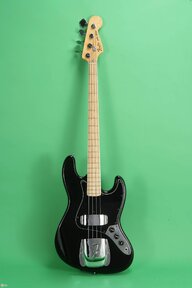
I dabbled in 5s for a short time, the Fender didn’t work for me the way the EBMM did.
I had a Sterling 5 string about 2-3 years ago, and found the neck profile to be excellent.
If Fender is not for you, there are a ton of Fender style basses to chose from like Performance.

It does notWhy does an inline headstock create a floppy B string?
I suppose aside the 5 string never really took off because a huge part of Fenders market are very conservative. Innovation and forward thinking is not what their customers want - this is a story that has repeated itself many times in the company's history.
Yup. The right answer. Would be kinda like if Cadillac made a pick-up truck. Oh wait...

The whole idea behind the 15 fret Fender V was to aid readers in the studio. The idea was that more high notes would be in lower positions with a high C. Folks who already knew their way around a fretboard saw no need to change.
Don’t underestimate Fender’s impact on the five string bass market. Fender is marketing at least four Fender Jazzes and a Precision with five strings, and at least two Squiers with five strings. In the world beyond Talk Bass boutique Jazz fans, five string Fenders are seen as a very viable option.
Just about every cover band I have seen in the past ten years featured a Fender 5 string. Occasionally a musicman or Warwick. That's about all I see in the wild.


scottfeldstein
Roots and fifths and a little extra.
I haven't read all the comments here, but I thought I would chime in to say that I have a 2002 Fender MIM Deluxe Active Jazz V. I also have a 2014 Warwick Rockbass Corvette $$ fiver. Both of these instruments have new, 2020 counterparts that sell for $925-$1,199. The Fender was made in Mexico, the Warwick in China.
Fender: It sounds...juicy. A little scooped, but with a nice juicy sizzle when you pop that G string. It weighs approximately 9,000 pounds, though. The bridge is pretty iffy. I can't get the B string height below 6/64s to save my life, and it still rattles if I'm not careful. It has a very weak output, even though it's an active bass.
Warwick: These humbuckers have big balls. The whole instrument feels high quality. I love the ergonomic tuners and the painted-black headstock. The body shape is exquisite. The neck is phenomenal. I have all strings, B to G, at just above to just below 4/64s and not a buzz to be found. I think the D and the G could go even lower. This thing is a joy to play and the B is super solid. On top of that it has a mechanically adjustable nut. Nice. The output of this thing is lightyears above the Fender. Way louder.
Fender: It sounds...juicy. A little scooped, but with a nice juicy sizzle when you pop that G string. It weighs approximately 9,000 pounds, though. The bridge is pretty iffy. I can't get the B string height below 6/64s to save my life, and it still rattles if I'm not careful. It has a very weak output, even though it's an active bass.
Warwick: These humbuckers have big balls. The whole instrument feels high quality. I love the ergonomic tuners and the painted-black headstock. The body shape is exquisite. The neck is phenomenal. I have all strings, B to G, at just above to just below 4/64s and not a buzz to be found. I think the D and the G could go even lower. This thing is a joy to play and the B is super solid. On top of that it has a mechanically adjustable nut. Nice. The output of this thing is lightyears above the Fender. Way louder.

Can someone explain to me what the bass itself has to do with a B string feeling floppy? Other than the stiffness of the neck or the scale length. Isn't this a function of the string itself rather than the bass? Given two basses of the same scale length, how could the identical B string feel floppy on one bass and not feel floppy on the other?
I've got a first year BB5000 with the narrow spacing. The neck is not just a BB3000 neck divided into 5. It is wider (and fatter) than a BB3000 and it has 24 frets. Yes it is very tight spacing but not nearly as tight as it would be if they just slapped 5 strings on a BB3000 neck. It came with very light strings but with modern 5 string set I don't notice the B feeling any floppier than any other 5 string bass of the same scale length. It isn't as stiff as a neck with carbon rods but it is a 5 piece laminate neck and seems reasonably stiff to me.
Anyway ... hoping someone can explain since I've read so many times that the early basses had floppy B strings. I'd like to know what property of the bass (other than neck stiffness and scale length) you think causes a B string to feel floppy. I want to call it a myth but my mind is open to being edumacated if there actually is something there that I'm not seeing.
I've got a first year BB5000 with the narrow spacing. The neck is not just a BB3000 neck divided into 5. It is wider (and fatter) than a BB3000 and it has 24 frets. Yes it is very tight spacing but not nearly as tight as it would be if they just slapped 5 strings on a BB3000 neck. It came with very light strings but with modern 5 string set I don't notice the B feeling any floppier than any other 5 string bass of the same scale length. It isn't as stiff as a neck with carbon rods but it is a 5 piece laminate neck and seems reasonably stiff to me.
Anyway ... hoping someone can explain since I've read so many times that the early basses had floppy B strings. I'd like to know what property of the bass (other than neck stiffness and scale length) you think causes a B string to feel floppy. I want to call it a myth but my mind is open to being edumacated if there actually is something there that I'm not seeing.


