• TalkBass has been independent since 1998. Add your voice.
    Create a free account to reply to discussions, view embedded media, and browse with fewer display ads.
    Join freeLog in
    Want zero display ads or expanded classifieds tools? Compare plans.

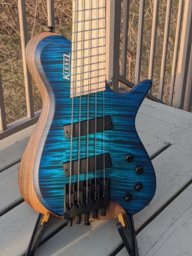
Won the Wal pickup on ebay!!!

Status
Not open for further replies.
That's a fairly recent Wal in your photo. Alembic did the filters first, starting back in 1968, and were in Jack Cassidy's bass in 1972. The Series I schematic I have is from 1977. It was updated to the Series II in 1980. Wal was formed in 1974 and the first basses were nothing like what Alembic was doing. They based the body on a Fender Mustang, and had regular passive electronics, rewound Guild humbuckers and Fender Mustang pickups. It was also a short scale bass. Notice they are using a Gibson EB-2 brige.

[Invalid or Expired Link Removed]


love the way that looks and sounds (in terms of what you said; though I'm sure it sounds killer, tonally as well)
 
What would the impedance of the pickup as a whole be?

Depends on how it's wired up. The Pro series had all the coils in series, so it was around 19.5K for the 4 string pickup.

The Custom basses have the string pairs of coils wired in series and then the whole thing is in parallel. That's about 4.8K for the 4 string pickup.
 
Ok a non related question... since you seem to know alot about pickups it would be a great opportunity to ask about Carvins SP pickups that they advertise as having side by side coil design. What does that mean? And how it differs from any other humbucker?
 
Ok a non related question... since you seem to know alot about pickups it would be a great opportunity to ask about Carvins SP pickups that they advertise as having side by side coil design. What does that mean? And how it differs from any other humbucker?

derail001.jpg

sorry i couldnt resist.
 
Ok a non related question... since you seem to know alot about pickups it would be a great opportunity to ask about Carvins SP pickups that they advertise as having side by side coil design. What does that mean? And how it differs from any other humbucker?

There are several ways to make a hum canceling pickup, but they always involve two coils. To make them sound more like single coil pickups, you want to sense the string in one location, and not two as in a regular humbucker, such as a Music man pickup.

One way to do that is having the coils side by side, as on a P bass. Some Jazz pickups are made that way too. They have two coils next to each other, and each coils sense two strings.

My Jazz pickups are regular dual blade humbuckers, but DiMarzio Jazz pickups, as well as others have the side by side coils.
 
Depends on how it's wired up. The Pro series had all the coils in series, so it was around 19.5K for the 4 string pickup.

The Custom basses have the string pairs of coils wired in series and then the whole thing is in parallel. That's about 4.8K for the 4 string pickup.
So, could you get something that sounds vaguely similar with just a regular two coil humbucker with 4.8 ohms? if so what would the impedance for each coil need to be? thanks
 
So, could you get something that sounds vaguely similar with just a regular two coil humbucker with 4.8 ohms? if so what would the impedance for each coil need to be? thanks

Multiple smaller coils lets you get a good output while keeping a clear tone, because each coil has a lot of turns, but not all that much wire. The number of turns is one of the factors that determines a pickup's output, and not the DC resistance, since that changes with wire gauge and the size of the coil. But it does effect the tone somewhat.
 
Multiple smaller coils lets you get a good output while keeping a clear tone, because each coil has a lot of turns, but not all that much wire. The number of turns is one of the factors that determines a pickup's output, and not the DC resistance, since that changes with wire gauge and the size of the coil. But it does effect the tone somewhat.
But what would you need (impedance or turns) to get something vaguely walish with two coils? Without the clarity I guess.
Sorry for my annoying pestering:hiding:
 
The thing is, define what a Wal sounds like? ;)
Gah! you're frying my brain!:p

I guess what kind of makes the Wal pickups what they are is the fat, yet clear sound. Without the clarity, it might just sound like an MM pickup, right?

Do you think something like an MM pickup would sound similar through the preamp?

Also, do you have any Idea what a humbucker with say, 2.5 ohms per coil would sound like? That's half of what an MM is.

Thanks for responding.
 
Gah! you're frying my brain!:p

I guess what kind of makes the Wal pickups what they are is the fat, yet clear sound. Without the clarity, it might just sound like an MM pickup, right?

Do you think something like an MM pickup would sound similar through the preamp?

Also, do you have any Idea what a humbucker with say, 2.5 ohms per coil would sound like? That's half of what an MM is.

Thanks for responding.

I think what David is trying to say is, there's a whole lot more to the way a pickup sounds that just the DC resistance value.

Mike
 
Gah! you're frying my brain!:p

I guess what kind of makes the Wal pickups what they are is the fat, yet clear sound.

Yes, thick but with a clear top end.

Without the clarity, it might just sound like an MM pickup, right?

No, they are very different designs.

Do you think something like an MM pickup would sound similar through the preamp?

Also, do you have any Idea what a humbucker with say, 2.5 ohms per coil would sound like? That's half of what an MM is.

I used to make pickups like that, the Ultra Wide Band lo-z pickups. They require a preamp, which they used to come with. They had a very natural sound. I'm going to be making them again soon.

My current neo humbuckers get a decent Walish tone.

Check out Link Removed. Near the second half second half, which is through a preamp, I do the riff from Schism. The Sidewinders take that tone and extend the top end way up as only a single coil can. ;)
 
I get that, however impedance is a good way to sum it up. It factors in the number of windings, and the wire gauge.

DC resistance is only good for comparing two pickups wound with the same gauge wire. You can wind 4000 turns of 42 and it might be 4K, but 4000 turns of 43 will be 7K. Then you can wind one with 40 gauge and it might be 2K. One wont be louder than the other, but they will sound different.
 
Yes, thick but with a clear top end.


No, they are very different designs.


I used to make pickups like that, the Ultra Wide Band lo-z pickups. They require a preamp, which they used to come with. They had a very natural sound. I'm going to be making them again soon.

My current neo humbuckers get a decent Walish tone.

Check out Link Removed. Near the second half second half, which is through a preamp, I do the riff from Schism. The Sidewinders take that tone and extend the top end way up as only a single coil can. ;)

Wow, your pickups sound great! Is that a filter based preamp, or a regular preamp?

The reason I'm wondering about all this stuff, is because I would like to make my own pickups when I start building basses. I love the Wal tone, so... yeah.

Also, how exactly do the filters in the preamp work? thanks
 
Wow, your pickups sound great! Is that a filter based preamp, or a regular preamp?

Thanks! That was a simple EMG BTC preamp.

Also, how exactly do the filters in the preamp work? thanks

I believe there is a discussion about the filter in this thread. The filters are active low pass filters, so when you turn the knob you change the frequency that the filters start to cut out the high end.

So you start with the full bandwidth, and then you can take just the highs off or all the way down to a dub tone.

Then there is a resonance control that creates a small boost right at the cutoff frequency, so you can use that as sort of a treble boost when the control is set high.

The Wal preamp also has a "pick attack" switch which boosts the upper mids.

Here's a low pass and high lass filter being swept on a plucked note. The first half is a low pass filter being swept from high to low. Then a high pass filter being swept from low to high.

Link Removed


The Wal only has the low pass filter. The ACG preamp has both. Mine is only going to have the low pass filter and pick attack.
 
Thanks! That was a simple EMG BTC preamp.


I believe there is a discussion about the filter in this thread. The filters are active low pass filters, so when you turn the knob you change the frequency that the filters start to cut out the high end.

So you start with the full bandwidth, and then you can take just the highs off or all the way down to a dub tone.

Then there is a resonance control that creates a small boost right at the cutoff frequency, so you can use that as sort of a treble boost when the control is set high.

The Wal preamp also has a "pick attack" switch which boosts the upper mids.

Here's a low pass and high lass filter being swept on a plucked note. The first half is a low pass filter being swept from high to low. Then a high pass filter being swept from low to high.

Link Removed


The Wal only has the low pass filter. The ACG preamp has both. Mine is only going to have the low pass filter and pick attack.

Cool! I was actually referring to how it works in terms of electrical components. :p I should have been more clear.

This is all super awesome info David! Thanks so much!
 
Cool! I was actually referring to how it works in terms of electrical components. :p I should have been more clear.

This is all super awesome info David! Thanks so much!

Not sure how in the Wal, but in general a low-pass filter is putting the signal input through a resistor in series with a load, and a capacitor in parallel with the load. (Load here being the output).

Edit: or just have a ganders at this lovely picture I found Link Removed

Because capacitors take time to charge, there is more time for the capacitor to get enough charge to give pretty much the same voltage as the input voltage at low frequencies. (low frequency = greater time period. f=1/t) Hence there is an audibly attenuated low-end.

At high frequencies, where there is a smaller time period, the capacitor has less time to charge up before the input signal oscillates (it being a wave and all). Hence the output will have a diminished amplitude because the capacitor has less charge at each oscillation, which gives an audible loss in high-end.

And by altering the value of the resistor (ie, making it a pot), you can change the frequencies at which the filter comes into effect.

Hope that helps :smug:
 
Status
Not open for further replies.