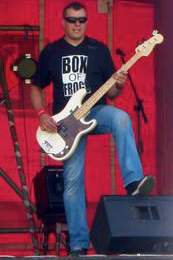
I used a Tronographic Rusty Box this morning. Not sure if it was working in the mix as well as it does for my covers band

TalkBass has been independent since 1998. Add your voice.
Create a free account to reply to discussions, view embedded media, and browse with fewer display ads.
Join free Log in
Want zero display ads or expanded classifieds tools? Compare plans.


that's an easy one! THE DELAY PEDAL LOL .....at least for guitarists ....no delay no worship! God only enjoys guitar tones ala the Edge!
i like a lot of christian music, i raised myself on Petra songs ...i can't beleive how one dimentional church worship has become....Lincoln Brewster ...that's more like it!

How do you like the Wren & Cuff compressor? That's one I need to put through my shootout still.

The Pitch Fork is only used for practice. Praise team leaders seem to think doing a song in the original key is sacrilege.

It's true. Most studio recordings of worship songs are way too high for the average congregant to sing, let alone the average worship leader. Tomlin is the chief of all sinners with his high lady voice. I remember doing his songs back in the day when I was leading from acoustic guitar. I would just do them in whatever key he was doing them without the capo. Worked out well. Like, he'd do a song in "G capo 4", and I'd just take the capo off. But it does make it hard for people to practice along, especially if you're sending them Mp3's in the original key an asking vocalists to learn melodies or instrumentalists to learn lead parts. I used a free music editing software to change the key of MP3's before I sent them out to the key I was doing them in. It made the lead vocals sound a little wonky and really low (I have a low voice), but it worked great. I can't think of what it was called now, but you could probably hit Google and find something similar. Makes a huge difference.I don't totally know your tone when you say this - that is, are you dead serious and frustrated or is it tongue-in-cheek or somewhere in between? In any case, we had this discussion over in the big P&W thread recently. I'm a lay worship leader and the more I've paid attention to vocals (I'm not a trained singer and I have far more experience on the instrumental side) the more I've found that most worship music is recorded by tenors and sopranos. It really is more than appropriate to bring, say, a Chris Tomlin song down 2 full steps to make it more singable for the majority of baritones and altos in a congregation. Occasionally, some worship leaders might go the other direction to make it appropriate for *them* but if that's the case they may not be adequately considering the congregation.

Planning Center has a free tool for just this:I can't think of what it was called now, but you could probably hit Google and find something similar.
-4 semi-tones is my standard Tomlin shift as well. As you say, it works out nicely when a lot of sheet music has the guitar capoed at +4, drop the capo, good to go. Over the past year or two I've been doing a lot of Dustin Kensrue stuff and he's a pretty consistent -3.It's true. Most studio recordings of worship songs are way too high for the average congregant to sing, let alone the average worship leader. Tomlin is the chief of all sinners with his high lady voice. I remember doing his songs back in the day. I would just do them in whatever key he was doing them without the capo. Worked out well. Like, he'd do a song in "G capo 4", and I'd just take the capo off. But it does make it hard for people to practice along, especially if you're sending them Mp3's in the original key an asking vocalists to learn melodies or instrumentalists to learn lead parts. I used a free music editing software to change the key of MP3's before I sent them out to the key I was doing them in. It made the lead vocals sound a little wonky and really low (I have a low voice), but it worked great. I can't think of what it was called now, but you could probably hit Google and find something similar. Makes a huge difference.

I don't totally know your tone when you say this - that is, are you dead serious and frustrated or is it tongue-in-cheek or somewhere in between? In any case, we had this discussion over in the big P&W thread recently. I'm a lay worship leader and the more I've paid attention to vocals (I'm not a trained singer and I have far more experience on the instrumental side) the more I've found that most worship music is recorded by tenors and sopranos. It really is more than appropriate to bring, say, a Chris Tomlin song down 2 full steps to make it more singable for the majority of baritones and altos in a congregation. Occasionally, some worship leaders might go the other direction to make it appropriate for *them* but if that's the case they may not be adequately considering the congregation.
I don't totally know your tone when you say this - that is, are you dead serious and frustrated or is it tongue-in-cheek or somewhere in between?
I meant no offense. I understand completely why keys get changed and can tell the difference between necessity and preference. As long as the leader is thoughtful enough to let us know in advance we're OK with it. BTW since I've been a member, we've covered between 250-300 songs recorded by artists of nearly every stripe/style/range and have done maybe 6 or 8 songs in the original key. Pax vobiscum!

*practice stuff at home to YouTube in whatever key
*begin rehearsal before service in sheet music key
*wait for inevitable "Can we change the key?"
*watch pianist laugh as she hears me mutter "balls" under my breath
*resolve to no longer practice service songs at home and make bleeps and bloops instead
*profit

I put so many notes on my chord sheets, that it's often easier to transpose on the fly than to copy out the scribbles onto a sheet in the right key. We did One Thing Remains today in A. I had a chord sheet for it in G...close enuf.I have a routine that I do most all the time. I practice at home along with recording but I leave it in the key that it was sent out with from planning center. While I am practicing the song I am also practicing my transposing. I do have OnSong so I can switch keys pretty easy but the brain stretching a transposing myself is a good exercise.
That's one of the nice formatting options on OnSong if you're using transposable format files. One of the "transpose" options is to NNS (as well as Roman Numerals and Solfege - it that's your tradition!)...I put so many notes on my chord sheets, that it's often easier to transpose on the fly than to copy out the scribbles onto a sheet in the right key. We did One Thing Remains today in A. I had a chord sheet for it in G...close enuf.
Most new songs I try to get in NNS (Nashville Numbering System), since CCLI has that now. I wish Song Select would follow suit.
Ooh, I'm totally stealing this one. Thanks!Planning Center has a free tool for just this:
Transposr.com brought to you by Planning Center
I know it would be a LOT harder and isn't likely to exist, but I need something that does this for actual staff music. If Song Select (CCLI) has the file, then you can do it there, but if you randomly find something on the internet you're out of luck...Planning Center has a free tool for just this:
Transposr.com brought to you by Planning Center
I put so many notes on my chord sheets, that it's often easier to transpose on the fly than to copy out the scribbles onto a sheet in the right key. We did One Thing Remains today in A. I had a chord sheet for it in G...close enuf.
Most new songs I try to get in NNS (Nashville Numbering System), since CCLI has that now. I wish Song Select would follow suit.


