• TalkBass has been independent since 1998. Add your voice.
    Create a free account to reply to discussions, view embedded media, and browse with fewer display ads.
    Join freeLog in
    Want zero display ads or expanded classifieds tools? Compare plans.

A note to all sound reinforcement engineers

I'm glad to find out this isn't just a local problem. I have seen more than one show with the low frequencies cranked up too far.
I just saw Napalm Death and Faith No More, and the sound guy ruined The ND set. Crazy sub-bass with blast beat double bass??? Pure mud. Apparently, FNM had their own sound guy, and they sounded like a cd..
 
The audience doesn't care about bass tone and they are paying the bills.
no, the audience just remembers the rumbly, murky, too loud s**ty sound at the last concert they went to and doesn't bother to buy concert tickets again. they'll just watch youtube videos of the bands they might have wanted to go see on their big screen at home.
 
  • Like
Reactions: DWBass and Geri O
"So,a note to all sound reinforcement engineers: Yeah, I want to feel the bass, but I want to hear it as well."

You mentioned the criticism of your comments as condescending.

Well, I found YOUR comments to be condescending, especially since they were directed at anyone reading, but I'll bet you didn't take the effort to send the comment to the bands management.

I stand by every word I said in this post. I've been there.
 
"So,a note to all sound reinforcement engineers: Yeah, I want to feel the bass, but I want to hear it as well."

You mentioned the criticism of your comments as condescending.

Well, I found YOUR comments to be condescending, especially since they were directed at anyone reading, but I'll bet you didn't take the effort to send the comment to the bands management.

I stand by every word I said in this post. I've been there.
You didn't say much. I'm guessing you're taking it so personally because you're a sound guy. If you're not guilty of bass heavy, mud mixes, why are you upset by his post. What he says is true. I also stand by everything I said in this post, I, also have been there, about 3-4 times a week.
 
Hear, hear.

But - the bit I don't get is why acoustic concert hall spaces would be the hardest. Naively, I would have thought quite the opposite. If the instrumentation is pushing out enough actual acoustic sound, then cool - turn the PA off and let everyone enjoy the beautiful room. Job done, what could be easier. If dealing with electric instruments, then amplify them so they mimic acoustic instruments - low volume point sources on the stage. Turn that up to the minimum level needed. Not really sure what flown line arrays and subs bring to the party when the room is already working well. Outdoors, beer barns, crappy stadiums, tent gigs - sure, you need help. But in a concert hall? Just - why?

What am I missing here? I get that some people get off on being crushed by SPL, but do those dudes care about the mix anyway?


Excellent point!! You are on the right track and I love the way you are thinking but here is the reality...Almost NO ONE uses these spaces this way anymore. It is a lost art and people expect sound reinforcement at most of these performances. You are exactly right in theory though! The problem comes in when artists DON'T play responsibly at the volumes the space was designed for and is further complicated by the inexperienced operator treating the space like a stadium! Lol. Volume is typically one of if not THE most critical component in the chain. I prefer to mix at between 95 and 100 db C weighted at the console. No lower than 90 and no more than 100 db p....period!! That is not always possible but that is where I try to be at every show regardless of the venue inside or outside. Volume and frequently effects are routinely used by those who can not create an intimate mix to overcome a lack of skills.

I once took in 4 Meyer Sound CQ-2 top boxes and 4 Meyer Sound 650-P subs into a really nice theater venue that held 2500 people and got incredulous looks from my crew, the venue manager, the buyer, and the house guy. They all wanted to unload the truck and fly this and stack that and do all kinds of crazy sh7t in a space that wasn't designed for any of it! I ground stacked a left/right stack of a pair of the CQ-2s on top of a pair of the subs per side and kept the band down on stage so I could get the volume to a point just above the level from the stage. The PA was completely transparent and you could only tell it was on when I cut it off. I averaged 92 db and EVERY instrument came through beautifully and everyone was blown away. The facility manager said it was the best show he had ever seen in there and was floored that little bit of PA not only covered the space, but sounded great from every seat in the house. I got a lot of compliments and a nice tip and eventually a $3,000 consulting fee to get their staff up on what I did and help them install the exact same rig I had used as a house system...I was there for 6 hours for $3,000....

The point is simple, it usually comes down to the experience of the operator and using some common sense acoustical science to solve a seemingly unsolvable problem. Be wary that a LOT of acoustical design firms are run by people who figure they can do it just as good as someone who has the education and YEARS of experience doing it....NOT!! This business is filled with egomaniacal children and the design field is just as full of them as any other. The people who designed these spaces typically did not have CAD programs or the building materials that we have today. No simulations in a computer, nothing but science and a lot of trial and error. Things used to be designed on a drafting table by someone who either knew what they were doing or by somebody who tried to copy what someone who knew what they were doing had done. We are now stuck with those results because you can't just tear down a multimillion dollar facility and start over...

The problem is also simple... places designed for no sound reinforcement have a long reverb time (RT60) and the acoustics are designed to fill the space with no help from a PA. By it's very nature adding lots of PA to that equation is usually less than stellar because the PA is now exciting the space instead of Accoustic instruments. The trouble comes in when you get the volume up beyond the level the room was designed for. All kinds of nasty things happen at that point with the addition of low end transmission into the space being only one of the problems. Because of the typically longer reverb decay and the nature of low end being omni directional, the room becomes a wash of muddy, boomy, harsh sound. The room is pelted by different frequencies arriving in different places at different times because all frequencies do not travel at the same speed from the point of origin to the point of destination. It sounds like a whole lot of reverb that you have no control over. This is compounded by the fact that the performance doesn't stop for those frequencies to settle down it just keeps going and the direct sound is now being fed into an excited and reverberated space that is in constant decay. The results are disheartening for anyone in the space.

The operator has to get the room under control in the right places to mitigate the multitude of additional problems that are created by dissonant frequencies that are now affecting the physical space and the building itself due to the additional volume produced by the PA. Volume itself is not necessarily the enemy (up to a point) it is the volume of CERTAIN PROBLEM FREQUENCIES within the space and thus the reason to "turn down" those specific frequencies in the spectrum (using the EQ) to a point they are no longer dissonant in the space. Due to the inherent design of most buildings there will ALWAYS be some point at which there is too much information at specific frequencies that are creating the disharmony in the space. The key is identifying and attenuating those specific frequencies to the point they are no longer dissonant or in the best case scenario, "tuning them out" to a point where they are no longer exciting the space to the point of dissonance. This is not an easy task for most operators because they either don't understand what they are hearing or lack the skills necessary to identify them and remove them by attenuating the levels produced at that frequency.

In the end, it is NOT rocket science but it is science nonetheless. Unfortunately a lot of people who design buildings usually are not versed in acoustics or physics and lack the expertise required to design a space from materials and construction techniques required to ensure that the problem areas are mitigated before the first note of music is played. I have been in a LOT of rooms that were "designed by" (insert famous architect name here) that were shockingly bad acoustically not because the designer was an idiot but because the people that were paying them were not willing to invest what it takes to create an acoustically friendly space. They would rather invest in more seating or better bathrooms or better flooring or whatever not knowing what effect the acoustical design deficiencies will have on the space. I have gone in behind numerous famous designers who delivered less than a stellar space and tried to fix the mistakes and it is VERY expensive after the fact when it could have been prevented with a bit more time and usually a lot less money. It is all too common to find that when these things do happen no one wants to take the responsibility and even fewer are willing to go to the expense to either fix it or start over.

Consequently we are left with trying to fix problems we should have never had to start with in spaces that were never meant to do what we are trying to do in them. Personally, I enjoy the challenge of going into a new "tough room" and kicking it's as8 and delivering a memorable performance for all involved. I prefer pristine rooms that make it easy for my band but they are sadly few and pretty far between. As a result, I am as busy as I have ever been doing the thing I love and someone is actually willing to pay me to do it...

Peace,

T
 
Thanks tommixx. That both enlightens and confirms a lot of what I've thought I've been hearing all these years. I dig the story about the little left/right stack. I've seen this done exactly once (kinda sad, coz I ain't no spring chicken) and it was just pure magic. It was at a John McLaughlin concert in a 2000 seat concert hall, Trilok Gurtu was doing his thing, water cymbals, blowing bubbles, rattling seed pods and so on, and it was like listening to a high end hi-fi system. Come to think of it, it looked like a high-end hi-fi system.
 
Thanks, tommixx. I often play without FOH support and use a big folded horn bass amp. I almost never crank it up very far. There have been the odd times that I have been asked to turn up, but never to turn down. The amp can be heard on the moon, if necessary, but that's never, ever necessary. Using the EQ as a notch filter, more or less sometimes help tame a room at my frequencies. I hate muddy, boomy bass, and have a limited bag of tricks for solving that problem, but now I have a better idea of what I'm actually doing. Trial and error got to a similar place as you, although my technique is far more primitive and limited to the bass amplifier.
 
no, the audience just remembers the rumbly, murky, too loud s**ty sound at the last concert they went to and doesn't bother to buy concert tickets again. they'll just watch youtube videos of the bands they might have wanted to go see on their big screen at home.
Exactly why I don't go to the Hampton Coliseum anymore. My last experience there was just a wall of unintelligible audio mush!! I just can't bring myself to go there anymore!
 
Well, what all y'all can do to help is to seek out and hire the mix engineers that don't suck for your own bands. What most all y'all do is "hire" the buddy who will work for beer or $50. Oh, and don't let anyone in your rock band (or any groupies) have any say as to how it's mixed - mostly likely all hearing damaged :( .
 
I prefer to mix at between 95 and 100 db C weighted at the console.
Last hobby band I "fired" from ever hiring me again was bitchin' me out about only running one stack in this weirdarse shaped highly-reverberant space - guess it didn't look loud enough even though I measured over 110 dBC at 40 feet (AKA stoopid loud). Venue owner said it was the best sound ever there. That's 5-10 dB louder than I want to be mixing at so I agree with your 95-100. Above that ear fatigue ruins the experience IME. I had the earplugs in - I really don't like mixing like that :( .
 
OP here:

Let me add a few more clarifications to my experience.

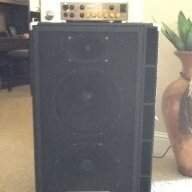
I have no idea if both 810s were actually used. There were two SVT 810s on the stage. There were two SVT heads on top of the cabinets. Only one was powered. The cab with the powered head had an Avalon DI on top of it. The cab under the unpowered head was mic'ed. (Draw your own conclusions). IMHO SVTs do not put out the sort of mud I heard, so I assume it was the reinforcement that was the issue.

In this venue, with this style of music, probably not a lot of reinforcement was necessary for the bass with that rig. That 1610 probably would have been fine on its own;)

IMHO The PA was probably overkill for this gig. However, everything but the bass sounded great. Once again draw your own conclusions.

From frequenting TB I believe that most of us are obsessed with our tone.

So, that was my reason for posting. I'm sorry if I offended anyone. However, I do believe this is an appropriate form to discuss this. If I knew who provided the reinforcement I would direct this to them, but I don't. So as TB is my place to vent all things bass, and as I don't believe this an isolated problem I believe its worthy of discussion.

I believe Todd and evey other bassist deserves to be heard (well, there are a few who shouldn't be heard, but that's another topic :D) and IMHO it is the job of whoever is providing the PA to make that happen. Bad room, bad day, at the end of the night, you've got a lot of paying customers who deserve to hear the band that they payed a lot of good money to see and hear. The whole band. Including us bassists.:bassist:
 
+1000 to what Tomixxxx said

We have a concert hall here designed for for the symphonic orchestra , all acoustic show are divinely sublime but as soon as there is a PA in the house , no matter what the band is or what soundman is , total crap. Wrong booking at the wrong place. They want to book these act at that place for the prestige.


IMHO The PA was probably overkill for this gig. However, everything but the bass sounded great. Once again draw your own conclusions.
One conclusion I can draw is that good bass tone is not the same for all bass players.
Maybe there were other people in the room wich liked the sound ?

For one , I absolutely hate 810 sound , so I would have probably agreed with you fo that particular show.
810 have the worst dispertion of all time in the history of speaker design....
 
Last edited:
Last hobby band I "fired" from ever hiring me again was bitchin' me out about only running one stack in this weirdarse shaped highly-reverberant space - guess it didn't look loud enough even though I measured over 110 dBC at 40 feet (AKA stoopid loud). Venue owner said it was the best sound ever there. That's 5-10 dB louder than I want to be mixing at so I agree with your 95-100. Above that ear fatigue ruins the experience IME. I had the earplugs in - I really don't like mixing like that :( .

Glad I'm not the only one to mix with earplugs in. I've done it to protect my hearing, and I've done it because when things get really truly loud, my brain shuts down and I can't hear anything anyway. Might as well hear less but be able to hear something, right?

Not ideal for sure, but it probably matters less than I think. I figure that if it's THAT loud, nobody else can hear anything either. The folks who are used to it that loud don't have any hearing left, and the ones who have hearing left have been blown out of the room. :D
 
What I'm attempting to point out is the very likely the level of the kick and the subs are out of the engineers hands... Do you have any idea what a small line array system costs ? Trust me, the opportunity to run one comes with strings attached. I see it all the time here. A couple of regional companies that are well funded and in it for the ego dominate ... The mixes suck but it isn't the fault of the guy at the board. It's the owner of the system that seems to need to impress with his subs -or- it's the crew chief that is essentially deaf above 4k - and if he can't hear the hi hat, then in his ears the mix is dull. Meanwhile patrons are stuffing bits of napkin in their ears.

I can assure you that at this level, the only people who are potentially dictating what the mix engineer does are Paul Rodgers and/or his tour manager. Not the owner of the PA, the systems engineer, the venue management or anyone else. Every major act I've ever encountered (hundreds, BTW) have clauses in their contracts stating that their mix engineer is to have full control of the PA and just about everyone at those levels carries their own FOH person at the very least. I've been that guy on dozens of major tours and I guarantee you that the only people other than me who had a say in the mix were the artists themselves (or the tour manager acting on the artist's behalf). What the act expects from the production supplier is spelled out in no uncertain terms in the contract. I have actually had to fire providers for not providing what they promised in the contract on tours where I acted as FOH engineer and tour manager. Not very pleasant business, really. :D

There are lots of factors that might have been out of the FOH guy's hands but this isn't one of them. Venue acoustics, excessive stage volume, etc. may well have played a role, though. It's surprisingly easy to overpower a venue with an SVT and 2 810 cabs and if eqed right (or wrong, I guess) the on stage rig could play havoc with the house sound and create a lot of mud. Been there lots of times: Reverberant space, band super loud on stage, very little control in my hands. Just try to get the vocals on top of the mess and pray for a quick death.

That said, excessive kick drum/sub energy is definitely a recurring issue in live sound. I think part of it (and I said this in another thread I believe) is that a lot of FOH people hack a lot of midrange out of the PA, which of course makes it ideal for reproducing the kick, but terrible for everything else. I see it all the time. Band engineer A hacks at the graph until everything between 100Hz and 4k is pulled out and then spends entire show trying to get the vocals loud enough. Band engineer B cuts a few problem frequencies here and there and leaves the rest alone and achieves a balanced mix where you can actually hear the bass guitar.

My apologies if I've double-posted this link but one of my sound engineer buddies posted this as its getting out of control and he can't stand it.

Invalid Link Removed

This is a great article and hits on a lot of issues that I have encountered over the years. My philosophy is pretty equivalent to the author's: Tune the PA/room comination as flat as possible with a bit of a dip in that low mid band and then if you need a bit more thump out of the kick (or whatever) dial it in on the strip. The 100-300Hz range will usually take care of itself, especially if wedges are involved. This approach usually results in a punchy, balanced mix. And yes, I have high passed the bass guitar at 100Hz in big, live rooms in order to clean up low end mud so you can hear the notes being played. :D
 
  • Like
Reactions: 1954bassman
I also agree with just about everything in Tomixxx's posts. It's great when you can use a venue designed for acoustic performances in a way that complements the space and it's totally possible to do that with sound reinforcement gear. The trick is to use the gear sparingly enough that it seamlessly blends with the room and the performers. This is usually not as easy as it sounds in practice but it is really nice when it's done right. Doing this successfully definitely depends on the artist. You're not going to be able to do it with a rock band that produces 110dB at FOH from pure stage volume (yes, I have seen this, more often than you might think) and the FOH person is clearly in a bad spot in this case.

I also like aux fed subs.
 
I also agree with just about everything in Tomixxx's posts. It's great when you can use a venue designed for acoustic performances in a way that complements the space and it's totally possible to do that with sound reinforcement gear. The trick is to use the gear sparingly enough that it seamlessly blends with the room and the performers. This is usually not as easy as it sounds in practice but it is really nice when it's done right. Doing this successfully definitely depends on the artist. You're not going to be able to do it with a rock band that produces 110dB at FOH from pure stage volume (yes, I have seen this, more often than you might think) and the FOH person is clearly in a bad spot in this case.

I also like aux fed subs.
Let's do some maths. 2 fridges @ 103 dB, makes 106dB with 1W at 1m.

Lose 6dB each doubling of distance, gain 3dB each doubling of power. 8m to the front of the stage, 3 doublings? 8 doublings of power to 250W. Net +6dB

112dB at the front of the stage just from the bass amp.
 

Latest posts