• TalkBass has been independent since 1998. Add your voice.
    Create a free account to reply to discussions, view embedded media, and browse with fewer display ads.
    Join freeLog in
    Want zero display ads or expanded classifieds tools? Compare plans.

Baer Amplification Megathread!

Without reading every last little detail of the paragraphs long posts in some cases over that last couple pages, I would have to agree with the 70/30 rule, maybe even push it up to 60/40 depending on the player.

I can play a $400 dollar rig or a $4000 dollar rig and I sound like me in either case. That said, one sounds like a better version of me than the other....one sounds like me in problem rooms more than the other, etc. I'm a bit of a gearhead when it comes to this stuff but you can't deny a good player sounds good on substandard equipment and good equipment brings out the not so good things about a not so good player.

I'd much rather play my gigs on good, 2way, awesome sounding cabs and they will be my "go to" rigs but if I had to, I can get people dancing with a 115 combo. May not be nearly as enjoyable for me, but the job will get done and done well.

That said, I run both knobs on my P's wide open and I can make as dull a thump or as bright a zing as you want to hear.
 
Hey Roger. Another thing that I tried to demonstrate in the various clips, is how great a slap tone can be with the right mid driver and crossover. The top end tone of your cab is the first 'mid driver loaded/no tweeter' cab that I would consider owning myself.

I would describe the top end of your cab (and I think this comes across in my clips) as 'bright with very little gank'. In other words, a nice upper mid response that isn't harsh, and enough extension into the treble region to provide the sparkle needed for my definition of a good slap tone.

The fact that overdriven tones also seem to sound great through your cab is quite an accomplishment IMO.

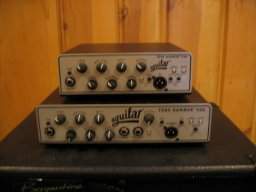
A bit of background on the ML Series cabs. Designing a speaker cab was not really a goal we had starting out. I had been working on the Valkyrie's pre amp for months, listening only with a headphone amp and my Beyerdynamic studio headphones. These phones are extremely revealing of every little nuance. After getting the preamp exactly how I wanted it, we started work on the power section. I was using every cab I could get my hands on, but nothing was really rocking my world. I could get a decent modern tone from most boxes, but I wasn't finding anything that let the tube distortion come through just like I had been hearing it with my headphones. Our engineer had come up with this amazing tube section, yet it was somehow getting lost in the translation to the speaker cabinets. I had been seeing post by Bill Fitzmaurice talking about the fact that many cabinets have a dip in the upper midrange and how a mid loaded design could get around that. After a few conversations with Bill, I was convinced that a mid loaded cab might be just what I was looking for.

At that time, I had just received one of the very first Kappalite 3012 samples from Eminence. So, it was off to the shop to build a cabinet. While the first prototype certainly needed work, I immediately knew we were onto something. The mid loaded cab just seemed to have more clarity and articulation and was much closer to the sound of the preamp through the headphones. After going through quite a few samples with Eminence, their engineer came up with a driver that he referred to as "an HO that acts and sounds more like a LF". Like the three bears story, this one was just right to my ears. Many prototypes later, I finally had the sound I was after and one that really made the tube section shine.

We have a lot of customers in the "I'm in a LOUD rock band and can't hear myself, please help!" bracket. It's amazing what a cab that doesn't have dips in the midrange, is decent off-axis and can put out fat lows without losing its punch (due to over-excursion) can do for getting you heard.

Having taken a lot of frequency response measurements over the last few years I can guarantee that the mellow top of AccuGrooves and the subdued midrange of the Acme 10"s is neither 'audiophile' nor truly 'flat', both are quiet in certain parts of the spectrum, so you can certainly aim to design a cab that really does measure flat without worrying about a lack of punch or clarity in the real world of loud gigs.

Bingo! I tried many of the “studio monitor” type cabinets and found that none of them were really recreating the sound of my recorded bass. A lot of the “details” were getting lost. It took a mid loaded cab with all it’s extra upper mid detail to give me the sound I was after. Granted, I was giving up some upper end sparkle by not using a tweeter, but I found that the magic in getting our tube section to sound as it should, wasn’t coming from the very top end, but from the upper mids and lower treble. Honestly, these cabs were total self indulgence. They were created to make the Valkyrie’s tube section really shine, but the effect does seem to translate to other amps very well.
 
  • Like
Reactions: 31HZ
This all makes perfect sense.
I've never cared for much grit/grind/overdrive through a horn.

I think you've taken the exact right approach to get what you wanted: kudos!

A bit of background on the ML Series cabs. Designing a speaker cab was not really a goal we had starting out. I had been working on the Valkyrie's pre amp for months, listening only with a headphone amp and my Beyerdynamic studio headphones. These phones are extremely revealing of every little nuance. After getting the preamp exactly how I wanted it, we started work on the power section. I was using every cab I could get my hands on, but nothing was really rocking my world. I could get a decent modern tone from most boxes, but I wasn't finding anything that let the tube distortion come through just like I had been hearing it with my headphones. Our engineer had come up with this amazing tube section, yet it was somehow getting lost in the translation to the speaker cabinets. I had been seeing post by Bill Fitzmaurice talking about the fact that many cabinets have a dip in the upper midrange and how a mid loaded design could get around that. After a few conversations with Bill, I was convinced that a mid loaded cab might be just what I was looking for.

At that time, I had just received one of the very first Kappalite 3012 samples from Eminence. So, it was off to the shop to build a cabinet. While the first prototype certainly needed work, I immediately knew we were onto something. The mid loaded cab just seemed to have more clarity and articulation and was much closer to the sound of the preamp through the headphones. After going through quite a few samples with Eminence, their engineer came up with a driver that he referred to as "an HO that acts and sounds more like a LF". Like the three bears story, this one was just right, to my ears. Many prototypes later, I finally had the sound I was after and one that really made the tube section shine.


Bingo! I tried many of the “studio monitor” type cabinets and found that none of them were really recreating the sound of my recorded bass. A lot of the “details” were getting lost. It took a mid loaded cab with all it’s extra upper mid detail to give me the sound I was after. Granted, I was giving up some upper end sparkle by not using a tweeter, but I found that the magic in getting our tube section to sound as it should, wasn’t coming from the very top end, but from the upper mids and lower treble. Honestly, these cabs were total self indulgence. They were created to make the Valkyrie’s tube section really shine, but the effect does seem to translate to other amps and taste very well.
 
I got to play through lomo's TC112 and it was the best tweeter loaded cab I have ever heard but, Im pretty sure that I would need 3 of them in alot of the places I play. I need to cover 90% of the volume from my amp. From my experience, two 12's are equivalent to three 10's. A 2x10 cab always has more output, at least the cabs I've used, including that TC. So, Im wondering how a pair of the ML112 cabs would compare to my NV610. Im sure that I would like the mids and highs even better. I've never heard a 12" loaded cab that had the same low mid punch as my favorite 10" loaded cabs. If this baer can do that, I'll buy one. Then, maybe two!:) Again, these are my favorite clips that Ken has done.

The NV 610 is quite a different beast and is certainly going to give you more volume than two of the ML112's. While there does seem to be a phrase "super 12's" attributed to these types of cabs, it's important for players to realize their limitations, as well as their benefits. They are a great single cab solution for those who need a fair amount of volume for small to medium sized gigs. When you downsize to smaller cabinets and you push them to their limits, it puts increased stress on your components and leaves you no where to go but down in volume. When you have a little more cabinet than you need, your drivers work less and can still have a little in reserve for those times when you need it.

I tend to be conservative in what I ask a cabinet to do, so I like to think of these cabs as equal in perceived volume to a good 210 cab. Two would be in the realm of a good 410. The Valkyrie into three of them is quite ridiculous indeed, but it is important to remember that we are still talking about a single 12" driver cabinet and you need to be aware of its limitations. Keep in mind too, that technique has a huge impact on cabinet capability. I've heard guys at NAMM fart out a ML112 at relatively low amp volume settings, while another player with great technique was able to crank the amp up full into one, with no issues at all.
 
I tend to be conservative in what I ask a cabinet to do, so I like to think of these cabs as equal in perceived volume to a good 210 cab. Two would be in the realm of a good 410. The Valkyrie into three of them is quite ridiculous indeed, but it is important to remember that we are still talking about a single 12" driver cabinet and you need to be aware of its limitations. Keep in mind too, that technique has a huge impact on cabinet capability. I've heard guys at NAMM fart out a ML112 at relatively low amp volume settings, while another player with great technique was able to crank the amp up full into one, with no issues at all.

I don't wish to disagree with you. More like amend what you said. In my experience, there's only one 2x10 box I've ever used that could keep up with at all with the ML-112. The Epi UL210 was a bigger box and tonally wasn't anywhere near as balanced. Perhaps an Acme 2x10, but that would take a much more powerful amp than most 300/500 watt amps out there.
 
I don't wish to disagree with you. More like amend what you said. In my experience, there's only one 2x10 box I've ever used that could keep up with at all with the ML-112. The Epi UL210 was a bigger box and tonally wasn't anywhere near as balanced. Perhaps an Acme 2x10, but that would take a much more powerful amp than most 300/500 watt amps out there.

Like I said, I like to be conservative in my estimations of a cabinet's capabilities, as I've seen the difference technique can play in the cabinet's ability to get loud. Also, comparing this cabinet to that cabinet assumes a certain level of experience with the gear that not everyone has. When your'e talking about big cabs, such as an 810, there's a lot of room for error in terms of having enough cab for the gig, but with these these smaller cabinets, there's less room for error and I would much rather under promise and over deliver, than the other way around.
 
Like I said, I like to be conservative in my estimations of a cabinet's capabilities, as I've seen the difference technique can play in the cabinet's ability to get loud. Also, comparing this cabinet to that cabinet assumes a certain level of experience with the gear that not everyone has. When your'e talking about big cabs, such as an 810, there's a lot of room for error in terms of having enough cab for the gig, but with these these smaller cabinets, there's less room for error and I would much rather under promise and over deliver, than the other way around.

+1 and a good approach. One ML112 would be perfect for the bassist who has not had luck with using a single 'production 112' on a gig, and is 'almost happy' with the performance of a 210 (i.e., a good quality 210 is loud enough, but the player finds the low end a bit thin when pushed and/or the upper mid definition is not where they want it).

Of course, two would IMO at the top of the '212' performance continuum.

And again, your particular execution of a mid driver loaded cab is unique to my ear... plenty of top end, but the ability to transmit the grind nicely if the player chooses. Very nice box.
 
...a driver that he referred to as "an HO that acts and sounds more like a LF". Like the three bears story, this one was just right to my ears...

I suspected as much! Where did you end up with Xmax and thus Vd? The sensitivity is quite high so the moving mass must be on the lower side and thus the voice coil shorter than the 3012LF and your port area is more in line with what a 3012HO needs.

Obviously I haven't heard one in except via youtube but I can picture it sitting sonically and performance-wise in between our Midget and our Big Baby which is a nice place to be! :)
 
The Midget T is very small and barely over 20lbs, so it's more of a 1x10" competitor that plays as loud as a decent 2x10". The Big Baby or Big Baby T are much more similar to these other "Super 1x12s". However, to mix things up I thought I'd send a Super Twelve T, which is a fair bit larger (AE212 size) but hardly any heavier and goes stupid loud (still waiting for a customer to find a gig that's too loud for it!) It'll need a home to go to after visiting a selection of reviewers...

This helps with the relative dimensions - all the badges are the same size: Barefaced Bass - Product Range

I have a nice home it could come to.....
 
That would put me at 2.67 ohms with my 4ohm minimum heads. I guess I could slave one from the other... I might try that just to see. The 4ohm Acme impedance would balance it a bit with the 8ohm Baer.

Ah--I assumed since you were comparing cabs that they would all be the same impedance. I get what you're saying about mixing them, pro and con.

Somebody correct me on this if I'm barking up the wrong woofer here, but it seems to me that A/B comparing 8 ohm and 4 ohm cabs defeats the purpose. With the 4 ohm cab you get more wattage, and thus more capacity for tall transient peaks. Those transients are a very big part of what gives our ears the sense of depth and strength in the low end. So even with Ken sounding just like Ken no matter what :p, if "all else is equal" the 4-ohm cab would sound like it had deeper low end extension, and/or more low-end presence.
Nu?
 
Ah--I assumed since you were comparing cabs that they would all be the same impedance. I get what you're saying about mixing them, pro and con.

Somebody correct me on this if I'm barking up the wrong woofer here, but it seems to me that A/B comparing 8 ohm and 4 ohm cabs defeats the purpose. With the 4 ohm cab you get more wattage, and thus more capacity for tall transient peaks. Those transients are a very big part of what gives our ears the sense of depth and strength in the low end. So even with Ken sounding just like Ken no matter what :p, if "all else is equal" the 4-ohm cab would sound like it had deeper low end extension, and/or more low-end presence.

Nu?

Yeah, don't really want to do that with my 4ohm minimum heads.

Actually, in some ways, 4ohm versus 8ohm makes much sense among these particular cabs. First, I'm not in any way pushing the heads to their maximum output at either 4ohm or 8ohm, so 'headroom' etc. is a bit of a moot point. And secondly, the GREATLY different efficiency of these cabs, with the Berg AE210 and Baer ML112 (both 8ohm) being WAY higher efficiency than the Acme and somewhat higher than the Thunderchild (both 4ohm), so actually (IMO) tends to make the comparisons a bit more apples to apples when using each cab as a stand-alone.

IMO there, and based on my limited technical knowledge about what is going on inside this stuff:).

Edit: Also, in the case of the Berg, the Baer, and the Thunderchild, there is no 8/4 option... so, the impedance is what it is, and hence the efficiency and impedance differences become (IMO) a valid part of the comparison process. Again, just IMO there.
 
Just found this thread, and not sure if anyone has pointed it out, but the Youtube comparison of ML112 and Berg AE210 is titled MB112 rather than ML112.

And "oh my" regarding the thought of 2 ML112's with my F500...

Thanks for the catch! I'll fix that. And yes, 2 x ML112 and the F500 would be a pretty killer rig, and have some of the characteristics of the F500/AE410 pairup, which I love.
 

Latest posts