• TalkBass has been independent since 1998. Add your voice.
    Create a free account to reply to discussions, view embedded media, and browse with fewer display ads.
    Join freeLog in
    Want zero display ads or expanded classifieds tools? Compare plans.

Boutique Basses 10k and up?

I agree, unless you have that kind of money to spend it seems silly to spend $10k + on a bass when you could get one just as good for $2k or less somewhere else.

That's the point. You can't find a bass that's just as good for 2k or less, otherwise all these boutique companies would be out of business, which they are clearly not.
 
Last edited:
Exactly. But how much more labor goes into a boutique than an assembly line? Some things are simply more effecient on an assembly line but a small company can't afford one. So, if a Fender requires 20 minutes iof manual labor to fine tune everything, how long does a boutique take to fine tune everything? 2 hours ? 4 hours? Any way you slice it. You're paying top dollar.

The only thing I can address with respect to this is that - when Paul Reed Smith initially made his basses/guitars - he did them in batches of 5-7 and it took him a year to complete a batch. Of course, in 1977 everything was done by hand. Divide it out based on a 60 hour work week and there you go. It was just him and Jude, in those days - who helped him with the inlays.

BassHappy

PS: Andrew Drake is currently making things entirely by hand in his own shop as well and I am sure there are other "craftsmen" doing the same thing. It's a labor of love involving hundreds of man hours. Andrew reminds me so much of Paul Reed Smith back in 1977. The mahogany fretboard binding and his overall workmanship on Wilma is nothing less than stunning - and it is hard to believe it was crafted from basic hand tools.

Wilma%20Two.png


img_4605.jpg
drakelogo.jpg


"My name is Andrew Drake and I have been crafting high quality, handmade, custom guitars and basses to order since 2005. I craft each instrument one at a time with special attention to fit, feel, and function. I carve my own necks and construct my own bodies to customer specifications. Drake instruments are truly handcrafted instruments as all work is performed in my shop with basic woodworking tools and lots of man hours."

--Andrew Drake
 
Last edited:
  • Like
Reactions: josiah goldfish
Just remember...parts are not that expensive. A pu that cost the manufacturer $20 might be too expensive to put in a million basses, but for a company that makes 200 basses a year it makes sense becuase of the prices they charge.

So when you get right down to it, how much can a custom made instrument cost to make? $400? $500? TOPS. The rest is rent and workmanship and much of that workmanship is cosmetic.

So when people see these small companies as little purist mom and pop operations, they're not really seeing the reality. They're a specialty store-- no different than Tiffany's or Bergdorf Goodman -- selling pretty much the same T shirts you can get at TJ Max's.

I think its more complicated that that. For example....Fodera decides to display a booth at NAMM. They have booth expenses, airfare, cost of being away from shop, down time from regular production to build show basses. How many instruments do they have to sell to attend NAMM?
Tools are expensive. Tools break. Frieght is expensive. Materials are expensive. Materials have to be stored somewhere. Skilled labor is expensive. Training labor cost money. Mistakes that we don't see costs money. Advertising costs money. These basses are not made on an assembly line.
 
Oh gee, who could have predicted this would turn out to be a douchefest?

I wish I could like this more than once, Jimmy....:roflmao:

Of course, it's an open forum and we can post whatever we like, within the guidelines of the owners of TB, and this is an admittedly benign topic,
but why does someone wonder about such things enough to post the musings about it here and get such feelings and opinions stirred up? Am I so old that I missed this becoming how seemingly intelligent people discuss things? Like we discuss politics??...:spit:

I'll say it first, this is probably the most meaningless post in this thread and I sincerely meant no insult or disrespect toward anyone participating. It's just a general observation.
 
  • Like
Reactions: allenhumble
I think its more complicated that that. For example....Fodera decides to display a booth at NAMM. They have booth expenses, airfare, cost of being away from shop, down time from regular production to build show basses. How many instruments do they have to sell to attend NAMM?
Tools are expensive. Tools break. Frieght is expensive. Materials are expensive. Materials have to be stored somewhere. Skilled labor is expensive. Training labor cost money. Mistakes that we don't see costs money. Advertising costs money. These basses are not made on an assembly line.

And Fodera employees have benefits including a 401K.

I would be interested to know how many people posting on this thread have been responsible for P&L or run a business. While there certainly is a premium that is paid for certain brands (if the market bears it), the idea that these companies have huge profit margins and a jacuzzi full of KFC gravy and MickyD fries just doesn't jibe with reality. There is a reason that many instruments are made in factories in other countries - and it certainly isn't so they can use "Hencho en Freedonia" as a marketing tagline...

And since Fodera has a 12 month waiting list for instruments, evidently the market says they are priced "right." Certainly there are plenty of people with more money than talent, but that's the way it goes. Grousing about it won't really change your lot in life.
 
All costs of business somehow enter into the cost of a product. Those that are not related to direct production are considered overhead and are allocated to units of production. Low volume businesses have a higher overhead cost per unit and thus a higher selling cost. As the units of production increases, the unit cost decreases with relation to overhead. Which is why some companies can offer the product at a much lower selling price. This is basic business.
 
Although I have not paid that much for any one bass, I do have a couple Alembics where replacement cost / retail price exceed 10K. I bought one because it was the culmination of everything I ever wanted in a bass, arrived at over years of playing, buying, and selling basses. I custom ordered with content I wanted. The other I bought because my favorite recording artist was selling it. I made him an offer, he accepted it.

If you are serious about the part in bold red print, I would like to suggest that you go to the Fodera Club threads and the Alembic Club threads, identify the members who post there often and seem to be approachable, and ask them your questions over PM. I think this approach is pretty much troll proof. I am sure if you sent PM to me, FC Bass, or Jazzyvee we would be willing to provide any Alembic info we could that would be helpful. I get (and answer) a lot of Alembic questions over PM. I'm trying harder, though, to not get involved in any "are they really worth that much more than a <fill in the blank>" threads. Even though your intentions may be good, this is the interwebs. So far your thread is free of clutter. Hope it lasts.
I like your posting Malthumb, i too am tiring of these "high end" bass bashing threads. They are a common thing on this and the UK Basschat forum and they are tedious. I have also had numerous PM's from members of the alembic forum and readers of it when they have been considering commissioning new instruments from alembic both sides of the >10k cost so there are a significant number of bass players and collectors too who are willing to pay those amounts of money and there is a growing number of luthiers making instruments for these buyers. I've yet to hear of musician who owns a high end bass that has questioned/criticised anyone's rationale for spending under 10k or any other high end price marker for their bass.
Personally, i've wanted an alembic since I first heard the sound on the return to forever albums and as soon as I could afford it without putting myself into financial problems I bought one, justification didn't come into it.
 
If I may humbly suggest...

This is well covered territory. There is no need to "justify" the purchase of a $10,000 bass any more than there is to justify the purchase of a $179 bass. We can explain or rationalize (or whatever word choice makes each of us individually feel better), but the debate is not necessary.

If we quit f$$$$$g posting in this d##n thread, it will go away. As it should...
 
  • Like
Reactions: allenhumble
I think its more complicated that that. For example....Fodera decides to display a booth at NAMM. They have booth expenses, airfare, cost of being away from shop, down time from regular production to build show basses. How many instruments do they have to sell to attend NAMM?
Tools are expensive. Tools break. Frieght is expensive. Materials are expensive. Materials have to be stored somewhere. Skilled labor is expensive. Training labor cost money. Mistakes that we don't see costs money. Advertising costs money. These basses are not made on an assembly line.


You're essentally agreeing with my point, yet taking the opposite position. All those things you mentioned -- getting a booth at NAMM, freight, tools, storage -- they're al things that are cheaper for a big manufacturer. But the fact that they're more expensive for a smaller company means nothing in regard to the end product. Why should I make up the difference? I should pay more because it cost THEM more?

Well, I don't care how much their booth cost, or their rent or their ads, or the fact that they don't sell as much. All I care about is the instrument.

I'd be willing to pay twice as much for an instrument twice as good, but I don't want to pay six times as much for something that's just a little better. And sorry, I've played enough Sadowsky's to say that. They're real good Fenders (with an occasional dog). If I could have my pick, I guess I'd take the best Sadowsky I ever played over my MIA and I'd pay a couple of hundred more for it. But an extra three grand? That's nuts. To me. I could be wrong.
 
I have little talent and 7 basses. What does that say about me? That I have obsessive bass disorder? Hoarders disease? Or I appreciate nice instruments (well, one is not so nice really). Two Zon's, one Sadowsky Metro, two Pedullas, an NS upright and a Warwick.

I guess if you added the new cost of them all together you might be around $20k, but I never bought one new so I am nowhere near that number. Not even half that.

Some I just don't want to part with, one I am totally in love with at present. I could get it down to 2-3 and be more than happy. But why not keep or trade what I have? I enjoy them. They're cheaper than women and less headaches too. Almost all 'hold their value' even as they sit in my closet, and every one of them has taught me something about what I want and need out of a bass.

If one knows that $xx thousand Fodera will float their boat than by all means life is too short not to own one.

We're all different. I don't mind buying quality pre-owned stuff with the depreciation already factored in but others won't. I also drive a pickup even though I can drive almost anything else out there because I like a pickup.

Some want to blow their load on a bass, others on a Tesla, others on a hydroplane or a Porsche. There are cheaper versions of all these products. Sometimes there are no answers to "why" other than "because I like it!".
 
  • Like
Reactions: allenhumble
..... German luthier, Jens Ritter. He is already quite well known for creating high end, boutique instruments for – well, how shall I put it? – stinking rich bass players.

Surprisingly, most of his basses are not made for "stinking rich bass players" and amazing examples can be found regularly used for around $5k new or $3500-4500USD used or even less. They are generally no more than a new MTD, Smith or fancy NYC Sadowsky or Roscoe.

This bass is a one-off and not a good representative of 99% of his work.
 
So when you get right down to it, how much can a custom made instrument cost to make? $400? $500? TOPS. The rest is rent and workmanship and much of that workmanship is cosmetic.
So you honestly believe that the materials involved in making a $10,000 bass is $400-500 TOPS? IMO, you are dreaming.

Show me where I can buy the highest quality (AAAAA) top/fretboard, the best quality body and neck woods, highest quality tuners, bridge, preamp, custom wound pickups, nut and finishing materials for $400-500. Add quality strings, straplocks, pots/wiring/knobs/jack and hardshell case to that of course.

A good set of Nordy, Aguilar, Duncan or EMG pickups paired with a high end preamp takes care of well over 1/2 of your $400-500, even when buying in bulk.
 
Last edited:
It sucks that so many people turn these threads into something the initial poster wasn't wanting, and specifically asked to keep out of the thread. Fortunately, most of the posting has been constructive thusfar, and I don't believe 'letting the thread die because the subject has been covered' is really how talkbass operates or stays interesting. The simple truth is that the high end bass market is constantly changing, so I enjoy reading these threads and seeing how they change over the years.

To answer the questions put forth- Its a combination of many of the answers already suggested here, and its going to be different for everyone who's buying a bass at this price point. Some want an instrument made by someone special or a logo, some want a combination of attributes only available from specific builders, some want bragging rights, some want an instrument that speaks to them, and some want to just support an artist/luthier/business that they think is worth supporting. For me its been a combination of the above as well. I wanted an instrument with a super long scale, custom pickup, custom electronics, 6 strings, made by someone who's an influence on me who owns a business I'm happy to support. He makes 30-40 instruments year, lets say on average $5000 each- lets say that's $200000/year gross. Take in to consideration 2 workers, a shop in Brooklyn, materials, machinery/tools, and its pretty easy to see why at 75, he's still working 10hour days. No ones getting rich in that shop, but there are some cool people making some cool instruments and I'm happy to be a part of that. Now that i have the instrument, yes, I post pictures about it online. People are curious about it and I'm happy to share it with others- is that bragging? I've gotten countless PMs asking about it, so why not share. And to those who would prefer to keep their information to themselves, that's their instrument and they can do what they please.

As many have said before- the price is dictated by the materials, work involved, and demand. The most expensive instruments have the biggest combination of these 3 things. Pickups and electronics might seem inexpensive off the shelf, but lets not forget that many of these caliber of basses come with custom wound pickups, out of better materials, which means more labor and more initial cost to the builder. Things like custom strings, better cases, and offering all kinds of options all add to the initial investment by the builder and the prices of instruments will follow.

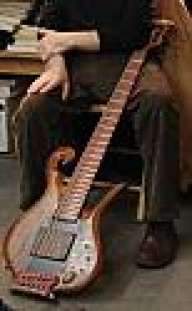
As for my experience, I have a 6 string 38" scale bass made with a variety of top quality hard woods, custom extras like a wooden bridge, nut, pickup cover, strap buttons, knobs, truss cover, tuners, and switch tips, a pickup wound from silver, custom hand made capacitors, top quality pots and wiring, as made by someone I want to support. To someone who sees a bass as a tool- this won't make sense, but I see my bass as art, and it inspires me to make music I wouldn't otherwise.
 
  • Like
Reactions: josiah goldfish
So you honestly believe that the materials involved in making a $10,000 bass is $400-500 TOPS? IMO, you are dreaming.

Show me where I can buy the highest quality (AAAAA) top/fretboard, the best quality body and neck woods, highest quality tuners, bridge, preamp, custom wound pickups, nut and finishing materials for $400-500. Add quality strings, straplocks, pots/wiring/knobs/jack and hardshell case to that of course.

A good set of Nordy, Aguilar, Duncan or EMG pickups paired with a high end preamp takes care of well over 1/2 of your $400-500, even when buying in bulk.


You're thinking retail my friend. If you bought 1000 sets of EMG pups you'd get them for around twelve bucks apiece. That's a fact. A preamp? There are preamps in $200 guitars. They can't cost more than five or six bucks to make. So one that's super high quality , I'd say around $50 wholesale in bulk. That's hardly half of $500.
 
Last edited:
[QUOTE="
As many have said before- the price is dictated by the materials, work involved, and demand. The most expensive instruments have the biggest combination of these 3 things. Pickups and electronics might seem inexpensive off the shelf, but lets not forget that many of these caliber of basses come with custom wound pickups, out of better materials, which means more labor and more initial cost to the builder. Things like custom strings, better cases, and offering all kinds of options all add to the initial investment by the builder and the prices of instruments will follow.

As for my experience, I have a 6 string 38" scale bass made with a variety of top quality hard woods, custom extras like a wooden bridge, nut, pickup cover, strap buttons, knobs, truss cover, tuners, and switch tips, a pickup wound from silver, custom hand made capacitors, top quality pots and wiring, as made by someone I want to support. To someone who sees a bass as a tool- this won't make sense, but I see my bass as art, and it inspires me to make music I wouldn't otherwise.[/QUOTE]

................................................

Again, how much better are the materials in a pickup that demand an increase of 1000% in price? Cases? Who cares? Nuts? Knobs? Capaciitors? Strap buttons? They're pennies.

And I see music as art too. It has nothing to do with this. The fact that Robert Johnson played a $5 guitar doesn't make him less of an artist just as the guy who buys a $4000 set of golf clubs doesn't make him a championship golfer.
 
Silver is substantially more expensive than Copper as far as pickup and capacitor materials go.

Invalid Link Removed

Were talking about the work involved in carving/inlaying knobs with 7 pieces of wood each. This takes time, and time is money. The instrument IS art.

I'm not suggesting every artist needs an instrument of this caliber to create their art, but the funny thing about art is that whatever the artist decides he needs, he needs. Yes many popular players and artists play on inexpensive instruments- that is not the conversation that's happening in this thread.
 
  • Like
Reactions: josiah goldfish