• TalkBass has been independent since 1998. Add your voice.
    Create a free account to reply to discussions, view embedded media, and browse with fewer display ads.
    Join freeLog in
    Want zero display ads or expanded classifieds tools? Compare plans.

Club Alleva-Coppolo (Part 15)

Status
Not open for further replies.
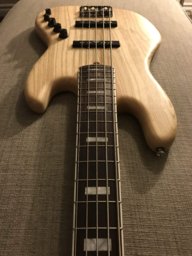
Cool pics Vic. Not sure if I view the new, thinner fretboard as a positive, but it sounds like Jimmy's execution of it is top notch.
Yeah, positive or negative is gonna' be player dependent, because Jimmy's process should take any issues of quality/construction out of the picture, so it should just be a tonal choice.

That said, my choice would also be slab, and FWIW, the slab boards are also the more desirable ones in the vintage market as well.
 
So a bit more on this...

Back in the day, Fender used to call the two board types "slab" and "veneer" because they literally were... a radiused slab, and a thinner piece of rosewood that was bent over a radiused neck face.

But the veneer deal is not what Jimmy does. He told me he actually shapes the bottom of the board, so it's really more of a "cap", where the wood is "fitted" to the neck... not bent to fit the neck. This as opposed to a veneer, where the wood is bent to fit the neck. Again, I can't recall if that's the exact word he used tho... maybe Kirk, Jason, or Yohan can chime in on that.

I did a little reading on this and the tonal result should be as expected... the neck wood plays more of a role in the tone.

The big difference here is, I'm guessing Fender simply did it to save money, and didn't really care about wood grain distortion from bending. I take Jimmy's process to mean he wants the wood grain to be intact... identical to the grain in the blank he started with... when installed.

I think this is a really cool option, but I think my personal preference would still be the slab. Not because that's what I already have, but more because if I want a rosewood board, I really want as much participation from that as possible. That is obviously not going to be everybody's choice, but it would be mine. I can easily see, on the other hand, where someone wanted some influence from the rosewood, but still wanted as much maple participation as possible, and would find this a great option. Also, if you're trying to be period correct to a specific period, this is just one more way Jimmy offers a way to get there.

FYI.

+1 .... it works really well, and this is part of the resulting tone one hears on that AC posted and much passed around Paul Turner clip.
On a five string, in particular, and with DN which can be generally darker than Indian rosewood (which is the only combo I can speak to) it's really really nice with an unbelievable B string.
 
The Capped FB is something that JImmy has been wanting to do for quite sometime... And now he has the tools to be able to do it..EDIT.. As a matter of fact from what i remember.... I think he had the tool /machine since NYC .. It was a big green thing...IIRC. anyway.

As Vic said, the board that Jimmy uses is radiused to the exact mating radius of the neck blank.. Then the two parts are married together. I guess it would be somewhat tricky to do... but it is what they did back in the day.. There are different ideas as to why Fender did it and then went back to a slab board again.. I think Vic may be correct with his assumption... But i never looked into it or asked anyone...

Some people feel that it (capped vs Slab ) affects the sound of the bass since the fingerboard is equally thick on the bass and treble ends as it is in the center.. Thus making the instrument have a more consistent attack from string to string..
I dont have enough experience with either to make any comment, but It does look nice..

It certainly is more custom feel and look, and its time consuming to do.. Very period correct for certain bass models.. and to my knowledge , i dont think anyone is doing as period correct instruments as Jimmy.. He eats, breathes,and dreams what he is doing...

I spoke with Jimmy and He is going to try to post here later on..

So in short the answer is . I just dont know?:) But i will find out...:)


So a bit more on this...

Back in the day, Fender used to call the two board types "slab" and "veneer" because they literally were... a radiused slab, and a thinner piece of rosewood that was bent over a radiused neck face.

But the veneer deal is not what Jimmy does. He told me he actually shapes the bottom of the board, so it's really more of a "cap", where the wood is "fitted" to the neck... not bent to fit the neck. This as opposed to a veneer, where the wood is bent to fit the neck. Again, I can't recall if that's the exact word he used tho... maybe Kirk, Jason, or Yohan can chime in on that.

I did a little reading on this and the tonal result should be as expected... the neck wood plays more of a role in the tone.

The big difference here is, I'm guessing Fender simply did it to save money, and didn't really care about wood grain distortion from bending. I take Jimmy's process to mean he wants the wood grain to be intact... identical to the grain in the blank he started with... when installed.

I think this is a really cool option, but I think my personal preference would still be the slab. Not because that's what I already have, but more because if I want a rosewood board, I really want as much participation from that as possible. That is obviously not going to be everybody's choice, but it would be mine. I can easily see, on the other hand, where someone wanted some influence from the rosewood, but still wanted as much maple participation as possible, and would find this a great option. Also, if you're trying to be period correct to a specific period, this is just one more way Jimmy offers a way to get there.

FYI.

 
Ok ... so ... this appears to be, in fact, a further evolution of what Jimmy did for PT and a few others, which did not use a radiused approach. The result was less Rosewood and a bit more Maple for sure, but these earlier versions without the radius have more Rosewood in the middle than on the edges (B and G strings).

Here is a pic of an LG/DN that Jimmy is doing for me, and in it you can see a piece of scrap rosewood from the heel (front center) that is indeed radiused. I imagine that this is what is going on now and appears to be incorporated into mine. Cool with me if it is ...
 

Attachments

  • BrianLannon3A.jpg
    BrianLannon3A.jpg
    48.3 KB · Views: 136
There are different ideas as to why Fender did it and then went back to a slab board again.. I think Vic may be correct with his assumption... But i never looked into it or asked anyone...
Well, I actually did look into it, and while I don't have the site links handy right now, this is pretty much unilaterally agreed upon where folks have taken the time to comment on its tonal affects. FYI/FWIW. That said, it's still an assumption for me personally since I haven't compared them directly myself.

Some people feel that it (capped vs Slab ) affects the sound of the bass since the fingerboard is equally thick on the bass and treble ends as it is in the center.. Thus making the insturnent have a more consistent attack from string to string...
This is an interesting aspect I didn't even consider, tho I do think the theory holds water.
 
My understanding is that the "veneer" fingerboard was referred to as Roundlam by Fender, and they went that direction primarily to conserve the Brazillian rosewood stock. So, it was primarily a cost decision by Leo; as if that's something new.

The neck has a huge influence on the acoustic behavior of the instrument; so this change did result in a sound that was closer to an all maple neck with a rosewood appearance. In other words, Roundlam tends to be just a little bit brighter than slab, somewhere in between what you would get with a rosewood slab vs maple fingerboard.

Of course this gets discussed a lot, and everyone has (and is entitled to) their own opinion. I believe that the primary tonal effect is due to the resonant lossiness of the neck as a vibrational structural component. The neck is a composite beam composed of the neck wood and the fingerboard. The effect of the stiffer fingerboards is not happening at the witness point with the string, but more as a composite beam. So, just as an all rosewood neck would produce a darker tone, so all maple produces a brighter tone, and then the composites fall somewhere in the middle. More of the dark element = darker, less = brighter.

Anyhow, that's how I think of it. Slab board instruments will tend to be a bit darker and the "veneer" will be slightly brighter. Jimmy's got good reasons to chase this, IMO. What started out as a cost decision by Leo actually becomes a tonal "option."

My 2c.
 
Can't speak to the entirety of your post, but ...
... Anyhow, that's how I think of it. Slab board instruments will tend to be a bit darker and the "veneer" will be slightly brighter. Jimmy's got good reasons to chase this, IMO. What started out as a cost decision by Leo actually becomes a tonal "option."

My 2c.

+1
 
...Roundlam... ...this change did result in a sound that was closer to an all maple neck with a rosewood appearance.
This is an interesting perspective... noting that Fender originally only had all maple necks, I wonder if, in addition to the wood/cost preservation, he did view it as a net positive... getting back closer to the original maple necks, yet giving the physical feel and look of rosewood for those who wanted that.

Of course this gets discussed a lot, and everyone has (and is entitled to) their own opinion. I believe that the primary tonal effect is due to the resonant lossiness of the neck as a vibrational structural component. The neck is a composite beam composed of the neck wood and the fingerboard. The effect of the stiffer fingerboards is not happening at the witness point with the string, but more as a composite beam.
Yeah, I generally agree with you the whole formula matters, but not that that's all that matters (unless I misread you). The reason is the proximity to the fulcrum point REALLY matters more than I think you feel with the different materials.

Not to get OT, but to at least give you one kinda' extreme example for the point, if you had a piece of leather and a piece of wood lam'd together and fretted both sides (the hardwood side and also the leather'd side), I absolutely guarantee you the tone would be different as you flipped that neck from the wood to the leather'd side, despite the overall construction being identical in both cases.

IMHO, anyway.
 
Not to get OT, but to at least give you one kinda' extreme example for the point, if you had a piece of leather and a piece of wood lam'd together and fretted both sides (the hardwood side and also the leather'd side), I absolutely guarantee you the tone would be different as you flipped that neck from the wood to the leather'd side, despite the overall construction being identical in both cases.

IMHO, anyway.
Quite correct.
 
I had an original '63P I bought from Jimmy back at the BootyQ that had a rosewood capped neck as opposed to the slab board. Later, I basically swapped it for my KBP4 Classic, which has a slab rosewood board. The KBP4 is richer and warmer than the '63 was, but also is far more even in response and pitch definition. I feel there is more going on than just the choice of materials, for example JC's superior fret jobs have a huge impact on the tone. I once had him refret a '73 Telebass I also bought from him and the difference was astonishing.
BTW thanks for the full on shot of the new 6, I was waiting for that!
 
the new 6!

I've known Jimmy for 20 years in NYC. we talked about this 6-string for approximately the past 5 years. even though the 6 was not a direction he heard his basses going, i figured it was a matter of time, because i knew he would put his sound and vibe into it whenever it happened. i was extremely honored when he told me he'd decided to do it, and that he wanted it for NAMM.

the new 6 is fantastic. completely 100% jimmy's sound and feel. it's supremely comfortable- great neck profile (a split-hair deeper than my old JPII, more similar to jimmy's 5), 34", 19 spacing, wide nut, exactly what we discussed. the bridge is jaco's mwah with density, the neck pup is punchy, focused and completely articulate.

the marketplace has many fantastic 6s- for example, the F booth was our neighbor, and george builds gorgeous 6-string pieces that garnered him a deserved international rep. jimmy's 6 is unique in that it's his modern-retro vibe throughout, in a coherent, organic design.

this bass's B is a duplicate in every way to his 5s- huge, bright & ballsy, sustain for days. one of jimmy's initial trepidations back in the planning was that the C would stand out clanky and shrill within his sonic palette.. instead, it sits in the same timbre zone as the G, completely integrated. a few times this weekend, yohan and i were sitting 10 feet away from guys just killin' it, and everything sounded unified, bright and deep.

i'm not writing this because jimmy and i are friends, i'm just telling it as it sounds- this bass is the great extension of his ideas and sound that built his rep on his 4 and 5s. it also now sits like a rare monolith in the marketplace as a benchmark 34", wide nut, 19mm, modern-retro masterpiece.

much respect to yohan, rick, lee, miko, karel, chris from san diego bass shop, ed and all the cats. these are class guys and killer players.
 
Thanks for the kind words Joey, it was a pleasure to hang with you again and I hope we get to do it again soon!

For those who have questions, please allow me some time to review the last few pages of the thread and gather them all and I will try to answer as much as I can as I can't imagine Jimmy being able to do any posting for a little bit, you'd think he'd take a break after the NAMM storm but no way, he was in the shop today trying to get back into the swing of normal shop life... He graciously agreed to letting me join him later in the week so I can have a couple days off.

All in all I had a blast at the show. I am extremely proud of Jimmy and the basses we put out. There were no reservations on my part whatsoever to show anyone any bass, every single bass was executed the way we all know Jimmy can. And I feel super proud and excited to have had a small part in the creation of these groove machines. Between the F Bass booth and ours, I can honestly say we were one of the hottest aisles in the whole show, the amount of traffic and talent that came through was unbelievable! I did not get tired of hearing these basses, I was there from 9 am to close everyday and it was awesome.

I will try to post my pics asap, though they would be the same as what's already been posted... But if you're like me, you wouldn't mind looking at the same bass from 15 different angles.

And oh ya, to top it all off... I am now the proud owner of the Trans White LM5 Deluxe Limited Edition seen in the pics!!!!!!!!!!!!
 
Thanks for the kind words Joey, it was a pleasure to hang with you again and I hope we get to do it again soon!

For those who have questions, please allow me some time to review the last few pages of the thread and gather them all and I will try to answer as much as I can as I can't imagine Jimmy being able to do any posting for a little bit, you'd think he'd take a break after the NAMM storm but no way, he was in the shop today trying to get back into the swing of normal shop life... He graciously agreed to letting me join him later in the week so I can have a couple days off.

All in all I had a blast at the show. I am extremely proud of Jimmy and the basses we put out. There were no reservations on my part whatsoever to show anyone any bass, every single bass was executed the way we all know Jimmy can. And I feel super proud and excited to have had a small part in the creation of these groove machines. Between the F Bass booth and ours, I can honestly say we were one of the hottest aisles in the whole show, the amount of traffic and talent that came through was unbelievable! I did not get tired of hearing these basses, I was there from 9 am to close everyday and it was awesome.

I will try to post my pics asap, though they would be the same as what's already been posted... But if you're like me, you wouldn't mind looking at the same bass from 15 different angles.

And oh ya, to top it all off... I am now the proud owner of the Trans White LM5 Deluxe Limited Edition seen in the pics!!!!!!!!!!!!

DUDE I WANTED THAT BASS!!!!!!!! Seriously I was going to call and see what the deal was about it tomorrow. Out of the dozens of bass's I played at NAMM that and a few of the Wynn bass's stuck out,oh well you snooze you lose
 
Status
Not open for further replies.