• TalkBass has been independent since 1998. Add your voice.
    Create a free account to reply to discussions, view embedded media, and browse with fewer display ads.
    Join freeLog in
    Want zero display ads or expanded classifieds tools? Compare plans.

Dingwall Owners Club

Here’s some inspiration for ya @pbass6811

finally a 6er family photo.
View attachment 3690049
Nate,
What’s the fretless like? I eventually want to get a fretless 6, and Dingwall is the one I would get. I can’t stand the low B on other manufacturers 5s or 6s. I play a fretless 4 Jazz with lines right now. Wondering how it is to fretless on a Dingwall with the multi scale.
 
Here’s the professional one:
C5E2C63E-9F91-43E2-8036-C5D7208E1F73.jpeg
 
Here’s the professional one:
View attachment 3694730
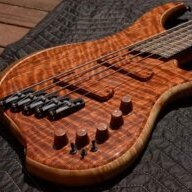
Specs on mine:
ABZ 6 Six String Bass 33.25" - 37"
  1. •Dingwall made in Canada FDV pickups

  2. •Dingwall passive controls, volume, pickup selector (Bridge, both parallel, both series, Neck), tone.

  3. •Dingwall USA strings - buy Link Removed

  4. •Two piece swamp ash body

  5. •Natural satin finish

  6. •Maple neck - satin finish

  7. •Wenge fingerboard

  8. •Banjo frets

  9. •Novax® Fanned -Fret System™

  10. •Select Hipshot ultralight hardware

  11. •New Deluxe Dingwall Gig bag with detachable accessory case

  12. •Weight - 8lb 6oz/3.8kg

  13. •Manufactured in Canada
 
Now if I just knew what strings came on it and which side of the truss rod wrench to use to tweak the neck now that it’s here in Virginia and not in Canada or the U.K.

I love the simplicity of the bass and sweetness of the tone. I love how it responds so well to where and how I play. The tone changes much more drastically without active electronics. It sounds so much more pure, organic, and uncompressed. This thing is truly alive acoustically! And the evenness of tone, feel, and playability across each string is unrivaled.

I owned a NG-2 5 string that was similar in the evenness, but this Canadian made Dingwall is truly more of everything. It’s definitely on a different level, not that the NGs are bad at all!
 
Last edited:
  • Like
Reactions: S-Bigbottom
Nate,
What’s the fretless like? I eventually want to get a fretless 6, and Dingwall is the one I would get. I can’t stand the low B on other manufacturers 5s or 6s. I play a fretless 4 Jazz with lines right now. Wondering how it is to fretless on a Dingwall with the multi scale.

if your used to a dingwall neck you’ll be fine and it will feel quite natural.

I have 3 fretless basses right now and it of course holds its own.
F8C29C3B-8E57-4AAE-9706-0032FEE563F7.jpeg


These carvins are worth every penny but the reality is it’s still like having a great, reliable Honda(carvin) at home but then taking the lambo(dingwall) out
 
Thanks Nate!

Brand spanking new! The ball end is the side that has the yellow wrap. The ball is so tiny, I wasn’t sure it was fitting right in the truss rod.
Thanks Nate!

Brand spanking new! The ball end is the side that has the yellow wrap. The ball is so tiny, I wasn’t sure it was fitting right in the truss rod.


It’s been a while on an AB series bass for me but I assume the wrench does not go straight into the nut. If it does, use the regular end.

the ball end compensates for the angle required for the wrench, at least on the Z series. Just make sure it’s firmly seated before adjusting.
Loosen your strings, especially the 2 middle ones so your not rubbing the wrench against them but also if you are removing relief you don’t want to fight the tension of the strings while adjusting. It can create added strain on the nut and more chance of slippage while torquing.
 
Loosen your strings, especially the 2 middle ones so your not rubbing the wrench against them but also if you are removing relief you don’t want to fight the tension of the strings while adjusting. It can create added strain on the nut and more chance of slippage while torquing.
A setup tip: If you need to tighten the truss rod to remove relief and flatten the neck (such as at the start of winter, when transitioning from more humid conditions to less humid conditions), hold the bass in your lap in normal playing position, then pull back on the headstock with your fretting hand to put some tension on the neck in opposition to the string tension, which will also temporarily remove some relief from the neck. While pulling back on the headstock, you should be able to tighten the truss rod without as much resistance.
 
Last edited:
A setup tip: If you need to tighten the truss rod to remove relief and flatten the neck (such as at the start of winter, when transitioning from more humid conditions to less humid conditions), you can hold the bass in your lap in normal playing position, pull back on the headstock with your fretting hand to put some tension on the neck in opposition to the string tension, which will also temporarily remove some relief from the neck. While pulling back on the headstock, you should be able to tighten the truss rod without as much resistance.

good tip, especially in an “on the fly” situation for sure. Usually I’ll just have the bass on the bench anyways at home doing a cleaning or something else at the same time. Perhaps even a string change anyways
 
I need to be talked out of listing this please. Been on the fence for a year now. I use my AB mostly so....seeing it hang day after day week after week is cruel. :(
View attachment 3690238
You won't get any help from me.

I don't lose much sleep over whether I have one bass or twenty, assuming that they're all getting used.

However, I'm a firm believer in ditching anything that doesn't get regular play. Let it get out there, and make magic for someone else!