• TalkBass has been independent since 1998. Add your voice.
    Create a free account to reply to discussions, view embedded media, and browse with fewer display ads.
    Join freeLog in
    Want zero display ads or expanded classifieds tools? Compare plans.

Fretless Side Dots

Upright bass and even the small violin are easier to play in tune. Why? Because the fingerboard is closer to you visually, there are landmark guides, the heel, the corners etc. In first to third position on the upright it's inches from your eyes. So yeah, you need guides for the electric bass. You can brag about how you do not need any guides. I call BS on it. Yes you can get so familiar but try a tune like a Zappa composition that changes keys so often. Or you are called to sight read You care going to need those dots.

Even for double bass, Edgar Meyer who has impeccable intonation and plays with his eyes closed has dots on his fingerboard. No shame on that.
 
Upright bass and even the small violin are easier to play in tune. Why? Because the fingerboard is closer to you visually, there are landmark guides, the heel, the corners etc. In first to third position on the upright it's inches from your eyes. So yeah, you need guides for the electric bass. You can brag about how you do not need any guides. I call BS on it. Yes you can get so familiar but try a tune like a Zappa composition that changes keys so often. Or you are called to sight read You care going to need those dots.

Even for double bass, Edgar Meyer who has impeccable intonation and plays with his eyes closed has dots on his fingerboard. No shame on that.

Well put - it’s surely common sense. By all means cover them up if you think you don’t need them but I would suggest even people who swear they don’t make use of them would struggle on a dark stage with the need to play anything more than rudimentary patterns in one position. As has been stated, the higher up the fretboard, the more difficult it becomes as the frets get closer together, so if your one position is high up - well I would certainly make use of markers for general orientation.
 
Last edited:
Hey, I know this topic has been discussed here before but I couldn't find an answer to one particular question.

Why are the fretless side dots often only on every other note...and if you are using the dots as a guideline then how are you suppose to do the same for the non-dotted note...is it just the middle between 2 dots...?

Thanks!

Also -- I know you should use your ears, so hoping to avoid that debate.
I learned on an unlined fretless, with dots where the frets would be. I eventually acquired a MIM jazz fretless with dots between the lines. It messed me up royally. I quickly shelved that bass and replaced it with a MIJ unlined jazz with dots on the lines. I guess it's all what you are used to. for me, I prefer an unlined fretless with dots at 3, 5, 7 etc....I would consider myself a fretless person because I learned that way and own 5 basses...all fretless. But, like I said, it's all about what you are used to
 
No, most have them in normal placement. I guess there are some that don't. I've had two electrics and an acoustic. Completely different companies. Dots in standard placement. It's standard placement.

Some companies put the dots right behind the fret on fretted basses as well. Again, not standard placement.

How do we determine "most"? Just personal experience? Because I would also disagree with this. Unless you are talking about a lined fretless. Every unlined board I've seen has dots on the notes. Rickenbacker and some Fender Jazz basses have been mentioned, but that's only two.
 
Lines/no lines is a purely aesthetic decision, but if you want to play in tune right off the bat, get a lined, it works. The luminlay line inlays idea is brilliant, but any high contrast material will work better than dots. I have an ebony fingerboard with maple inlays, and its visible right down to very low light.
 
Always had unlined fretless basses. I've had both dots at just 3,5,7, etc and at every fret with larger dots at teh 3,5,7 both worked equally well for me. Currently I have the later.

I don't expect them to be absolutely perfect but I certainly need at least some dots as a visual reference if I'm doing much shifting of left hand positions.

I don't need dots when playing upright but there's a different kind of physical reference when you're standing against an upright and I rarely move past 3rd position on upright anyway.
 
  • Like
Reactions: BurningSkies
if you are using the dots as a guideline then how are you suppose to do the same for the non-dotted note...?
0000.jpg

the middle between 2 dots

per the OP: i know you were trying to avoid "use your ears" --- but your ears were created just for things like a fretless! ;)
 
The dots are position locators just like the dots and inlays on a fretted instrument.

Agree.

However, it’s also worth noting that some builders place the side dots where the fretboard inlays are traditionally found. Which is to say between the actual fret positions. Other builders place them where the actual fret would be. There is no formal standard every builder adheres to.

Either way, side dot markers - and even lined fretless necks - are approximations at best and shouldn’t be relied on for accurate intonation. Unless, that is, you don’t mind having bad intonation.

tl:dr - Ears rule! Don’t depend on your eyes when playing fretless bass.
 
Here's a hint, if you're lookin at the dots you're probably out of tune.

Here’s another one- if you’re not looking at the dots you’re probably even more out of tune.
 
Hey, I know this topic has been discussed here before but I couldn't find an answer to one particular question.

Why are the fretless side dots often only on every other note...and if you are using the dots as a guideline then how are you suppose to do the same for the non-dotted note...is it just the middle between 2 dots...?

Thanks!

Also -- I know you should use your ears, so hoping to avoid that debate.
I suppose you could get them for every half-step if that would suit you better. Local luthiers might find that a quick and easy job.
 
Upright bass and even the small violin are easier to play in tune. Why? Because the fingerboard is closer to you visually, there are landmark guides, the heel, the corners etc. In first to third position on the upright it's inches from your eyes. So yeah, you need guides for the electric bass. You can brag about how you do not need any guides. I call BS on it. Yes you can get so familiar but try a tune like a Zappa composition that changes keys so often. Or you are called to sight read You care going to need those dots.

Even for double bass, Edgar Meyer who has impeccable intonation and plays with his eyes closed has dots on his fingerboard. No shame on that.
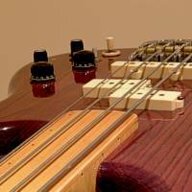
You have landmark guides on an unlined and unmarked fretless bass as well.

The heel of the neck. The cutaways. The horns.

The neck is also flatter than on an upright, so that you’re able to maintain position easier. Since your plucking hand and fretting hand are closer together, you’re less likely to have your left hand drift out of position.
 
I like the dots right where the frets would be. I find it disorienting otherwise.

Same- side dots where they would be on a fretted are useless on a fretless. Unfortunately I’ve always had to custom order my fretlesses to be this way:
96636039-6AF6-44EF-AD85-016585BE5397.jpeg
 
I would put dots on an upright. I would also stay away from the Upright side of TB even if I played upright. Those guys are serious.

So I’m glad I didn’t put dots on mine...

But you’re not exactly right about them being “serious”. There needs to be a word that’s the equivalent of “serious squared”...then it’d be about halfway to the level of seriousness.

Good info and people, but yeah....you get it.
 
  • Like
Reactions: RichSnyder
Only if you're deaf. Fretless is about muscle memory and ears. Not eyes. I practice fretless in the dark.

Muscle memory is strengthened by hand/eye coordination. Ears only tell you when you’ve already made the mistake and it’s too late to fix. If you’re not using one of the available tools to get yourself to play in tune then you’re just taking a longer, harder, and less accurate road to get to the same place.
 

Latest posts