• TalkBass has been independent since 1998. Add your voice.
    Create a free account to reply to discussions, view embedded media, and browse with fewer display ads.
    Join freeLog in
    Want zero display ads or expanded classifieds tools? Compare plans.

Jeff Berlin Discussing Music Ed

Status
Not open for further replies.
Jeff, how would you advise a player to improve their time without the use of a metronome? Assuming that they've been playing for years, have decent time already, but really want to hone in on their small timing issues? Or would you say that small timing issues aren't really a problem in the first place? And if that's the case, let's assume that they have horrible timing.

It all boils down to this comment: You can't play what you don't know!" Earlier I asked everybody to list anything, absolutely anything in the world that is best learned in time rather than out of it. Nobody offered one suggestion because there aren't any. Everything, absolutely everything is best learned out of time including music.

How do you learn how to play in time without a click? By counting the subdivisions until they are natural in the pieces that you are practicing. By, internally hearing the rhythms, or the quarter note, which is always, without fail, best learned slowly. Good time playing is easy if you already know how to play. Almost without fail, the guys who have time problems are the guys who haven't learned how to play well.
 
You can't do it because you haven't learned the notes.
That's incorrect, I do know the notes and I even knew the notes when I used to rush like a bastard.
JB said:
You make the same mistake that some guys make who feel that their improvement comes from another source than where it came from.
You make assumptions about me without any knowledge or evidence.
JB said:
Metronome users do the same thing. They would have always learned how to play in time if they used a click or not, but don't have the musical experience to know this.
What musical experience is that, Jeff? We always hit this place, I'll be happy to type everything I have in the past again, but I have the feeling that since it doesn't really fit into your preconceptions you will again ignore it. The only way I learned to play with steady time, time that wasn't reliant on the time feel of everyone else in the band was by working with a metronome in some pretty specific ways. And it's not just me, I'll be happy to trot out the quote I got from Gary Burton that you dismissed last time with the "Well, maybe a musician of Gary's caliber can get something out of working with a metronome...". Look, you can get folks showing up and paying tuition at your school and they never touch a nome, more power to you. Do you have anyone that's out of school working jazz gigs in New York I can go talk to and hear in person?
 
Jeff,

I am thinking about taking your one week intensive class in March 2010 and have been playing bass for about 11 years. I know it's hard to say without actually knowing much about where I stand in terms of bass playing, but is there anything I can do between now and then in order to maximize the one week course? I can read, a little, but I don't do much on a day-to-day basis in order to keep it current. I was just wondering if you had any tips that would help me prepare for what you guys are preparing for. Thanks,

Tim
 
Kudos to you, Mr. Berlin, for walking fully into the fray and I appreciate the thought, detail and time you are putting into your discussions here.

Some of the best teachers and most influential people I've known have also been very direct, opinionated, outspoken and unapologetic about their views. While many people may feel that sort of attitude and presentation are unpleasant or unfriendly, it's never really phased me and as a result, I've been able to learn some really valuable things by ignoring the presentation and listening to the substance.

Regarding metronomes;

There are times I find practicing with a metronome to be useful. There are times when I find practicing without one to be useful. There are times I find sitting and listening to the environment around me for repeating patterns of sound, like a washing machine in it's spin cycle or the pile-driver at a nearby construction site or a car alarm, and improvising a groove along with them to be very useful.

However, relying on any of those things to 'make me more musical' is not the point. Those things are tools - they all help and none of them can do anything for me if I don't appreciate what or how they can contribute to my practice routine. Adding a metronome does not equal making me better. Understanding ways to use a metronome in practice most definitely can. Expecting it, as a mechanical device, to do anything other than tic in time is foolish.

I don't credit a device for my ability to be musical. I credit my years of experience playing with a wide variety of musicians in a wide variety of musical ensembles for that. But I will definitely credit using the various tools to help me practice for improving my ability to physically play my instrument with more proficiency - metronome included. I'll credit the act of practicing itself for helping to improve my mental ability to perform and I'll credit getting out there and playing with people for my ability to be musical.

My $.02.

Thanks for taking the time to offer your thoughts, Jeff! Much appreciated!
 
Jeff, how would you advise a player to improve their time without the use of a metronome? Assuming that they've been playing for years, have decent time already, but really want to hone in on their small timing issues? Or would you say that small timing issues aren't really a problem in the first place? And if that's the case, let's assume that they have horrible timing.

If, after years of playing, somebody still has problems with their time, then I know that music is not a part of their life. Playing is. And there is a BIG DIFFERENCE between playing and music.
Do you read? Have you learned how to count and subdivide rhythms during your formative years? I am going to say that you haven't had much formal training to make this claim, even to tidy up small things. Time is time, in small ways, in big ways. If you can't keep in time, then the error is the content that you worked on, and not you at all. Further, anybody with horrible time is simply somebody who never learned how to play correctly. Unless one is that extremely odd bird who doesn't have a musical note in their body no matter how hard they worked at musical things (I am this way with drawing. I don't have any inherent skill whatsover), unless one is not made of musical stuff, then anybody with horrible time simply learned the wrong ways to play and regard music.
 
That's incorrect, I do know the notes and I even knew the notes when I used to rush like a bastard.
You make assumptions about me without any knowledge or evidence.
What musical experience is that, Jeff? We always hit this place, I'll be happy to type everything I have in the past again, but I have the feeling that since it doesn't really fit into your preconceptions you will again ignore it. The only way I learned to play with steady time, time that wasn't reliant on the time feel of everyone else in the band was by working with a metronome in some pretty specific ways. And it's not just me, I'll be happy to trot out the quote I got from Gary Burton that you dismissed last time with the "Well, maybe a musician of Gary's caliber can get something out of working with a metronome...". Look, you can get folks showing up and paying tuition at your school and they never touch a nome, more power to you. Do you have anyone that's out of school working jazz gigs in New York I can go talk to and hear in person?

You are right; I DO make assumptions but it is based on experience. Most of the time I'm not wrong either, not about musical things. With everything else? You betcha!

People with time problems are always people who haven't learned the right ways to play. I am not dissing you. I am lumping you into a group who almost to a man discovers that time comes from knowing content learned over time. Gary Burton's rushing story was one part of the story; he could already play, he knew his stuff and his rushing issue was his interpretation when he was a kid of 17, already a virtuoso, and somebody who has stunning time in his lines. He just rushed them according to Gary. What does one expect? He was 17.

Regarding anybody who is out of my school who is playing jazz gigs in New York, I wish to say that academics is different than learning. I've been saying this over and over, but you may not have caught on to this. Many students here have come having played one way for years and have been stuck in their musical improvement. In a few months these guys are playing in time and know musical perspectives well enough to continue to grow and develop as players. This is a music school. It is not a "get-a-gig" academy. As one improves, then one qualifies to get gigs. But learning comes first.

Finally, I do refute your statement that you got good time from a click. Loads of guys have come to The Players School of Music and have found out that their time wasn't as good as they thought it was. My experience is that you may not be clear about what good playing or where good time comes from.

Try my DbminMAJ7 exercise the way that I said. Don't use a click and learn the arpeggio to the very top and then to the very bottom of your neck. If you can play this with no problem, something that I doubt, then substitute an Eb for the Db and continue playing this exercise. The Eb becomes the 9th and subs for the root. I will bet that you can't do this in time right now, nor should you. It is a new exercise. But, I confess to believing that you may be overstating your playing ability because most do who discuss music with me or who come to The Players School to study. The truth is, talk is cheap. If you can play this exercise without a metronome in a few days in time, then good time doesn't come from a click. It comes from musical knowledge and experience. Let me know how it comes out.
 
Jeff,

I am thinking about taking your one week intensive class in March 2010 and have been playing bass for about 11 years. I know it's hard to say without actually knowing much about where I stand in terms of bass playing, but is there anything I can do between now and then in order to maximize the one week course? I can read, a little, but I don't do much on a day-to-day basis in order to keep it current. I was just wondering if you had any tips that would help me prepare for what you guys are preparing for. Thanks,

Tim

There is nothing that you have to do to prepare for The One Week Intensive. The idea is for me to see where you are at, exactly where you are at, not colored or disguised in any way. You, or anyone else who will attend this event don't have to do a thing except to show up exactly where you are as musicians. I will take it from there!

It may surprise you to know that I am a super-easy going teacher. The reason is that I know that the process for learning is guaranteed. If you makes mistakes, fine! You are supposed to make them as you are learning. If you play out of time, fine. You are supposed to play out of time as you learn. As I mentioned, and this is something that nobody can answer, name me anything that is best learned in time. Nothing will ever come to mind because learning is always always always always best done out of time first and foremost.

I guaranteed that you will go home improved as a player. I will put you on the right road toward musical improvement. What you do once you are on this path is up to you.

You will have a ball here, and you will get more than you imagined for your tuition. See you in a few months.
 
Hey Jeff, let's see an updated photo of the current rig and basses!

How's the old P/J bass with the Bartolini holding up?


Invalid Link Removed

I play through two of these gems. No doubt about it, this is THE best combo amplifier I ever played through. When I joined Markbass a few years ago, they sent me this amp and I fell in love with it like Michael Corleone fell in love with Appolonia in The Godfather. I was hit by "the Thunderbolt!" So, they instantly called this the Jeff Berlin Combo and I won't play through anything else. I play through two of these amps with a chorus pedal.

Invalid Link Removed

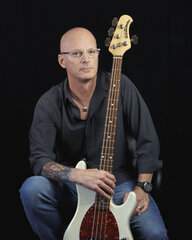
I own one bass guitar. That's it. Just one. It is the guitar that I am holding in the picture in this link. Some find it limiting to only own one bass, but it is the best bass I ever played and I never have problems with it. So I just own one guitar. Dean makes an active pick-up version of this bass because some guys like active pick-ups. I greatly dislike them, as I greatly dislike tweeters. I took the tweeter out of my amp because my combo produces lots of highs already, but they are sweet highs because no tweeter is in there making "dog frequency" highs. Tweeters are awful for me, especially since any decent bass amp with tone knobs can produce sweet highs in abundance instead of those awful artificial sounding high frequencies.

My blond bass with the Bartolinis got stolen a few years ago. Shame because this was a nice guitar.
 
Here is a question about metronomes. Name me something that is learned "in time". I will bet that you can't do it. If you can't do this with anything in the world, then why is music exempt from the same learning principles that EVERYTHING else is connected to?


I've said this before, but rhythm is best learned in time. In fact, if you don't learn rhythm in time, it's not actually rhythm. Since it's also a significant portion of music, one would follow that it's important to us as musicians.
 
Hey Jeff,
FYI, since our last talkbass discussion, I have succesfully pursued Roy Vogt and have received one lesson from him last Sunday. He is the man, and I haven 't been so challenged in many a moon. The lesson was full of "factual" things like "go learn the head, changes, inversions to the changes, and Parker's solo from "Ornithology" We are also studying out of the Chord Studies for Bass (Trombone) book that you recommended.
I highly recommend others consider this book, as it is addressing a problem that I have that I am sure is not unique to me, of tending to start solos on the root of each change, what Roy called, "the bass line solo"
As you might guess, the answer to learning to solo better, comes from knowing music better, and putting in the hours to really understand the harmony.
No one has ever really asked me to do that as I haven't really studies Jazz before.
Thanks for inspiring me to kick my own butt and find a great teacher.
I can see why so many complain about what you teach-it is hard work! Whew!
Once a teacher challenges you though, your choices are to go on being lazy and content with your current level, or to accept the challenge and put in the work.
 
I've said this before, but rhythm is best learned in time. In fact, if you don't learn rhythm in time, it's not actually rhythm. Since it's also a significant portion of music, one would follow that it's important to us as musicians.

Actually, rhythm is best PERFORMED in time. How you learn it is a different story.

One on-line dictionary defined rhythm as "the pattern of regular or irregular pulses caused in music by the occurrence of strong and weak melodic and harmonic beats."

Nowhere does this mention that if you don't learn rhythm in time, it's not rhythm. And you will never find such a statement anywhere. Where did you get this from? I am curious.
 
Hey Jeff,
FYI, since our last talkbass discussion, I have succesfully pursued Roy Vogt and have received one lesson from him last Sunday. He is the man, and I haven 't been so challenged in many a moon. The lesson was full of "factual" things like "go learn the head, changes, inversions to the changes, and Parker's solo from "Ornithology" We are also studying out of the Chord Studies for Bass (Trombone) book that you recommended.
I highly recommend others consider this book, as it is addressing a problem that I have that I am sure is not unique to me, of tending to start solos on the root of each change, what Roy called, "the bass line solo"
As you might guess, the answer to learning to solo better, comes from knowing music better, and putting in the hours to really understand the harmony.
No one has ever really asked me to do that as I haven't really studies Jazz before.
Thanks for inspiring me to kick my own butt and find a great teacher.
I can see why so many complain about what you teach-it is hard work! Whew!
Once a teacher challenges you though, your choices are to go on being lazy and content with your current level, or to accept the challenge and put in the work.

I am thrilled that you decided to study with Roy. If Roy is making music the central method of his lessons, you cannot, repeat, CANNOT go wrong in your pursuit of musical growth. Yes, playing on gigs, listening to CD's and imitating what you hear, playing with different guys; it's ALL GOOD. But a great lessons gives you facts and little matters more than learning great information out of time. Congratulations! Let me know how your lessons are going.
 
WOW!

Hi Jeff. I don't know if you remember, but in the old thread I asked you about the principles of good time - and in another post you mentioned that the academic way to learn good time was to subdivide.

I the past week I practiced (not even with my bass), to tap my foot on the 1,2,3,4 and singing and clapping the 16ths. No metronome.

I'm a completely changed player. I can feel not only the beats, but also all the offbeats.

I went to my bass lesson today and my teacher said he had never seen anyone develope good time in such a short period of time. He was totally blown away too. He is a very experienced teacher who has taught at the conservatoriums here in Denmark, so one must assume that he knows what he is talking about.

I'm an example that good time can be learned without a metronome.

Thank you very much, Jeff.
 
Regarding anybody who is out of my school who is playing jazz gigs in New York, I wish to say that academics is different than learning. I've been saying this over and over, but you may not have caught on to this. Many students here have come having played one way for years and have been stuck in their musical improvement. In a few months these guys are playing in time and know musical perspectives well enough to continue to grow and develop as players. This is a music school. It is not a "get-a-gig" academy. As one improves, then one qualifies to get gigs. But learning comes first.
So that's a "No", then?

JB said:
Finally, I do refute your statement that you got good time from a click.
Refute all you want. It may be easier to say than actually do, however.


JB said:
Loads of guys have come to The Players School of Music and have found out that their time wasn't as good as they thought it was.
And that's exactly where I was when I moved to NYC in 1987. I had been to Berklee, I had a lot of experience playing jazz, I had the opportunity to play with musicians like Elvin Jones, Mousey Alexander, Bernard Purdie, Frank Tate, Junior Mance, Clifford Jordan, Bill Barron and any number of not as well known players on the scene in NY and I did not have good time. What DID get me to a place where I had a steady swinging timefeel was working in some very specific ways with a metronome.


jb said:
My experience is that you may not be clear about what good playing or where good time comes from.
Unfortunately, none of your experience is actually with ME. That may make it hard to make an accurate assessment.

JB said:
But, I confess to believing that you may be overstating your playing ability because most do who discuss music with me or who come to The Players School to study.
Sorry, but that says more about your range of acquaintance than it does my ability.
 
He had already stressed the point that I internalized the subdivisions. And I've practised the exact same thing earlier - with a metronome.

My one theory is that I let the metronome keep the time, which didn't pushed me to feel the subdivisions myself. I was just keep along with 'nome, not keeping my own time and not developing my own internal time sense.
 
Having a sense of rhythm is subjective and very definitely does not require a metronome.

Using a metronome in practice is not going to harm your ability to be musical or rhythmic. Depending on one might, but using one in practice certainly won't.

Why is there even a debate? A metronome is a tool - like an amp. Do you need an amp to play bass? Does it interfere with your ability to play bass if you use it? Depends on who you are and how you understand these things.

When I listen to classical, jazz - even those zany piano bar players - I hear them slow down, speed up, get louder, softer - ebb/flow - emote, express... none of it sounds at all like it's tied to anything perfect or metronomic - all of it (even those piano bar dudes) sounds quite musical though. Do they practice with metronomes?

Yes and no. Funny thing is - whether they do or not doesn't really come out in the wash.
 
So that's a "No", then?

Refute all you want. It may be easier to say than actually do, however.


And that's exactly where I was when I moved to NYC in 1987. I had been to Berklee, I had a lot of experience playing jazz, I had the opportunity to play with musicians like Elvin Jones, Mousey Alexander, Bernard Purdie, Frank Tate, Junior Mance, Clifford Jordan, Bill Barron and any number of not as well known players on the scene in NY and I did not have good time. What DID get me to a place where I had a steady swinging timefeel was working in some very specific ways with a metronome.


Unfortunately, none of your experience is actually with ME. That may make it hard to make an accurate assessment.

Sorry, but that says more about your range of acquaintance than it does my ability.

Forgive me, but you talk a lot but you aren't doing the musical exercise that I asked you to try several times. Talk is cheap young man. Stop defending your position and just do the homework that I assigned to you because you appear to me to be avoiding it. Please don't write me anymore, not until you've done your homework and reported back your experience. Thank you!
 
Forgive me, but you talk a lot but you aren't doing the musical exercise that I asked you to try several times. Talk is cheap young man. Stop defending your position and just do the homework that I assigned to you because you appear to me to be avoiding it. Please don't write me anymore, not until you've done your homework and reported back your experience. Thank you!

Not until you do YOUR homework.
 
Status
Not open for further replies.