• TalkBass has been independent since 1998. Add your voice.
    Create a free account to reply to discussions, view embedded media, and browse with fewer display ads.
    Join freeLog in
    Want zero display ads or expanded classifieds tools? Compare plans.

Peavey Amps Club

groovaholic said:
Series wiring is pretty simple;

right now your cab is wired so that + and - from your cab's input go to + and - on one speaker, then + and - on the second speaker.

The change recommended here, is to rewire your 210 as follows:
oThe input wire + goes to one speaker's +
oThe - goes to - on the other speaker's -
oThe series connection goes from the - terminal on the first speaker to the + terminal on the second speaker

If that's confusing at all, PM me your email address and I'll email you some diagrams.

Uh oh... I haven't had a chance to make any if the writing modifications yet, let alone even use the amp as I've been so busy lately. Anyway, I fired her up this evening to get a quick practice in before my band rehearsal tomorrow and all I could hear was a white noise type of hiss coming out... any ideas what this might be? A blown tube maybe?

 
Uh oh... I haven't had a chance to make any if the writing modifications yet, let alone even use the amp as I've been so busy lately. Anyway, I fired her up this evening to get a quick practice in before my band rehearsal tomorrow and all I could hear was a white noise type of hiss coming out... any ideas what this might be? A blown tube maybe?

Are you sure you have a signal? Did you try a different cable and a different instrument?
 
http://www.flickr.com/photos/r_jackson/7865829190/

Back in '84 when I was at BIT in Hollywood we had a Peavey Max in the big performance room, P2. That was at the old campus back when the school was on Hollywood Boulevard before the move to McCadden. Anyway, most of the rooms had Acoustic 360 heads with folded horn enclosures and Peavey Mace 2x12" combos for the guitar players. Those Mace combos ran six 6L6 tubes for about 160 watts of death ray and you could barely hear yourself play on the Acoustic rigs. But in P2 with the Peavey Max it just never seemed to run out of steam.

I was walking around in the Tampa Guitar Center a few days ago and saw an old Peavey Max sitting in the used gear. I had no way to resist its call. These things were essentially a Peavey CS-800 400-watt per channel stereo PA amp with a bass preamp feeding it all packed up in a (not so) little rack case. They wanted $200 for it and there was no way I could pass it up. Still sounds exactly the way I remember it from all those years ago.

7865829190_c14e7edb3f_b.jpg
 
It starts as soon as I turn it on. I have tried replacing all cables and each cab on its own with no difference. Even if I turn the volume all the way down, it still makes the noise.

So I'm going to run out and buy a replacement tube, as I was planning on replacing it anyway... I believe the stock tube is a 12AX7... any recommendations on an alternate tube type?

Thanks!
 
Going from old memory, but I think the 12AX7 is a preamp tube. If your getting "white noise hum" even with the volume down, my first guess would be main amp output problems. I'd advise taking it to a tech and have them look it over. You could change every tube in it and still not find the problem.
I used to work in electronics wholesale, and I have seen this happen.....a lot. :hmm:
 
http://www.flickr.com/photos/r_jackson/7865829190/

Back in '84 when I was at BIT in Hollywood we had a Peavey Max in the big performance room, P2. That was at the old campus back when the school was on Hollywood Boulevard before the move to McCadden. Anyway, most of the rooms had Acoustic 360 heads with folded horn enclosures and Peavey Mace 2x12" combos for the guitar players. Those Mace combos ran six 6L6 tubes for about 160 watts of death ray and you could barely hear yourself play on the Acoustic rigs. But in P2 with the Peavey Max it just never seemed to run out of steam.

I was walking around in the Tampa Guitar Center a few days ago and saw an old Peavey Max sitting in the used gear. I had no way to resist its call. These things were essentially a Peavey CS-800 400-watt per channel stereo PA amp with a bass preamp feeding it all packed up in a (not so) little rack case. They wanted $200 for it and there was no way I could pass it up. Still sounds exactly the way I remember it from all those years ago.
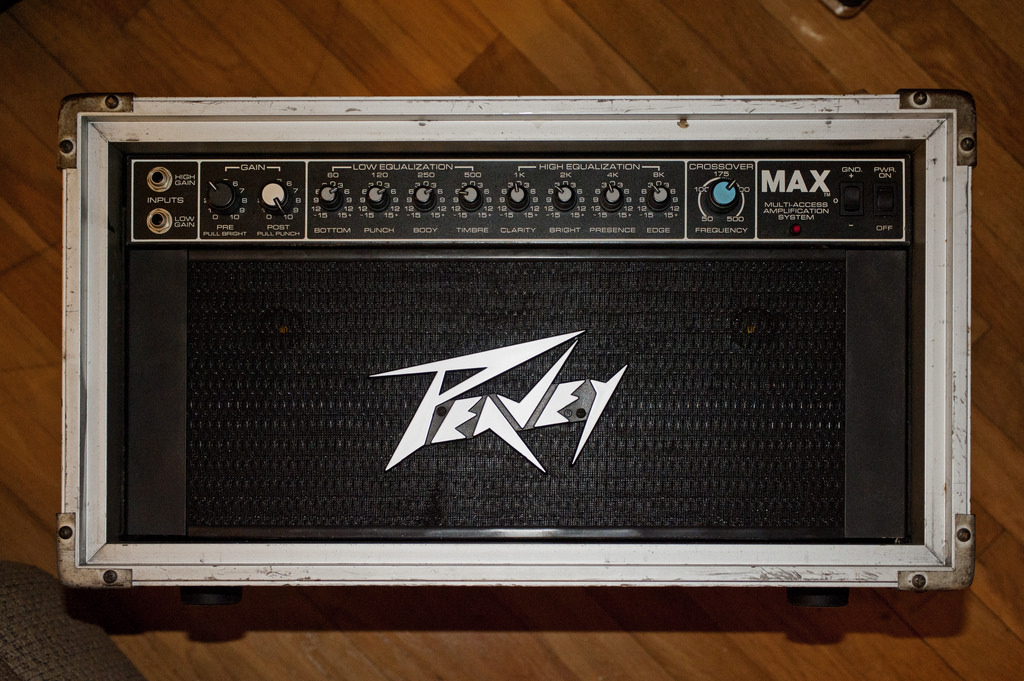
7865829190_c14e7edb3f_b.jpg

Great score. Those are good sounding, reliable amps. Heavy, but what 800 watt amp in a flite case wasn't back then? No telling how many ten of thousands of that series CS amp are still out there kicking butt. Went to an Atlanta Rhythm Section concert back in the day and Paul Goddard had a wall of those and 1820s. He had one Peavey Combo 300 (?) in the middle of the stack and I was told it was used as his bass drum monitor. He truly deserved the nickname Thunderbass.

mech
 
Going from old memory, but I think the 12AX7 is a preamp tube. If your getting "white noise hum" even with the volume down, my first guess would be main amp output problems. I'd advise taking it to a tech and have them look it over. You could change every tube in it and still not find the problem.
I used to work in electronics wholesale, and I have seen this happen.....a lot. :hmm:

Yeah, it's only one tube and it's in the preamp. If Xandros uses just the SS channel, he bypasses the tube and the possibility of that being the issue which I doubt as well. For a new production 12ax7 I prefer Tung-Sol with JJ as second pick but I doubt that will help the issue. Good luck!
 
I remember Goddard having those, now that you mention it. Ha! I hadn't thought about that in ages.

I opened it up and it had sucked in quite a bit of dust over the years, which I spent an afternoon carefully cleaning out. Other than that it seems to have weathered the past three decades pretty well. It doesn't even have any scratchy pots.

Great score. Those are good sounding, reliable amps. Heavy, but what 800 watt amp in a flite case wasn't back then? No telling how many ten of thousands of that series CS amp are still out there kicking butt. Went to an Atlanta Rhythm Section concert back in the day and Paul Goddard had a wall of those and 1820s. He had one Peavey Combo 300 (?) in the middle of the stack and I was told it was used as his bass drum monitor. He truly deserved the nickname Thunderbass.

mech
 
Yeah, it's only one tube and it's in the preamp. If Xandros uses just the SS channel, he bypasses the tube and the possibility of that being the issue which I doubt as well. For a new production 12ax7 I prefer Tung-Sol with JJ as second pick but I doubt that will help the issue. Good luck!

I tried the SS Channel, same thing... was thinking about that at work and realized that it's likely more than just the tube :) Like I mentioned, I had planned on picking up a new tube anyway (which I did - got a Tung-Sol) but as Ayce suggested, it looks like I'll be off to see a repair tech :(

Thanks for all the responses!
 
I actually just replaced the grill cloth on that Sunn cabinet last night, so it looks a little less...er, "seasoned" since I took this photo. I actually didn't mind the look so much, but every time I took it somewhere I got black stuff on my hands from the grill, which seemed to actually be dissolving. Finally, I was like, "I gotsa do sumpin' 'bout this..."

My only real note on this setup is that I wish it all collapsed into briefcase-sized components for transport...and that those components weighed a fraction as much when collapsed.

The Gauss 18" is a Karlson coupler, which is still the only flavor of 18" cab I like. The Sunn is the 2 x 12" version of the 4 x 12" cabs Entwistle used to use. I dunno that they sound better or worse than any other option for the highs, but every time I catch sight of 'em I'm right back at the midnight movies watching, 'The Kids Are Alright' as a teenager. And of course the Peavey is lovely. All the effects loops and line-outputs make it a real Swiss Army Amp and it never runs short on juice. Big ol' iron in there and capacitors the size of soda cans. Which of course ain't light, but that's the story of my life...

http://www.flickr.com/photos/r_jackson/7848234764/

7848234764_d92cdccf6a_b.jpg
 
I actually just replaced the grill cloth on that Sunn cabinet last night, so it looks a little less...er, "seasoned" since I took this photo. I actually didn't mind the look so much, but every time I took it somewhere I got black stuff on my hands from the grill, which seemed to actually be dissolving. Finally, I was like, "I gotsa do sumpin' 'bout this..."

My only real note on this setup is that I wish it all collapsed into briefcase-sized components for transport...and that those components weighed a fraction as much when collapsed.

The Gauss 18" is a Karlson coupler, which is still the only flavor of 18" cab I like. The Sunn is the 2 x 12" version of the 4 x 12" cabs Entwistle used to use. I dunno that they sound better or worse than any other option for the highs, but every time I catch sight of 'em I'm right back at the midnight movies watching, 'The Kids Are Alright' as a teenager. And of course the Peavey is lovely. All the effects loops and line-outputs make it a real Swiss Army Amp and it never runs short on juice. Big ol' iron in there and capacitors the size of soda cans. Which of course ain't light, but that's the story of my life...

I would have almost killed for a rig like that back when. The caps were considered computer grade. Can't remember the brand but they were blue and huge things by modern standards. If you get it serviced, ask the tech to remove the output transistors and renew the silicon grease on the mica insulators. Carefully, of course. The transistors plug into sockets so the operation is easy, he just needs to keep them in order or do them one at a time. Transistors just need to be snugged down well and not over tightened. Also get him to spray some contact cleaner on all the round pin plugin connectors and maybe tighten up the female pins. They will stretch and loosen up a little over the years. Loose plugin connections, dried out silicon grease and capacitors that have lost some of their dielectric oil are the biggest cause of failure in these old workhorses, AFAIK.

mech
 
  • Like
Reactions: Giffro
I would have almost killed for a rig like that back when. The caps were considered computer grade. Can't remember the brand but they were blue and huge things by modern standards. If you get it serviced, ask the tech to remove the output transistors and renew the silicon grease on the mica insulators. Carefully, of course. The transistors plug into sockets so the operation is easy, he just needs to keep them in order or do them one at a time. Transistors just need to be snugged down well and not over tightened. Also get him to spray some contact cleaner on all the round pin plugin connectors and maybe tighten up the female pins. They will stretch and loosen up a little over the years. Loose plugin connections, dried out silicon grease and capacitors that have lost some of their dielectric oil are the biggest cause of failure in these old workhorses, AFAIK.

mech

I appreciate the advice. Here's a shot of the guts I took just before I cleaned it out. Lotta dust sucked into it over the years. You can see those big blue caps, though.

http://www.flickr.com/photos/r_jackson/7896336010

7896336010_c89782e239_b.jpg
 
One more, really quick. Here's the interior of the preamp section. Note the teeny little Bubble-Yum-sized transformer for the DI:

The preamp is really clean. The small transformer is a Hi Z to Low Z balanced and feeds the XLR connector. No current so it can be small.

It's amazing how much dust can collect in these beasts and they still operate.

The main cap brand was Capacitor Technology (I knew it would come to me). The size of the cap for it's value (10,000uF?) is one of the reasons it sounded more powerful than it was for the available technology. The engineer's name was Jack Sondermeyer. He was basically responsible for the Peavey gear of that time and through the early 2000s having such a reputation for reliability. Before Peavey, Jack had worked at Bell Labs and then with RCA on the team that developed the first rugged output transistor. A refined version of those were used in the CS-800s and many other Peavey amps. Jack's relationship with RCA and later Motorola was what let him get exactly what he wanted in an output device since he knew the inner workings. Earlier output transistors were delicate things, as anyone who bought the first Fender solid state, snake bit, PA heads learned. I tried to fix several of them as a store tech back in the day and it seemed to smoke always came out again. Fender couldn't do any better. One of the truly poor designs.

mech