• TalkBass has been independent since 1998. Add your voice.
    Create a free account to reply to discussions, view embedded media, and browse with fewer display ads.
    Join freeLog in
    Want zero display ads or expanded classifieds tools? Compare plans.

Scales, more than box shapes

For diatonic scales, I use a system that is primarily 3 notes per string (or shift). To do this, you have to realize that there isn't a single box for a given scale/mode. Instead, there are multiple patterns (shapes/boxes) for each scale/mode.

For example, in this approach a major scale can start with 1st finger, or 2nd finger, or 4th finger. This means 3 different "shapes" for a major scale. I think most people (I used to be among them) get stuck in the box that starts on the 2nd finger. As you expand, though, you realize that this box ends on the 4th finger, so you can continue with the next pattern (starting on 4th finger) and repeat the scale. The major scale that starts on the 4th finger ends on 1st finger. The major scale that starts on the first finger ends on the 2nd, and you're back to the where you started.

As you move from one of the 3 note patterns to the next, you can move up (or down if you're playing descending) a string, or you can shift, but the pattern continues. Over time, your mental representation of the patterns will begin to expand to cover the entire fretboard.

In this video, Anthony Wellington shows how to apply the patterns to modes on a 7 string bass. You don't have to have a 7 string bass to use it, but it makes an interesting point.


WW
WW
WW
hW
hW
Wh
Wh

Obviously, my post isn't a lesson on scales. I'm just pointing in the direction of the approach that I'd use to answer your question about how to expand scales to more than box shapes. It starts with a box shape, then expands it to multiple shapes, then it expands to patterns across the fretboard. Eventually, the boxes fade and it becomes notes, in convenient and accessible patterns.


Wow. Thanks for sharing this.
 
So ive gotten pretty good at my box shape major minor amd blues scales. What Im having trouble with is continuing the scales down the neck of the bass. Is there any advice on practicing this?

PM me tomorrow to remind me to send you some fingerings. I was stuck for years. I was just moving 2,4 1,2,4 1,3,4 across and up the neck but there's much more. There is no absolute right way but when you see these which a teacher hesitatingly gave me, it will open your eyes to a whole lot of potential. He hesitated only because he didn't want me to think that even these were the absolutes... but I explained that some of need a kickstart after being stuck for years.
 
There is a lot of advice here, but let me add this one :

Whenever you fret a note, make sure you can say the name of the note AS you fret it. You want to learn every note on the neck, this is the way to do it.

When you play a scale you know, you need to say every note as you play it. You simply then would transfer those patterns to different areas on the neck.

To be honest, I would start all this by learning all the arpeggios.Make sure you can play maj, min, dim, dominate, augmented, sus..While you practice those shapes, say every note you are playing while you play them.

A major crutch a lot of players develop is they learn a few scales, maybe venture out of one or two boxes and that's it. It's far more effective to learn every chord shape and every note involved. That way you are thinking more musically (adding a #11 over a major chord, b9 over a minor....stuff like that). This will all make more sense once you see all the notes on the neck.

Chord tones are the most important notes in each chord. When I think of basslines, I almost always use the chord tones first and then add scale tones in where appropriate.
 
  • Like
Reactions: Ant Illington
I would agree apart from this bit. Shifting is a key skill that is a bogeyman weakness for many players, IME. My advice is to tackle it head on and don’t be afraid of it. Play scales and arpeggios on one string. Target intervals like fifths and octaves on one string without glissing. Relax the thumb and get your left arm supple. Use as little fingering pressure as you can get away with. Sure you undershot or overshoot sometimes to begin with, but it is well worth the effort. YMMV but probably not by much!

I agree. As I've stated in many threads the concept of "minimize shifting" handicapped me hugely for well over a decade. Perhaps I took it too literally but I became a much better bass player once I got out of the box. Now, I sometimes practice shifting even when it's totally unnecessary. Eventually you will get to the point where your fingers will just know where to go; you'll be able to even play scales with one finger up one string without even thinking about whole step half step, you'll just hear it.... and my ear lacks a lot for transcribing but it gets this.
 
  • Like
Reactions: SteveCS
I gaze at the fingerboard of a bass from across the room and hear the pitches in my head-
I'll work things out and think things up without even holding onto a bass.
Boxes. Ledges. Constellations.
I had wondered if I was alone in this way of thinking. I guess not.
 
Some awesome stuff in the posts above. Don't get discouraged as you work through these different lessons and techniques. I found it helpful to split my practice time between learning my scales and finger positions and learning new songs. For me, it kept my practice time from becoming overly tedious. But, stick with it! You'll soon find learning new material much easier, because you understand why certain bass lines were constructed they way the were, even if the original artist didn't.
 
Learn the repeating pattern where the unisons and octaves are.
Octave = up two strings and up two frets. Also, up one string and up 7 frets.
Unison = down one string and up five frets.

There are more, but those are easy.

Next learn where the fifths are. Then thirds. Apply octaves to those. Repeat.
 
I just learned the index/pinky trick from a recent Scott Devine lesson and it has really helped me.
He explains it at about 17 minutes in, but the entire video has great tips.

 
I would agree apart from this bit. Shifting is a key skill that is a bogeyman weakness for many players, IME. My advice is to tackle it head on and don’t be afraid of it. Play scales and arpeggios on one string. Target intervals like fifths and octaves on one string without glissing. Relax the thumb and get your left arm supple. Use as little fingering pressure as you can get away with. Sure you undershot or overshoot sometimes to begin with, but it is well worth the effort. YMMV but probably not by much!
When I was learning bass I didn't know that shifting was hard so I just practiced it like anything else I was learning. As a result I surprised the crap out of a couple teachers later on. Anybody who doesn't think learning scales isn't important will almost always lose a gig to someone who does.
 
  • Like
Reactions: SteveCS
I agree with memorizing, but disagree with rote memorization. The way to learn these things is to work them out slowly, for yourself, over time. Making yourself figure out the rest of the notes in the Bb major scale going up to the 15th fret is what will get you to eventually memorize them all.

Just work at it, repetition is your friend. Learn tunes that will leverage your knowledge and push you to continue to explore.

Make yourself learn all the names of all the notes in tunes you already know but play mostly by "shape". There's no secrets, no shortcuts, it takes work, but that doesn't mean it needs to some sort of musical Bataan Death March, either. Work at it a bit at a time, you'll get it sooner than you think.
 
I agree with memorizing, but disagree with rote memorization.
Gotta start the memorization process somehow. Rote is as good as any. Internalizing all the info comes with time and effort, but you do have to be able to remember that the 15th fret on the E string is a G before you can internalize it and use it in your playing.
 
I am gonna throw a grenade into this by saying that I think knowing the notes in the chords is more important than knowing scales. Knowing you can play a D or a B under a G can lead to really interesting bass lines.
Nonsense. Every chord is built on the intervals among the notes of the scale of the key being played. They're only separable when you do not understand them.
 
  • Like
Reactions: SteveCS
Back when I was teaching, I spent tons of time with people trying to get them to think outside the boxes. Bass players are notorious for using box shapes for things when instead they should try to listen to what they're doing and play up and down the entire fingerboard. This is absolutely critical in improvisational music.

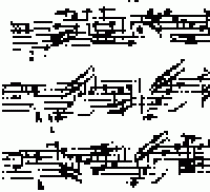
Attached are some examples I'd have them look at to try and get them to think about the notes up and down the neck. When you're practicing scales, don't worry about the shape as much. Instead, listen to what's happening. You know what note comes next... you know the intervals... so always focus on the next note. You should always, always, always focus on the sound of the chord and what scale you're using. Knowing what it's supposed to sound like is 10x more important than memorizing a shape.
 

Attachments

  • Like
Reactions: Mushroo
In addition to learning where all the notes are up and down the fretboard, as @5544 said, the first thing to work on is learning three different patterns for fingering a scale across the strings in one position: one that starts with your index finger on the root, one that starts with your middle finger on the root, and one that starts with your pinky on the root. I'm guessing that the "box pattern" you're already familiar with is probably the pattern that starts with your index finger on the root, as that's the one most of us learn first. If you know all three of these patterns, you can use whichever one of them works best starting at any given place on the fingerboard.

Once you have those down, the next trick is to incorporate shifts to enable you to move up the neck. For example, by incorporating shifts you can play the entire first octave on the E and A strings (assuming you started from a root on the E string), and then repeat the same pattern (or switch to a different pattern) in the next octave. When you shift, you're switching from one of the three fingerings to one of the others, and you can mix-and-match parts of them as you work your way up the neck.

Yes...this! But the standard box I'm thinking of uses middle finger to start, 2nd position uses 1st finger, and 3 position uses 4th finger to start. But yeah, THIS!
 
  • Like
Reactions: Mushroo
I'm so struggling with this the last little while, just need to spend LOTs of time on it. I understand the theory part and all the mechanics, the notes and the notes on the fretboard, it just needs to become immediate. I'm trying some of the practice ideas people have put forward to see what helps. Actually I think I'll just start slower until my brain gets used to it... if it ever will. Some wins with just ionian, dorian, mixolydian, aeolian which I consider the most important, they cover a lot of ground.
 
Last edited:

Latest posts