
I recall this being an option with at least one manufacturer years ago. You literally stacked the individual pots on a shaft to get the number and values needed. The brand name will come back to me, but this was for a complex engineering control application, and I don't think cheap was part of the equation.I wonder if it's possible to disassemble a few pots and take the resistance tracks out to build what you need.

Enjoy the benefits of a premium membership!
Upgrade Account
-
TalkBass has been independent since 1998. Add your voice.
Create a free account to reply to discussions, view embedded media, and browse with fewer display ads.
Join free Log in
Want zero display ads or expanded classifieds tools? Compare plans.
You are using an out of date browser. It may not display this or other websites correctly.
You should upgrade or use an alternative browser.
You should upgrade or use an alternative browser.
More options
Who Replied?
I've done that a number of times to get certain values. I don't suggest it that often because people generally don't seem interested and/or someone will come into the thread and say it's not possible or otherwise pick an argument.
It's certainly easiest on pots that have a stamped "side" and a separate back piece, as you usually see on multi gang pots. Just order one that has the mechanical configuration you want and a couple cheap basic pots from the same series that have the resistance values you want and have at it.
It's certainly easiest on pots that have a stamped "side" and a separate back piece, as you usually see on multi gang pots. Just order one that has the mechanical configuration you want and a couple cheap basic pots from the same series that have the resistance values you want and have at it.

I know how an SVF works, I just didn't know how you were implementing it. My Alembics used variable via a pot or 3 position in a separate switch which seems far more useful to me than a single setting. My current version is variable like the one's I've built in the past or an Alembic S2.
I agree, it's definitely more versatile to have constantly variable Q or a few selectable values via switch.
The problem here is as I said in the first post is space on the bass and no extra drilling. So let's say I have four holes on my bass - 2 filter controls, 1 volume, 1 blend. No extra space for Q (except some special 3 gang concentric pots, but that's outside this scope now). If I'm not mistaken, Wal has it that way.
Also, I'm not using a SVF topology for this

I recently (like a couple months ago or more) finished building my own alembic series 2 style filter preamps. two of them (on the same board, sharing power supply components). Unfortunately, as I opted for the constant variable q knobs, I didn't take into account that the gain would be audible much higher with the q turned up. I'm trying various dual gang pots so I can coincidentally lower the gain while increasing the q pot, but have had trouble finding the right pots for the job.
frustrating! But I mean, all that said, it works great.
However, my system is setup in a very me-friendly, but everyone else alienating, way:
q and frequency knob for neck pickup, q and frequency knob for bridge pickup, pickup blend (mixer) knob for blending the outputs of the two filter preamps, which then goes into a third preamp - a 3 band - so I also have bass, mid, and treble controls, and then a master volume.
It's the most versatile bass I've ever played. But the radical volume changes of the q controls really is frustrating. If I changed them to switches then I could balance the level with fixed resistors (or trimmer pots internally), but I really want the variable q thing.
I need to sit and work it out, but honestly I'm just done LoL. The issue with the dual pots for level control during q changes is that the rate needs to be different for level control versus q. linear q pot and log (ish) level compensation pot. And I haven't found those anywhere.
Sounds friendly enough to me.
So you say you when you turn up the Q, the gain goes up as well?
I don't know what topology you are using, but this can be avoided.
A state variable filter in the inverting configuration has Q and gain that are independent.
Also there are a few ways for a Sallen-Key filter to be made to work like that - the Passinwind open source preamp being one of them.
There could also be some GIC based filters that could do the same, but I don't remember them very well.

As for disassembling and reassembling various pots to get the desired value - that is an option, but I just think it's to cumbersome at the moment. It would require much time and getting various compatible pots to work.
Not appealing enough for me right now.
Still, thanks for the suggestion!
Not appealing enough for me right now.
Still, thanks for the suggestion!

Passinwind
I know nothing.
- Dec 3, 2003
- 23,079
- 46,041
- Disclosures
- Designer/Toaster Tech @ Passinwind Electronics
Ok. I'm gonna contact them tomorrow and get back with whatever info I get.
Thanks for that. One feature that Omeg offer that I really like is 12mm long threaded bushings, but IIRC that may only be for the 20mm metal pots like the ones I'm using.
BTW, a while back I asked Klaus Noll if he could set me up with the MECs via his custom pot options (Banzai Music offer this too I think), he said no go for dual C taper.
Passinwind
I know nothing.
- Dec 3, 2003
- 23,079
- 46,041
- Disclosures
- Designer/Toaster Tech @ Passinwind Electronics
As for disassembling and reassembling various pots to get the desired value - that is an option, but I just think it's to cumbersome at the moment. It would require much time and getting various compatible pots to work.
Not appealing enough for me right now.
Still, thanks for the suggestion!
I'm pretty sure @RobbieK has posted some brand specifics in an older thread, maybe he can jump in with details.
Thanks for that. One feature that Omeg offer that I really like is 12mm long threaded bushings, but IIRC that may only be for the 20mm metal pots like the ones I'm using.
BTW, a while back I asked Klaus Noll if he could set me up with the MECs via his custom pot options (Banzai Music offer this too I think), he said no go for dual C taper.
Seems the ECO line of pots also has 12mm bushings available. The P16 don't have it listed in the datasheet, but it might be available nonetheless if requested.
Strange about the MEC though, looking at the sheet at Banzai, I'd assume you could put any taper you wanted.
[Invalid or Expired Link Removed]
Passinwind
I know nothing.
- Dec 3, 2003
- 23,079
- 46,041
- Disclosures
- Designer/Toaster Tech @ Passinwind Electronics
Seems the ECO line of pots also has 12mm bushings available. The P16 don't have it listed in the datasheet, but it might be available nonetheless if requested.
Strange about the MEC though, looking at the sheet at Banzai, I'd assume you could put any taper you wanted.
[Invalid or Expired Link Removed]
I got the impression that Omeg can do a lot more than what's on their basic config pages. I just took a stab at requesting a price on something that might be relatively cheap and easy for them, and they came back with that price and a ~one month build time. Since I can readily use the same value for the frequency and Q pots buying a dozen wasn't a huge bite in my case.
I didn't go deeper with Mr. Noll but I expect I'll be talking to him again soon, my primary luthier client uses a lot of his stuff. I didn't run this by Banzai though, maybe I should have.
Freq Neck, freq bridge, Conc vol/bal, conc Qs. I've done it this way, but I don't like it as much as separate Q controls.The problem here is as I said in the first post is space on the bass and no extra drilling. So let's say I have four holes on my bass - 2 filter controls, 1 volume, 1 blend. No extra space for Q (except some special 3 gang concentric pots, but that's outside this scope now).
OK. I do.Also, I'm not using a SVF topology for this

Sounds friendly enough to me.
So you say you when you turn up the Q, the gain goes up as well?
I don't know what topology you are using, but this can be avoided.
A state variable filter in the inverting configuration has Q and gain that are independent.
Also there are a few ways for a Sallen-Key filter to be made to work like that - the Passinwind open source preamp being one of them.
There could also be some GIC based filters that could do the same, but I don't remember them very well.
no the gain doesn't go up, I shouldn't have said that. I was just being casual in the terminology. It is a state variable filter. The q increases the output around the filter cutoff by as much as roughly 15db. That is the huge boost I'm talking about, and it IS huge. What alembic did with the series 2 was have custom made dual gang pots for the q knobs, and those are exactly what I want. but I'm not going to pay big bucks for them... it's just a nice-to-have, not worth the price of an entire second project bass ;-)
It's a fantastic setup, by the way.
The only downside is I'm currently running it from a single 9v battery. All 3 preamps. Sound wise it's great. Battery lifetime wise it sucks. But one step at a time....
I mean, sucks in the sense that it lasts through weeks of regular use, not a year like my other active basses... and there isn't any audible warning of it dying - it just dies suddenly. So I'm putting in an emergency bypass passive mode switch that will take the neck pickup (basically the precision position) and send it directly to the output jack.
Anyway - having owned an alembic series 1 many years back in my most prolific days as a musician, I missed that level of control.
so yes, I have two independent SVFs, one for each pickup.
no the gain doesn't go up, I shouldn't have said that. I was just being casual in the terminology. It is a state variable filter. The q increases the output around the filter cutoff by as much as roughly 15db. That is the huge boost I'm talking about, and it IS huge. What alembic did with the series 2 was have custom made dual gang pots for the q knobs, and those are exactly what I want. but I'm not going to pay big bucks for them... it's just a nice-to-have, not worth the price of an entire second project bass ;-)
It's a fantastic setup, by the way.
The only downside is I'm currently running it from a single 9v battery. All 3 preamps. Sound wise it's great. Battery lifetime wise it sucks. But one step at a time....
I mean, sucks in the sense that it lasts through weeks of regular use, not a year like my other active basses... and there isn't any audible warning of it dying - it just dies suddenly. So I'm putting in an emergency bypass passive mode switch that will take the neck pickup (basically the precision position) and send it directly to the output jack.
Anyway - having owned an alembic series 1 many years back in my most prolific days as a musician, I missed that level of control.
so yes, I have two independent SVFs, one for each pickup.
Ah, that's another story then. I thought the overall gain changed.
Out of curiosity, since you are running a state variable filter, shouldn't it be a simple matter of adjusting the Q to be of lower value (changing a few resistors)? Assuming it's a diy/custom built filter and not factory made.
The q is continuously variable between roughly 0.7 to much higher. so the peak at filter resonance goes between about 0 (smooth rolloff) to a huge peak, and everything between. like an alembic. wonderful result.. but definitely an audio engineer friendly concept ;-)Ah, that's another story then. I thought the overall gain changed.
Out of curiosity, since you are running a state variable filter, shouldn't it be a simple matter of adjusting the Q to be of lower value (changing a few resistors)? Assuming it's a diy/custom built filter and not factory made.
I don't have a quote yet, but I have gotten a reply from Omeg. 
So I'm going to need some feedback from you guys...
They say it can be done, and was ordered before. This is the photo they sent me:

As they don't have the necessary tooling, they can't make the pins of the upper gang go all the way down.
The other option they offer is to mount the same switch to the PC2G16ECO model of the pot:

So basically no option for all the pins to be on the same side (which isn't much of an issue for me personally).
Which one would be more user friendly (since it would seem other people could be interested in this kind of pot)?
They offer a 8mm M10×0.75 bushing and a F14 L=19mm spindle (see datasheet). This is where I need help deciding - is a 8mm bushing enough for most type back routed guitars? It states in the datasheet that there is a 12mm option available, but I'll need to ask and confirm that.
Also, what about the spindle? Will it accept normally available knobs? Sorry I'm not so familiar with guitar knobs on the market.
@Passinwind, what kind of spindle dimensions did you specify for your order?
I'd like to know these things so I can get back to Omeg and get a quote.
Thanks!
So I'm going to need some feedback from you guys...
They say it can be done, and was ordered before. This is the photo they sent me:
As they don't have the necessary tooling, they can't make the pins of the upper gang go all the way down.
The other option they offer is to mount the same switch to the PC2G16ECO model of the pot:
So basically no option for all the pins to be on the same side (which isn't much of an issue for me personally).
Which one would be more user friendly (since it would seem other people could be interested in this kind of pot)?
They offer a 8mm M10×0.75 bushing and a F14 L=19mm spindle (see datasheet). This is where I need help deciding - is a 8mm bushing enough for most type back routed guitars? It states in the datasheet that there is a 12mm option available, but I'll need to ask and confirm that.
Also, what about the spindle? Will it accept normally available knobs? Sorry I'm not so familiar with guitar knobs on the market.
@Passinwind, what kind of spindle dimensions did you specify for your order?
I'd like to know these things so I can get back to Omeg and get a quote.
Thanks!
Passinwind
I know nothing.
- Dec 3, 2003
- 23,079
- 46,041
- Disclosures
- Designer/Toaster Tech @ Passinwind Electronics
I don't have a quote yet, but I have gotten a reply from Omeg.
So I'm going to need some feedback from you guys...
They say it can be done, and was ordered before. This is the photo they sent me:
As they don't have the necessary tooling, they can't make the pins of the upper gang go all the way down.
The other option they offer is to mount the same switch to the PC2G16ECO model of the pot:
View attachment 4475246
So basically no option for all the pins to be on the same side (which isn't much of an issue for me personally).
Which one would be more user friendly (since it would seem other people could be interested in this kind of pot)?
They offer a 8mm M10×0.75 bushing and a F14 L=19mm spindle (see datasheet). This is where I need help deciding - is a 8mm bushing enough for most type back routed guitars? It states in the datasheet that there is a 12mm option available, but I'll need to ask and confirm that.
Also, what about the spindle? Will it accept normally available knobs? Sorry I'm not so familiar with guitar knobs on the market.
@Passinwind, what kind of spindle dimensions did you specify for your order?
I'd like to know these things so I can get back to Omeg and get a quote.
Thanks!
I went with the 3/8" by 12mm bushing and a 1/4" by 26mm spindle, which leaves 14mm showing above the bushing. Yeah, they offer some mixed measurement formats that way.
6mm is the other standard spindle diameter and will probably leave more knob options for where you live. You can still use 1/4" format knobs with an inexpensive sleeve adapter anyway.My primary luthier client uses pretty soft core wood and usually a ~1/4" top cap in quite a few of his builds. And then there's shielding, which I sometimes have to cut away around the pot just to make it fit with the standard 3/8" or even 10mm long pot bushings. 12mm length lets me use a regular thick-ish lock washer and/or a stop nut to adjust the shaft/spindle height. But with a switch added you'll also want to look at total depth in the control cavity as well. A standard Fender top route is only about 1.2" deep, so I think you're looking at "just depends." Many standard pots use a 7mm bush length and that's great for a control plate but potential problematic for a top route in my experience.
I'd also recommend going with the high torque rotation option, it has a nice feel and should minimize inadvertent setting bumping.
Hope it works out for you, and please keep us informed either way.
Some more news form Omeg:
So it would seem these pots are indeed possible to make. It's just that the 12mm option for now would be way more expensive since they need to make the tooling first.
I did some measurements on my bass with a Bourns guitar pot with 9.5mm bushing - the bass is around 6mm thick, and with the lock washer (don't know if thats the correct English word for the washer with teeth), normal washer and nut, there is barely any bushing left.
So the Omeg ones would at best maybe barely fit (with some routing one the bass) and worst case not fit at all.
Asking them to make the extra tooling would be justified if I needed a large order, but the min quantity of 10 is already more than I need...
Which means I might be back at step one
Btw, @Passinwind, on your preamp, did you try using linear pots, and what was your experience with them if you did?
Mouser has those 9mm Bourns pots, and they have a lin option.
Omeg said:We have not yet moulded a 12mm long bush for a pot with a push-push switch, tooling would have to be made.
(The 12mm long bush for the dual gang without switch is different internally and does not work with the push-push switch).
F14 spindle L=22mm can be made. Tooling is already in place so it is just an adjustment of the moulding length.
So it would seem these pots are indeed possible to make. It's just that the 12mm option for now would be way more expensive since they need to make the tooling first.
I did some measurements on my bass with a Bourns guitar pot with 9.5mm bushing - the bass is around 6mm thick, and with the lock washer (don't know if thats the correct English word for the washer with teeth), normal washer and nut, there is barely any bushing left.
So the Omeg ones would at best maybe barely fit (with some routing one the bass) and worst case not fit at all.
Asking them to make the extra tooling would be justified if I needed a large order, but the min quantity of 10 is already more than I need...
Which means I might be back at step one
Btw, @Passinwind, on your preamp, did you try using linear pots, and what was your experience with them if you did?
Mouser has those 9mm Bourns pots, and they have a lin option.
Passinwind
I know nothing.
- Dec 3, 2003
- 23,079
- 46,041
- Disclosures
- Designer/Toaster Tech @ Passinwind Electronics
Some more news form Omeg:
So it would seem these pots are indeed possible to make. It's just that the 12mm option for now would be way more expensive since they need to make the tooling first.
I did some measurements on my bass with a Bourns guitar pot with 9.5mm bushing - the bass is around 6mm thick, and with the lock washer (don't know if thats the correct English word for the washer with teeth), normal washer and nut, there is barely any bushing left.
So the Omeg ones would at best maybe barely fit (with some routing one the bass) and worst case not fit at all.
Asking them to make the extra tooling would be justified if I needed a large order, but the min quantity of 10 is already more than I need...
Which means I might be back at step one
Btw, @Passinwind, on your preamp, did you try using linear pots, and what was your experience with them if you did?
Mouser has those 9mm Bourns pots, and they have a lin option.
That’s all about what I expected, but good on you for doing the homework. If enough people start building filter preamps maybe Omeg would take a flyer on doing the tooling on their own.
My original design did use dual linear pots, mostly those Bourns box shaped ones, and I still haven’t officially changed that. They work fine and just fit in my bass, but the way so much frequency sweep bunches up at the high end isn’t so great for me personally. Others who want to emphasize the lower frequencies might like it better though since the control granularity down there will be better. My compromise was to use a low-ish resistance and thus reduce the sweep range. As a practical matter that meant the useful sweep range was from about half up to full up, approximately 3K-8KHz. With a C taper it works well with a smooth sweep from ~350-8+K with 50K ohms, or 750-8+K with 20K ohms. My Omegs are 22K (their stock value in that range, and I’m currently at something like 700-8.8K on my test bass.
That’s all about what I expected, but good on you for doing the homework. If enough people start building filter preamps maybe Omeg would take a flyer on doing the tooling on their own.
My original design did use dual linear pots, mostly those Bourns box shaped ones, and I still haven’t officially changed that. They work fine and just fit in my bass, but the way so much frequency sweep bunches up at the high end isn’t so great for me personally. Others who want to emphasize the lower frequencies might like it better though since the control granularity down there will be better. My compromise was to use a low-ish resistance and thus reduce the sweep range. As a practical matter that meant the useful sweep range was from about half up to full up, approximately 3K-8KHz. With a C taper it works well with a smooth sweep from ~350-8+K with 50K ohms, or 750-8+K with 20K ohms. My Omegs are 22K (their stock value in that range, and I’m currently at something like 700-8.8K on my test bass.
Thanks for the insight on the linear pots!
At the moment I'm using the Bourns big ones (PDB183), 250k A taper - it's just wired reverse. It's counter intuitive, but it works like a C taper, and I do like the sweep feeling. On the other hand, I think few people other than me would be ok with rotating the pot CW to reduce frequency and CCW to increase it.
I just might try a linear pot and see if I like it or not.
As for the tooling, if I ran a business or something and did this for a living (wishful thinking lol
 ), I'd have no problem just asking them to do it, no matter the cost.
As for now I'll stick with the hobbyist friendly cheaper options.
Anyways, I'll sleep a bit on this and decide whether I should make the order or not. At the very least, I could just order some anti log pots like you did
I'll keep this thread updated, and when I collect all the info from Omeg, I'll post at your thread.
Passinwind
I know nothing.
- Dec 3, 2003
- 23,079
- 46,041
- Disclosures
- Designer/Toaster Tech @ Passinwind Electronics
25863702[/URL], member: 208708"]Thanks for the insight on the linear pots!
At the moment I'm using the Bourns big ones (PDB183), 250k A taper - it's just wired reverse. It's counter intuitive, but it works like a C taper, and I do like the sweep feeling. On the other hand, I think few people other than me would be ok with rotating the pot CW to reduce frequency and CCW to increase it.
I just might try a linear pot and see if I like it or not.
As for the tooling, if I ran a business or something and did this for a living (wishful thinking lol
As for now I'll stick with the hobbyist friendly cheaper options.
Anyways, I'll sleep a bit on this and decide whether I should make the order or not. At the very least, I could just order some anti log pots like you did
I'll keep this thread updated, and when I collect all the info from Omeg, I'll post at your thread.
I actually did advocate for using that hack with A taper pots in my long thread, which I ‘ve done in various circuits in the past. For something like a high pass filter it’s pretty easy to get used to, clockwise just equals more bass and we could always call it a sub bass knob. But for the LPFs, maybe not so much for many people. Craig Anderton mentioned this in his first DIY effects book back in the mid seventies, I believe.
In any case the 20mm metal Omeg dual C tapers like I bought are a pretty decent option, and to me even a single pair might’ve been worth what I paid for a dozen. At the very least I expect I’ll probably have another set in some NAMM bass next summer, and I have plenty of spares for myself.
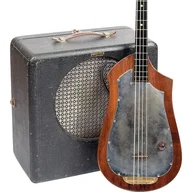
I wonder if it's possible to disassemble a few pots and take the resistance tracks out to build what you need.
It depends on the mechanical construction of the potentiometer, whether you can reassemble the pieces or not. In 2015, I made a 'FrankenPot' for my Lakland 55-02D by taking apart three Bourns pots and using the pieces to put together the one I wanted - with a 250 Kohm B taper element, a 50 Kohm B taper, with a DPDT push-pull switch and a center detent.
Why: I snagged a rare N-Tune tuner off eBay for my bass. It replaces the volume control with one with a push-pull switch and a slot cut in the threads for a cable up to a LED board. Pull up on the knob and it mutes the bass and turns on the tuner, push down to unmute the bass and turn off tuner. Sometimes I play some hand or mallet percussion on-stage, have a small percussion setup, and had previously modded three other basses to have a push-pull mute on the volume control to make it easier to switch between.
But then the Lakland didn't have a passive mode, and passive sounds more authentic for some music. So i replaced the 50 Kohm preamp treble pot with the new FrankenPot. Now with the treble knob down the bass is in active mode and the treble control cuts or boosts, with the knob pulled up it's in passive mode with a traditional (Alvino Rey) hi-cut tone control with a 0.068 uF orange-drop capacitor.
Unfortunately I didn't take any pics or document the steps (was figuring it out as I went), but if anyone is thinking about doing this I can add more (possibly) useful info.


