Lowendtech
Happily trending in my own peculiar direction.
Extremely unlikely this is.a more recent clip from 2020

TalkBass has been independent since 1998. Add your voice.
Create a free account to reply to discussions, view embedded media, and browse with fewer display ads.
Join free Log in
Want zero display ads or expanded classifieds tools? Compare plans.
Extremely unlikely this is.a more recent clip from 2020
Perhaps Mr. Townshend can explain it:
And a more recent clip from 2020 where he takes a bass solo (not the best sound quality, but a pretty neat solo):
Not really a The Who fan either, but got to give credit where credit is due, and John Entwistle had serious chops and a fairly unique playing style, sort of slapping the strings with the tip of his fingers.
Extremely unlikely this is.


Accurate, as he is.Townshend sounds like a tool here to be honest.
I really liked his guitar playing style while I was growing up (however Entwistle was my inspiration) but Pete is full of twaddle.My honest opinion about Pete Townshend would have me banned, so I'll refrain from that.
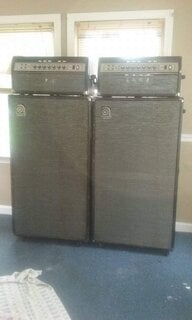
I always thought this was a funny thing Pete Townsend said about Entwistle:
goto 1m55s
I have more of a problem with Bill Wyman's place in the pantheon, and I've seen bassists on this forum defend him fiercely. I remain unconvinced. These things are annoyingly subjective. I love The Who and I love John's playing. Makes me unobjective.
If you listen to Townshend's demos maybe you'd hear what John normally brings to the table via it's absence. Not that his contributions are all that subtle in the first place...
Part of the problem with Wyman is that, Keef played far more of the bass parts than most people know and as far as I am concerned, Keef is a better bass player.
JE pioneered that bright, Rotosound tone, hounding James Howe's company so he could get a tone on bass that resembled an electric guitar, but lower. Previously in the early 60's, a lot of bass sounded like thumpy organ pedals.
View attachment 3768046
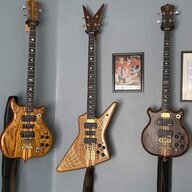
My friends at Alembic ( see that video at the start of this thread, that Explorer-shaped Alembic Exploiter became one of his trademarks) explained for his basses, they'd get the neck dead straight, and lower the action to where you'd be hard-pressed to get a piece of cigarette paper between the strings and the frets. Unplayable for anyone there, yet John could pick it up and fly on them. He once requested a 34" scale Flying V-shaped bass. Of course it wound up being almost five feet long, but it worked for him.
View attachment 3768041
View attachment 3768043
And he had to ply his trade between Keith Moon, Townshend, and Roger Daltrey. Playing with Moon alone would have been a monumental task for anyone.
And this may provide a little insight:
Daltrey claims everyone (except for him) in the band was taking drugs in the early 60s. Virtually everyone in that band had a serious vice or serious issues with their upbringing - and drugs helped them deal with it. Daltrey claimed he never took drugs because he was afraid it would affect his libido...lol!
I have no reason to believe that Entwistle didn't begin using drugs as soon as he could obtain them.
The guy from the Kinks had the first Ric in England.
I saw a biography on him and I believe he was a guitarist first. And his noodling on guitar was transcribed to bass and that's how his sound was considered original. Of course he wasn't the first to do what he does, but he was the first to become famous for it.
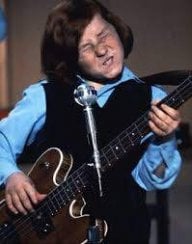
+1. He tells the story of the song--what we should all aspire to do.That and I love his choice of notes. He's busy but he's a superb conversationalist musically speaking.
He was not finished. Moon is an easier target; he once passed out during a 1970s show in San Francisco, forcing the band to pull a drummer out of the crowd. "With Keith, my job was keeping time, because he didn't do that," says Townshend. "So when he passed away, it was like, 'Oh, I don't have to keep time anymore.'" The Who by Fire, Stephen Rodrick, Rolling Stone Mag. Nov. 25, 2019