Thanks jimfist for adding much more detail than I know about on speaker simulators -- you hit the nail on the head with the problem I've kept trying to get over about using a mic with a cabinet, which many people seem to have misunderstood as either saying that cabinets are a bad thing or a clean DI feed of the raw bass signal is what should be used...
Your solution (cab for on-stage, speaker simulator for FOH) and mine (speaker simulator for FOH and flat monitor) should be equivalent, done properly -- and assuming that all the live tone adjustments in your case are done before the DI split, not in any amp after it.
However any difference between the simulator sound and actual cabinet won't be heard (and potentially be corrected) by the player; with a DI split to FOH and monitor you hear exactly what's going out front since both go through the same simulator, so any tweaks you make to get the on-stage sound closest to your "perfect sound" also apply to FOH.
Your solution gives the "perfect sound" on-stage (because it uses the real and much-liked cabinet) with some differences at FOH (simulator vs. cab differences); mine may sound less good on-stage (simulated instead of real cabinet) but out-front may be closer to the "perfect sound" after the player tweaks it.
Either way, it's nice to know there's another way which is commercially supported (if expensive) to get FOH sound closer to the on-stage "golden sound" that people like so much, while fixing many of the problems that can happen with micing up a cabinet.
On the cost side, given the availability of high-quality low-cost ADC/DSP/DAC nowadays there's no real reason that an excellent digital cabinet simulator should be expensive (they ought to be a lot cheaper than a decent amp + cabinet!), except that right now they're made in small volumes by high-end manufacturers because not many people use them...
Your solution (cab for on-stage, speaker simulator for FOH) and mine (speaker simulator for FOH and flat monitor) should be equivalent, done properly -- and assuming that all the live tone adjustments in your case are done before the DI split, not in any amp after it.
However any difference between the simulator sound and actual cabinet won't be heard (and potentially be corrected) by the player; with a DI split to FOH and monitor you hear exactly what's going out front since both go through the same simulator, so any tweaks you make to get the on-stage sound closest to your "perfect sound" also apply to FOH.
Your solution gives the "perfect sound" on-stage (because it uses the real and much-liked cabinet) with some differences at FOH (simulator vs. cab differences); mine may sound less good on-stage (simulated instead of real cabinet) but out-front may be closer to the "perfect sound" after the player tweaks it.
Either way, it's nice to know there's another way which is commercially supported (if expensive) to get FOH sound closer to the on-stage "golden sound" that people like so much, while fixing many of the problems that can happen with micing up a cabinet.
On the cost side, given the availability of high-quality low-cost ADC/DSP/DAC nowadays there's no real reason that an excellent digital cabinet simulator should be expensive (they ought to be a lot cheaper than a decent amp + cabinet!), except that right now they're made in small volumes by high-end manufacturers because not many people use them...


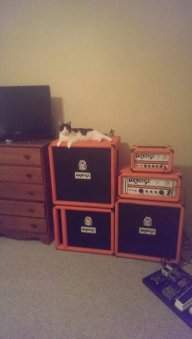
 Well at least I threw the biggest and baddest DI that sounded like a tube amp at them. I suppose that counts for something.