
The fretboard on the first bass is very dirty, maybe the strings were dead too? Just asking.
Exactly what I was thinking. New strings > New zing....old strings.....no zing.

TalkBass has been independent since 1998. Add your voice.
Create a free account to reply to discussions, view embedded media, and browse with fewer display ads.
Join free Log in
Want zero display ads or expanded classifieds tools? Compare plans.
The fretboard on the first bass is very dirty, maybe the strings were dead too? Just asking.

So many claims, so little evidence.Yes body wood makes a difference, and the neck wood makes a lot of difference as well.

Well, he did offer a two-bass, in-store comparison as the basis for his conclusion. That’s called... well, call it what you like. But, in the narrow sense of the term “proof,” I’ll give it to you — yes, he did not use that word.The OP said nothing about "proof."
You can't prove a negative. You can prove that it makes a (real life) difference. People have claimed this is easy to prove thousands of times, but still noone actually proves it.Is there any experiment or other scientific proof that wood doesn't effect tone?
I'd love to see it if there is.

I blame it on cosmic cussednessI blame it on Hysteresis.
Everything makes a difference, the argument is really over relative percentage of effect.



It's not so much about the species of the wood; it's the net stiffness of the body that affects the sound. In this case, the swamp ash body is probably softer and structurally weaker than the okoume body. When you pluck the strings, the swamp ash body microscopically flexes more than the okoume body, which changes the sound ringing on the strings. Which changes what the pickup "sees" on the string. In particular, it softens the high end tone on the string. The deeper tones come through better. That's why, in this case, the bass with the swamp ash body sounds different from the one with the okoume body.
However, this does not mean that swamp ash bodies always sound better than okoume bodies, or even that they will always sound different from each other. The difference in stiffness between them is not that much. Another swamp ash body might be made from a heavier, stiffer piece of wood. A different piece of okoume could be lighter and softer. There's a lot of variance and overlap between individual boards. So, another pair of swamp ash and okoume G & L's may sound exactly the same as each other.
Also, you could take that first okoume body and modify it to make its stiffness about the same as the swamp ash body. Take a 1/16" off the thickness of the body, or cut a couple of small chambers in it. Simple dimensional changes will weaken it, reducing its stiffness. Making changes like that would bring the sound of that first okoume bass much closer to the sound of the swamp ash one.
Again, it's the net stiffness of the body that determines how and how much it affects the sound. The choice of wood species is part of the final stiffness, but it's not all of it. The design and dimensions of the body can be used to adjust the stiffness of the body into the desired range, using almost any wood. You can't just say that swamp ash sounds like this and okoume sounds like that. Because someone will have examples that will sound the opposite, or exactly the same. And that's why we have all these arguments about Tonewood. It's not just the wood species.
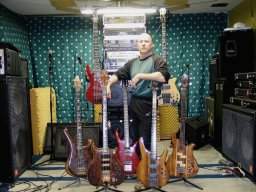
Three highly identical bases, same pickups, same brand new strings, same exact electronics and hardware, same type of swamp ash body wood, three different neck wood configurations. Three distinctly different tonalities. If you are in the NYC area come over and hear the difference for yourself.So many claims, so little evidence.
Anecdotes are still not evidence.Three highly identical bases, same pickups, same brand new strings, same exact electronics and hardware, same type of swamp ash body wood, three different neck wood configurations. Three distinctly different tonalities. If you are in the NYC area come over and hear the difference for yourself.[/ATTACH]
It's not so much about the species of the wood; it's the net stiffness of the body that affects the sound.
So many claims, so little evidence.

Im in the “woods make a tonal difference” camp.. We are in good company! (with expert builders & master luthiers with decades of experience, like Mike Tobias, Sadowsky, Ken Smith, Fodera & many more )Even with examples like you provide, the people that deny wood makes a difference, will never be convinced, no matter what evidence is shown.Three highly identical bases, same pickups, same brand new strings, same exact electronics and hardware, same type of swamp ash body wood, three different neck wood configurations. Three distinctly different tonalities. If you are in the NYC area come over and hear the difference for yourself.
View attachment 3136905 View attachment 3136906

not the battery, I rarely use the active position on a bass that has the option
The L-2000 has a passive/active/ active + treble boost switch.
The first bass was working fine, it just wasn't sounding great.
It sounded "normal", not fantastic.
I did see a post somewhere recently that included oscilloscope tracings showing the differences. If I can find that I will post a link. Maybe somebody else saw it and has it handy.Anecdotes are still not evidence.
Yeah, it is important to acknowledge that not everyone has the same level of hearing acuity. They literally might not be able to hear the difference.Im in the “woods make a tonal difference” camp.. We are in good company! (with expert builders & master luthiers with decades of experience, like Mike Tobias, Sadowsky, Ken Smith, & practically any seasoned instrument builder will attest to)Even with examples like you provide, the people that deny wood makes a difference, will never be convinced, no matter what evidence is shown.
Again: anecdotes are not evidence that it makes a (real life) difference. It might as well be difference in the pieces of wood, not the type of wood. Or something completely different.I did see a post somewhere recently that included oscilloscope tracings showing the differences. If I can find that I will post a link. Maybe somebody else saw it and has it handy.
More in the vein of the original post, here are three more swamp ash bodies, one with a different fingerboard material, which also makes a noticeable difference in the sound all by itself. Subtle but noticeable. The other two sound virtually identical, despite being 21 years apart in age, and despite the fact that one is 1.5 pounds heavier than the other. The heavier one has a slight bit more sustain, but very slight.