• TalkBass has been independent since 1998. Add your voice.
    Create a free account to reply to discussions, view embedded media, and browse with fewer display ads.
    Join freeLog in
    Want zero display ads or expanded classifieds tools? Compare plans.

Tonewoods

It's all about what happens at the bridge. Whether hollow or solid body, its the energy going back through the bridge to the string that colors the sound.
There really is no debating that this occurs. The issue arises from different people's ability and willingness to hear, and just the general kind of weird BS that occurs in forums, hot air. Most of us can at least tell maple from mahogany, there is really just a few stubborn people who would rather appear smart while thrashing their brains on science then stop and listen....real musicians can hear it easily. But not all who play instruments are musicians.

I wonder how many who hear the difference can hear the difference in a level matched double blind test?

I can't argue that there isn't a difference (in fact I suspect it does make a bit of a difference, although significantly less than on an acoustic instrument) - but I absolutely can argue that sighted evaluations are so prone to bias as to be almost useless.

--
aborgman
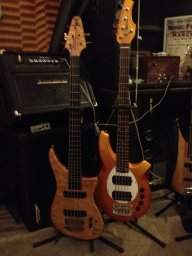
 
That's true...but if you a/b different basses you may be able to tell that they are different basses. There was a TB member who did an a/b recording with 2 different Peavey Cirrus basses. One was alder with a flame top, the other was walnut with a bubinga top. You could easily hear the difference, although it could be tricky picking which bass was which in a recording.

...and tricky to attribute the differences specifically to the wood used for construction. I'm sure they'll sound different, but who is to say how much is due to wood and how much to other factors?


--
aborgman
 
I wonder how many who hear the difference can hear the difference in a level matched double blind test?

I can't argue that there isn't a difference (in fact I suspect it does make a bit of a difference, although significantly less than on an acoustic instrument) - but I absolutely can argue that sighted evaluations are so prone to bias as to be almost useless.

--
aborgman

I've been beating that drum for a while in here, myself. ;^)
 
I don't think anyone would be willing to do it. There are too many variables that would really need to be assessed to keep it a 100% legit experiment. It could be done, but it would cost a lot of money and time.....unless you wanna pony up.

Nope... all it requires is someone with a digital recorder, a couple basses identical except for tonewood, and a copy of pcabx - see: www.pcabx.com

--
aborgman
 
Nope, they're P pickups in a guitar HB sized housing.

according to the wiring diagram, an XL-2 utilized EMG 85s, which was a custom pickup manufactured for Steinberger.

is it identical to the 40P that Steinberger used on the Synapse model? unless you have the exact pickup specs for both it's anybody's guess

all the best,

R
 
according to the wiring diagram, an XL-2 utilized EMG 85s, which was a custom pickup manufactured for Steinberger.

is it identical to the 40P that Steinberger used on the Synapse model? unless you have the exact pickup specs for both it's anybody's guess

all the best,

R
The HB-SS are P internally as far as I'm aware. Not sure if another type was made or my info wrong. I'm trying to find where I got that info to confirm, but IIRC it was info from EMG when I enquired about getting an HB with CS internals.

I thought the P in the Synapse was just the 40P5 from the standard catalogue range.

Edit: my brain sparked awake for a momnet and checked the EMG cat - the 85 is a geetar pickup.
 
Just email Mike Tobias.

I think he knows more than most of us when it comes to this.

But Sadowsky says he can't tell live or in a recording. I think this is how religious wars start ;) It really doesn't matter how many people think they can tell if they can't demonstrate it it's just not scientific in any way. You can believe whatever you want but going to a manufacturer for verification of their own advertising claims doesn't make too much sense. Besides the golden ears here have already said Mike can't even tell when he sold to Gibson and his website is lies. So who ya gonna believe? I'll believe the first person who can show their claim. It would be really easy to prove if the skill is there. I can hear the difference between minor and major chords and I can think of many ways to show that that don't require I know the answer in advance. No one has shown they can hear wood species based on it's genetic signature when a piece of wood is in contact with a vibrating string whose disruption of a magnetic field has then been passed through a handful of transistors as heard from differing positions in a non controlled environment and a fluctuating power supply.
 
are you absolutely certain that the control pots had the same resistance value, and that the pickups were of identical specification and construction? manufacturers can and do make subtle changes to a product line without broadcasting it via a world-wide press release. it would also be good to be certain that the strings were of the same material, same gauge, and same manufacturer.
Absolutely, also manufacturers have been known to change suppliers simply because they can get a better price. I remember Tobias went through a handful of bridge suppliers, plating, different finishes... But we never hear about the Wilkinson Tobias' and how that thin aluminum bridge changed the tone, it's always the wood.

for an even greater impact, change the engineering specs of a specific pickup shape while keeping its resistance the same (i.e. different magnet strength, different wire diameter, different number of windings) ... I know I could keep a lot of you arguing about Alder vs Ash bodies if I changed a pot value or pickup, because most would not even think to investigate these parts of the picture since they are visually identical.
I feel looks is one of the more important factors in a bass' tone. And that it's a real experience. Just not accurate.
 
I know it's not definitive science, but you have to admit that different materials have different acoustic properties.

I don't think any one is arguing they don't, just that they aren't so pronounced that claims like "I can always tell maple from mahogany" aren't true.

There are many things that could hypothetically effect tone, humidity, wind, body fat. Some have even argued that the shoes they wear change their tone. There are so many ridiculous claims and I just like to see the most basic evidence since it should be so simple to demonstrate.
 
He may make nice basses, but he also believes you can 'age' them by leaving them next to a stereo speaker for a few minutes.
Did Mike really say that? He's still my favorite luthier even though he gave us the phrase tone plate.
Nope, they're P pickups in a guitar HB sized housing.
That what I've read too. Also all the Tobias soaps are supposed to be reverse P's.
 

The instruments became more "alive". 45m of the "shaking" would age an instrument roughly 10 years. It could also even out the dead spots.
The results were captured with a $13,000 computer program, doing before and after testing.
They have a program that measures how alive an instrument is? :eek: That post read like an infomercial, lots of keywords and no facts.
 
But Sadowsky says he can't tell live or in a recording. I think this is how religious wars start ;) It really doesn't matter how many people think they can tell if they can't demonstrate it it's just not scientific in any way. You can believe whatever you want but going to a manufacturer for verification of their own advertising claims doesn't make too much sense. Besides the golden ears here have already said Mike can't even tell when he sold to Gibson and his website is lies. So who ya gonna believe? I'll believe the first person who can show their claim. It would be really easy to prove if the skill is there. I can hear the difference between minor and major chords and I can think of many ways to show that that don't require I know the answer in advance. No one has shown they can hear wood species based on it's genetic signature when a piece of wood is in contact with a vibrating string whose disruption of a magnetic field has then been passed through a handful of transistors as heard from differing positions in a non controlled environment and a fluctuating power supply.


Very long winded.. To get to the simple point that you dont agree with me.

Look I dont care what you think, aside from the fact that Mike knows more about this than you or I, I have heard the difference.

I played two MTDs that were the exact same specs (Ash body, maple neck and burl maple top, with a stain color) Except one had a maple FB and the other had a rose wood FB. Now, mind you I was just like you about this: Skeptical to say the least, but when I plugged them both in one after the other repeatedly into same amp I could not beleive my ears. Proof is in the pudding folks. Not to mention they had consecutive serial numbers made right after eachother.


As for mike not being able to tell when he sold his company to Gibson, who gives a flying ****, that does not effect my opinion on him and it most certinly does not discredit anything he has said on this matter, remember this isnt politics, its the real world. Digging up something that someone said on a certin matter does not make them wrong on completely different subject. No matter how you construe it.

You are too analytical and not willing to listen to what people say, I see you in these threads all the time pushing the same rhetoric. Ask any classical guitar maker and they will set you straight.

:hmm:
 
Very long winded.. To get to the simple point that you dont agree with me.

Look I dont care what you think, aside from the fact that Mike knows more about this than you or I, I have heard the difference.

I played two MTDs that were the exact same specs (Ash body, maple neck and burl maple top, with a stain color) Except one had a maple FB and the other had a rose wood FB. Now, mind you I was just like you about this: Skeptical to say the least, but when I plugged them both in one after the other repeatedly into same amp I could not beleive my ears. Proof is in the pudding folks. Not to mention they had consecutive serial numbers made right after eachother.


As for mike not being able to tell when he sold his company to Gibson, who gives a flying ****, that does not effect my opinion on him and it most certinly does not discredit anything he has said on this matter, remember this isnt politics, its the real world. Digging up something that someone said on a certin matter does not make them wrong on completely different subject. No matter how you construe it.

You are too analytical and not willing to listen to what people say, I see you in these threads all the time pushing the same rhetoric. Ask any classical guitar maker and they will set you straight.

:hmm:

Classical guitars are a totally different animal.

But whatever. If you hear a difference then it's real to you.
 
Classical guitars are a totally different animal.

But whatever. If you hear a difference then it's real to you.

Good, I am glad you understand that I'm right. (Look! I can play the troll game too)

But classical guitars are no different. The woods effect the tone by restricting or enforcing the vibration/sustain of the srting.. Basses are made of wood, strings are made of metal (not too far off from most acoustic/classical guitars) and if the strings are affected by the woods that they are attached to then the tone that is produced by the string is picked up throught the magnetic pickups.

Its not too complicated.. Really, its not like a leap of faith to beleive something like this.