• TalkBass has been independent since 1998. Add your voice.
    Create a free account to reply to discussions, view embedded media, and browse with fewer display ads.
    Join freeLog in
    Want zero display ads or expanded classifieds tools? Compare plans.

Entry level bass is total BS?

Hey guys and gals! I'm a bit perplexed and perturbed. What is the deal with the term "entry level bass"?! Entry level to me is code for "cheap". I understand not many of us have a Warwick Corvette with SVT full stack with a board full of pedals with MIDI budget but really, ENTRY level? I think the term does a disservice to the beginner. You go out you buy an insert your who's who brand here and BAM! All of a sudden the beginner is spending more time at the GC butcher, I mean repair technician spending there pennies instead of learning! IMHO the places that all of these guys go wrong is in the electronics and the bridge! The electronics will work right if the assembly is correct and come on for pete's sake use better hardware for the bridge saddles! Rant over and always friends, Keep 'em straight up there!

I simply can't agree with you that most so called entry level basses are basses of bad quality, as you describe it.

Personally I play an Ibanez Mikro as my main, which I admittedly swapped the stock pickups on, a bass that can be had for about 180$ from new, and I never owned a bass that felt more comfortable playing, despite the fact of having owned some 1000+$ basses.

Also my Mikro has a real stable neck with no sharp frets sticking out, it stays in tune nicely and have no fret buzz even at fairly low action.

When that is said I think I can agree with you, if that was even one of your points, that it doesn't do the beginner a favor to start out on a bass of poor quality, and as such I guess you are right that the very term entry level instrument doesn't make much sense and is somewhat misleading.
 
  • Like
Reactions: Tom Young
It's a bass that is good enough for a beginner to start on.
And inexpensive enough so that if the beginner does not want to continue playing,it will not be a total waste of funds.
Here’s the scenario that plays in my head as I read this. When said player decides not to play anymore this is what usually happens.
1: Instrument goes in closet never to be seen or heard again.
2: Instrument gets returned or possibly traded for way less than originally paid for and repeat until broke and sad.
3: Instrument winds up on craplist or insert classified here and winds up in closet never to be seen or heard again.

My head hurts I must’ve been in a really crappy mood or something when I started this thread.
 
View attachment 2858385 I'm old enough to remember when "entry level" meant, not just "Cheap" - as in "inexpensive" - but, also as in "Badly Made". And, an awful lot of them were just that. Unfortunately, that perception has never gone away; "Cheap" is still synonymous with "Badly Made". Today, though, that's seldom the case. You can still get a pretty junky instrument, if you try; but, odds are high that it'll be something you've never heard of, made in a country you haven't heard of, either... As has been said already; most of the "Cheap"ness today, comes from 2nd tier hardware and electronics; the lack of good QC; and, most importantly, as little hands-on time at the factory as possible. A well set up and maintained CNC machine doesn't care where it is, and will cut a $300 bass' body just as precisely as it will one that's gonna cost $2000. The price difference between those 2 basses is going to be the electronics/ hardware, and - most importantly - how long it spends in someone's hands at the factory. Case in point? This is my "Entry level" Alembic Epic. Before Alembic dropped this model, the list price for a "no options" one - like mine - was $6300. Yes, it's exquisitely made, but it was mostly made by hand, by several highly paid people who had their hands on it - a LOT. And it's that key word - people - that made it cost that much....:cool:

Yes I remember when "entry level" meant crap. Back in the hey day of cheap Japanese basses where the "brand" was determined by a sticker on the headstock that soon peeled off. But those days are long gone. Today my $99 SX fretless Fender clone stands with any gigable basses. And in a sense I've done "entry level" at many levels. My original entry 4 string bass actually was one of those Japanese things. But years and year later when I wanted to make an entry into 5 strings I bought a cheap Aria Pro II from some metal dude in Cleveland. It wasn't exactly bad, but I could never get the tone and feel I wanted out of it. I tried new pickups, luthier setups, EMG electronics and EQ all of it a fail. Eventually just Traded it in on a G&L Tribute which makes the point others have made here that namely as a newbie you really aren't qualified to judge what you really are going to end up wanting in a bass so spending a lot of money for the wrong thing is likely to happen.

That said (This is where the do as I say not as I do comes in) for my next "entry" I just totally ignored what I learned and I jumped into the deep end of the pool with a brand new Alembic Epic that looks just like yours except it isn't left handed, has 6 strings and is fretless. Was that a formula for losing a bunch of cash or what? Today a much better idea would have been a $200 SX 6 string fretless (Avatar) except they didn't sell them back then. Only go figure, I love that Alembic bass. It does JUST what I want in 6 string fretless. Of course I still own and love it! So there you go. A bunch of sensible advice but it still worked out great even when I ignored my own lessons.
 
I simply can't agree with you that most so called entry level basses are basses of bad quality, as you describe it.

Personally I play an Ibanez Mikro as my main, which I admittedly swapped the stock pickups on, a bass that can be had for about 180$ from new, and I never owned a bass that I felt more comfortable playing, despite the fact of having owned some 1000+$ basses.

Also my Mikro has a real stable neck with no sharp frets sticking out, it stays in tune nicely and have no fret buzz even at fairly low action.

When that is said I think I can agree with you, if that was even one of your points, that it doesn't do the beginner a favor to start out on a bass of bad quality, and as such I guess you are right that the very term entry level instrument doesn't make much sense and is somewhat misleading.
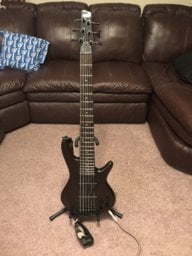
You hit it on the head! I wasn’t attempting to start a riot or anything like that. But yes I believe that a beginner can easily be sold on an instrument that is either problematic or just not a good fit thus when they take it home and play it for a while they encounter buyers regret and lose interest or probably money on searching for a solution to that problem.
 
Entry level applies to many industries. Not just bass guitars. In the musical instrument industry, it is referring to instruments designed, built, and marketed towards students 'entering' the world of musical study. Entry level cars, homes, etc exist and share similar marketing traits. It is not intended to be insulting or indicative of poor quality. It is intended to define the market audience so there is no confusion as to whether the seller is marketing the item as it's entry, mid market, or premium product. That's all there is to it.
Cars are an even bigger issue. ‍♂️
 
I bought a used, beat-up "entry-level" bass--a Squier Affinity P-bass--for $50 at a pawn shop, because I already played guitar and thought it would be fun to own a bass and learn to play one a little.

I haven't changed the used stock electronic guts at all, and I've been dinking around with it happily for ten years now...in fact, I play more bass than guitar these days and love it. I'm happy with it and don't feel a need to upgrade its internals, or upgrade to a more expensive bass. It does what I need and I like how it sounds and plays.
I did the complete opposite of you. I started with a bass but now I have couple guitars and a banjo in my collection.
 
I like snatching up supposedly entry level instruments and upgrading them into a serious player.

Case in point, bought an Affinity P (CL $80), gigbag to get her home (GC $20), swapped stock pup for Seymour Duncan Quarter Pound (TB classifieds, $40), changed cracked single ply PG for a Fender MIA red tortoise unit $15), added rosewood thumb rest ($10), replaced bridge plate with flaking chrome with a better used one ($10) and strung with La Bella tapes ($35).

All in I'm at about 2 bills, and it looks, plays and sounds like a bass 3-4 times as much.
The key is that you took the time to understand and learn how to make those upgrades on it.
 
  • Like
Reactions: jaybones
My 11-yr. old grandson just got a Squier by Fender kit for Christmas. It includes a black Squier PJ bass and a Fender Rumble 15, which is all he needs for home-practice. I was impressed with the bass. It's very nicely made with great fit and finish and it sounds really good. I was surprised at the neck because it seems to be as wide as a p-bass but is no where near as thick as the ones I've seen. It's almost as thin as my Jazz and it took me 10-years to find a Jazz with that thin, fast neck. This is an "entry-level bass" that I wouldn't hesitate to gig with if I needed to. I think he scored big time!
I love to hear this type of story! I hope your grandson enjoys it for years to come!
 
  • Like
Reactions: Rip Van Dan
a cheap crappy bass..as you put it..is not best to learn on..because you can get a pretty good bass used for not a lot of money.....and you said it took you ten years to figure out what you wanted in your next bass...?...either you are slow or you wasted a LOT of time..
I appreciate the passion in this discussion! I’m new to talkbass and I apparently have woken up some feisty folks (including myself!) Please folks let’s keep in mind life isn’t a race to see who figures out what first and investing time in what you love is never a waste. Peace ✌️
 
  • Like
Reactions: el jeffe bass
Well this whole topic just seems so silly.
It would be like someone saying, "Yeah, I have a Mazda Miata Roadster and it is almost as well built and performs almost as well as a Ferrari. They are both red and have two seats. I don't know why they say that the Miata is an entry level race car".
You’re speaking my language but the hole in this statement is that a miata could beat a ferrari on a track with short straights. A miata will outcorner that ferrari all day!
 
well..try and not be too thin skinned about it..maybe you should have worded your original statement differently and you may have gotten different responses..others react to how you say what you say..
Squier was specifically instituted to compete with cheap knock-off imports in a race-to-the-bottom price war. Fender happened to own the brand name already due to the acquisition of a company that made strings under that name. Fender did not want their main brand to be diluted by participating directly in that market. At the time there was no consideration to the psychological factors you describe. It was a product of market forces.
Awesome bit of history there!
 
I see a lot of short-scale basses being designated here and there as "entry level".

As if scale length determines whether you are a beginner or not.

I suppose when you really go "pro" you ditch your 34" for a 35".
I tend to think that there is an assumption that an "entry level" bassist is young and small.
(unless you are a tall lanky kid)
And a short scale may be what they need to get started.

When you have grown up you tend to out grow your "entry level" bass.
They assume you are ready to graduate to a long scale.
 
Last edited:
This kind of goes to what my intended mission is. My early years of playing bass I learned the fundamentals of instrument maintenance and repair. But nowadays the days of yore where I could go to a local music store and buy what I need, shoot the breeze with the owner and get some pointers seem to be over.
Yeah the customer loyalty stuff went out the window. Used to be I could text an employee and they could have whatever I wanted ready to go so I could pick it up and be in and out. Then the stores got rid of all those employees because they didn’t want to pay them. These days I get talked down to by teenagers who are making minimum wage who I know from being an active member of the local scene that they not only don’t play in a gigging band but they also don’t even attend local shows. That’s why I really only use stores like GC as an emergency these days. Like if I forgot to order strings for example. And I buy anything new from Sweetwater or buy used from eBay or reverb.
 
Don't understand the rant.

To any bass can be entry level.

Price for the entry level depends on what you want to pay for someone's first bass.

My 1sy entry level bass for me was a used pawnshop bass.

I picked it up my '74 Fender Jazz Bass for$64.64

My 2nd entry level bass was also a paw score.

I paid $125 for my '90 MIJ Fender '57RI P-Bass.

My 3rd entry level bass I just picked up last month at a pawnshop.

I paid $203 for my '94 Fender JazzV bass
 
  • Like
Reactions: Drgonzonm
I don't buy instruments over $500. Under that price, you can find exceptionally good instruments, do a little tweak and have joy. A few years back I played some open air festival and after the show, some "bass player" came to me and said: "Damn, that Lakland sounds impressive"...
It was Yamaha BBG5S, I payed under $250 with case on ebay.
Case closed.
 
I don't buy instruments over $500. Under that price, you can find exceptionally good instruments, do a little tweak and have joy. A few years back I played some open air festival and after the show, some "bass player" came to me and said: "Damn, that Lakland sounds impressive"...
It was Yamaha BBG5S, I payed under $250 with case on ebay.
Case closed.

How was the BBG5S mistaken for a Lakland? :eyebrow:

(nice bass, by the way!)