• TalkBass has been independent since 1998. Add your voice.
    Create a free account to reply to discussions, view embedded media, and browse with fewer display ads.
    Join freeLog in
    Want zero display ads or expanded classifieds tools? Compare plans.

Jule Amps Monique part 5

I have an Fdeck but I keep it velcro'd to the tail piece of my upright. I purchased a Broughton HPF which is a really small pedal, no battery. I forget what they call that size.

I've tried a number of different things. First on the pedal board and last. I've also used it between Mo and my M 700 which is cool if you don't want it to impact the FOH.

Currently it sits last on my pedal board.
image.jpeg
 
Last edited:
  • Like
Reactions: kevk
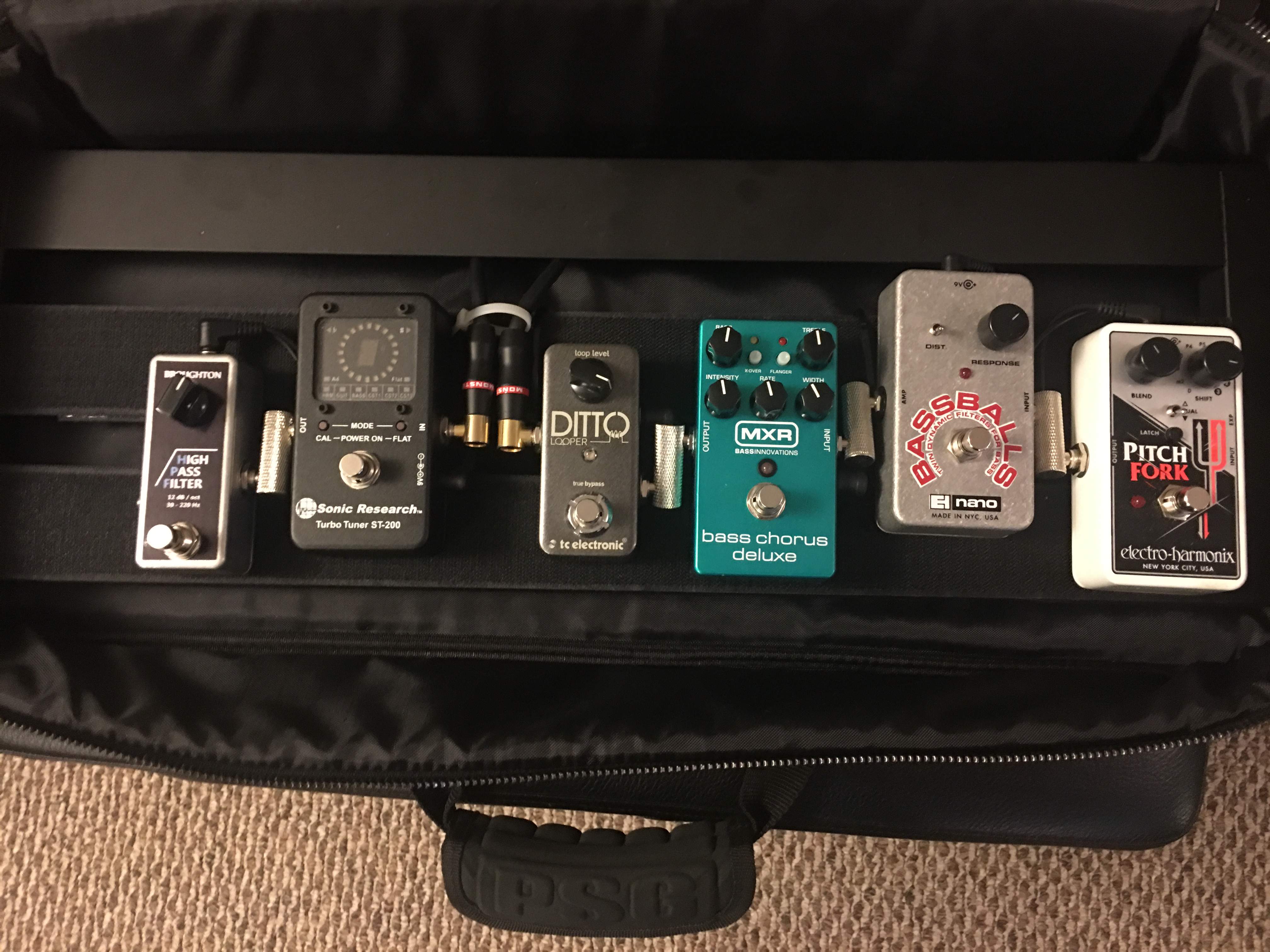
I have an FDeck HPF-3 inbound, and wondering where best to place it in my signal chain? Current chain is a small pedalboard (pic)>Monique Bamboo>M2500...planning to power it with a VL PP2P underneath my board.
View attachment 897840
Before obtaining the M2500, I was simply using the DSP hpf option in my Crown XLS2502...[EDIT: there's one place I'm at regularly, with only my pedalboard>Mo>DI'd to FOH (and sound guy has limited expertise on hpf'ing the mains) I'm looking forward to having hpf capability somewhere before what I send to the FOH to "help out"...]

Looks like several of you are using an FDeck with your Jule amplification, so any trial/error signal chain advice is welcomed...:)
I used to use an fdeck before going into Monique. Then one day I decided not to use it. Well there was a major difference in tone. Perhaps it's an impedance thing, I really don't know, but I found that the fdeck was robbing me of some sweet Monique tone from my Fodera. I no longer use it with my electric basses.

I now only use my fdeck right after my keyboard for synth bass patches.
 
  • Like
Reactions: kevk
Broughton does not have a website, you can find the thread on TB or PM Azurie Skies. True bypass and he makes the one I have but also a combo LPF/HPF and seems open to custom stuff. The louder I'm playing and the more boom in the room the more I turn up the HPF. It leaves me with the EQ for fun tone shaping stuff.

I've been playing for the better part of 30 years and have always been a bass-cable-amp guy I've recently embraced pedals in the last year. No sonic loss is very important to me, I do admit the pedal order is a bit of give and take. I've seen a few example of folks using the same or similar pedals at the beginning and the end of the chain because in some cases the effect is better in that position for the desired result.

BTW - little trick here. I use the ditto looper at home to practice. At gigs I will loop a verse during sound check put my bass down and walk into the room while the band is playing. Allows me to get a good sense of what's going on and make adjustments based on what I hear throughout the room. It's pretty rare that I actually perform with it.
 
I have a curiosity question about the M2500. How much amperage is recommended for the circuit that the amp is on? 2500W/110V = ~23Amps so it would seem that if this amp was running full tilt you would need 23 amps plus enough current for any other loads on the circuit. Perhaps any gig where you'd be likely to crank this amp you would likely have industrial strength power available.
 
I have a curiosity question about the M2500. How much amperage is recommended for the circuit that the amp is on? 2500W/110V = ~23Amps so it would seem that if this amp was running full tilt you would need 23 amps plus enough current for any other loads on the circuit. Perhaps any gig where you'd be likely to crank this amp you would likely have industrial strength power available.

This looks like an excellent power cable. For power cables used with any Class D amplifier, the larger the wire gauge (smaller number means larger gauge), the better the experience. The The M700/M2500 cables we ship are 14 gauge. The shortness is also a good thing. Longer cables deliver less power.

Monique will run nicely on a very small gauge power cable. Experience with the M700 shows it will tolerate less-than-robust power delivery issues pretty well. Still, it is good to find the largest capacity power strips for all Class D amplifiers with this power delivery capability.

M2500 is not so forgiving of "challenging" power situations. The M2500 is best plugged directly into the wall if you want to get anywhere near the maximum power delivery. Not many power strips have the capacity to deliver 2500 watts, or even a real 1000 watts.

Jim I would only guess you simply won't see the full capabilities of the amp. That being said the full capabilities could be pretty darn scary!
 
I have a curiosity question about the M2500. How much amperage is recommended for the circuit that the amp is on? 2500W/110V = ~23Amps so it would seem that if this amp was running full tilt you would need 23 amps plus enough current for any other loads on the circuit. Perhaps any gig where you'd be likely to crank this amp you would likely have industrial strength power available.

Not to mention a restriction on what else is running on the circuit...

Most of my gigs have all of the electrical devices plugging into the same outlet. PA, monitors, guitar amp, bass amp, lights, etc.
 
I have a curiosity question about the M2500. How much amperage is recommended for the circuit that the amp is on? 2500W/110V = ~23Amps so it would seem that if this amp was running full tilt you would need 23 amps plus enough current for any other loads on the circuit. Perhaps any gig where you'd be likely to crank this amp you would likely have industrial strength power available.

The typical rule of thumb is that on average real world bass guitar draws at a max around 1/3 to 1/4 of that figure you cited, which isn't quite right for a few reasons: there are efficiency losses in the amp and US line power is more like 120 volts. And that 1/3 factored draw is only when/if you are kissing the clipping point on every note peak, and/or running with fairly heavy compression.
Yel_wink.gif


Lights are the real killer when it comes to trying to run a whole band on one 15A service. The 300 seat club I used to mix in has 4 15A services for audio and a whole separate AC feed for lights.
 
  • Like
Reactions: kevk
I'm not versed in electronics at all, and appreciate learning from those who are! That said, from my experience in the short time I've had my M2500...

This power strip didn't work for me--tripped off (Mo+M2500 only) after 45 min:
image.jpeg

These two work fine for me:
image.jpeg
image.jpeg


The PL-PLUS DMC has an amp draw meter setting, and so far I haven't seen it go higher than (iirc) 4._...I'll do some more experimenting (take some screen pics) and report back...
 
Last edited:
  • Like
Reactions: juledude
Anyone using the M2500? What cabs? Any drawbacks to having too much power?
I've had mine a short time now, and the only two drawbacks so far...my neighbors stopped talking to me, and I'd like to have a rackmount version, also! :-)

I use Berg cabs...HDN112(x3), NV610T, and coming soon, HG310(x2)... I must say that my HDNs went to another level of awesomeness (tremendous gut-feeling punch) for me with this amp, but feeling the need to hpf them, so researching that area now. I was using the DSP hpf option on my XLS2502, before the arrival of this beast!

Power-wise, I was hoping to use a power strip, but so far... my old rackmount pc units are what I have that works!
 
Jim I would only guess you simply won't see the full capabilities of the amp. That being said the full capabilities could be pretty darn scary!
I was actually thinking more about tripping a circuit breaker if the circuit could not deliver sufficient current. Just wondering if Jule had any guidance. We have to make sure that Jule's jewels get their joules.
 
Last edited:
After finally looking at the M2500 specs, I think it is time for ol' Jule to go live in a nice quiet padded room. ;) Holy crap, that is one crazy amp.:woot:

I do some big gigs with my Monique Dovecage, Minnie 800 and 2 Berg AE210's and still have TONS of headroom.

Unless my cover band gets a suprise stadium gig and the FOH is down, I will never NEED a M2500. Do I WANT one? Sure. But I want a wall of 8x10's behind me at every pub gig too. Doesn't make it "normal".:D
 
  • Like
Reactions: juledude
I chose the M2500 (vs M700) primarily because I like running 2.67 ohm cab setups...and on paper, the M700 is only rated stable to 4 ohms. Although in practice, many have successfully used the M700 at 2.67, but I didn't want to have any concern...

After receiving it, I couldn't believe the difference in bass attack/monster presence, when a/b'ing with my fav amp, Glockenklang Blue Rock ([email protected])...this, at normal playing volumes, including when the BR drive feature was engaged.

Notes just get bigger, more forceful, with increased "presence." Besides just shear power, perhaps the hypex brand module is a factor? (Unfortunately, electronics is not my expertise...)

The bottom line for me...the M2500 amp can obviously get stupid loud and (with the right combination of cabs) could certainly be played ANYwhere! I will never need that kind of power! But, I do hear a qualitative difference in bass note presentation at a normal playing level...and that makes this amp worthwhile to me.

Two more M2500 thoughts:

• I find the M2500 quickness very close to the B|Amp, which is still THE quickest amp I've ever played.

• The amp seems to be fully capable of operating on "not so completely isolated" 15amp circuits. (maybe not one with lights and tons of other big gear on the same circuit though)

This amp is simply a whole lot of fun to use with Monique!
 
Last edited:
I chose the M2500 (vs M700) primarily because I like running 2.67 ohm cab setups...and on paper, the M700 is only rated stable to 4 ohms. Although in practice, many have successfully used the M700 at 2.67, but I didn't want to have any concern...

After receiving it, I couldn't believe the difference in bass attack/monster presence, when a/b'ing with my fav amp, Glockenklang Blue Rock ([email protected])...this, at normal playing volumes, including when the BR drive feature was engaged.

Notes just get bigger, more forceful, with increased "presence." Besides just shear power, perhaps the hypex brand module is a factor? (Unfortunately, electronics is not my expertise...)

The bottom line for me...the M2500 amp can obviously get stupid loud and (with the right combination of cabs) could certainly be played ANYwhere! I will never need that kind of power! But, I do hear a qualitative difference in bass note presentation at a normal playing level...and that makes this amp worthwhile to me.

Two more M2500 thoughts:

• I find the M2500 quickness very close to the B|Amp, which is still THE quickest amp I've ever played.

• The amp seems to be fully capable of operating on "not so completely isolated" 15amp circuits. (maybe not one with lights and tons of other big gear on the same circuit though)

This amp is simply a whole lot of fun to use with Monique!
The last sentence above is the only purpose of the M2500. Lots of technical stuff, lots of descriptions, attempts to describe tones, even math, but it all boils down to having fun.

The idea being, "wouldn't it be fun to never run out of headroom, to hear all parts of every note of every performance?"

The M2500 is my answer to the above question, but all good things have requirements.

With the M2500 Bass Power Amp there is a real opportunity to reduce your expensive bass cabinet to a smoldering mass of plywood splinters. To avoid doing so, you have to be aware of and stay within the limitations of the cabinet/s. Either use multiple cabinets to handle the power or keep the level within the capabilities of the cabinet. The volume knob is your friend.

With the M2500 Bass Power Amp there is a real opportunity to trip the current monitoring of many AC circuits you plug into. You can play a lot of gigs and stay within the 10 amp limitation of many power strips. In the shop we run most of the tests on a 5 amp current monitored circuit. The M2500 can take and use a lot more AC power if it is available. If you are going to run near the 2500 watts, you should have a dedicated AC connection capable of delivering at least 20 amps. . . or you need to keep the level within the limits of the house circuit. The volume knob is your friend.

One more M2500 requirement should be kept in mind, and that is cooling. The M2500 like the M700 will quietly, safely, shut itself down if the maximum temperature is reached, but that is of no value at the gig. The fan in the M2500 is a heavier flow fan than the one in the M700. You should expect to keep the M2500 fan running. Unlike the fan in the M700 that is almost impossible to hear, you can hear the fan in the M2500. It isn't loud, but it is detectable. The aluminum heatsink in the M2500 is twice the size of the one in the M700 (makes sense) and the M2500 fan is beefier because the M2500 can generate more heat than the M700.

The M2500 is like the larger, crazier brother to the more well behaved, predictable, powerful M700. Both have their places.

I was the larger brother. I know. ;)
 
Seems like this might be a good place to ask this:
Does someone make a limiter &/or compressor that you can set based on a given current draw that you want to avoid going over?
I don't really know anything about the subject, so forgive me if this is a stupid question.
I am not aware of any product as you describe that is related directly to AC current draw. It seems to me that any measured incremental limitation of power would apply for this purpose. A bit like understanding that when the Volume knob is straight up it is half of the available volume, but I like your idea better.

The volume control on the M2500 is, unlike many volume controls, a Linear potentiometer so that we can visually see where we are as to power delivery.
 
  • Like
Reactions: kevk

Latest posts